Márquez-Gómez Miguel, Díaz-Navarro Marta, Visedo Andrés, Prats-Peinado Lourdes, Muñoz Patricia, Vaquero Javier, Guembe María, Sanz-Ruíz Pablo
Department of Orthopaedic Surgery and Traumatology, Hospital General Universitario Gregorio Marañón, 28007 Madrid, Spain.
Instituto de Investigación Sanitaria Gregorio Marañón, 28009 Madrid, Spain.
Antibiotics (Basel). 2024 Dec 17;13(12):1225. doi: 10.3390/antibiotics13121225.
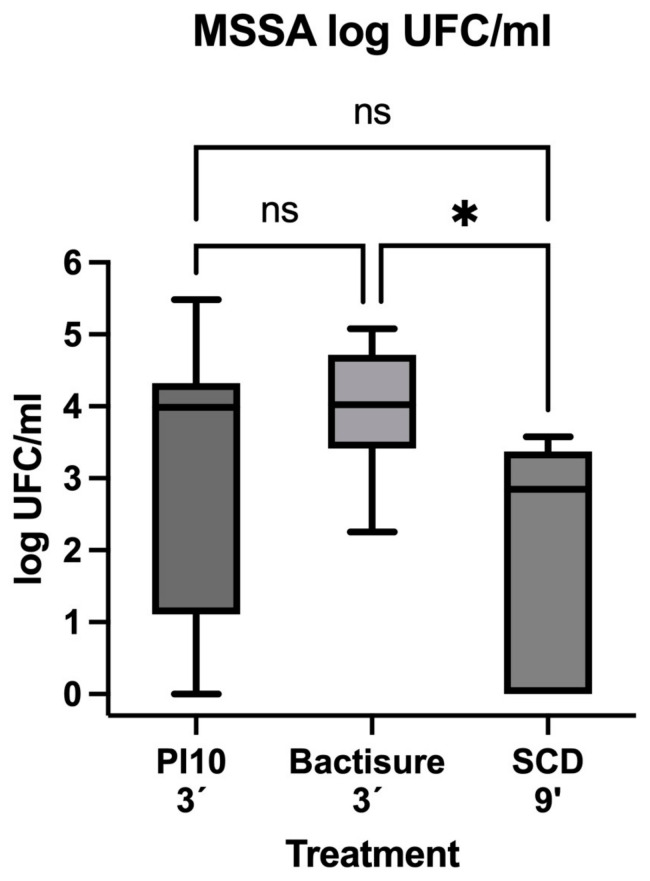
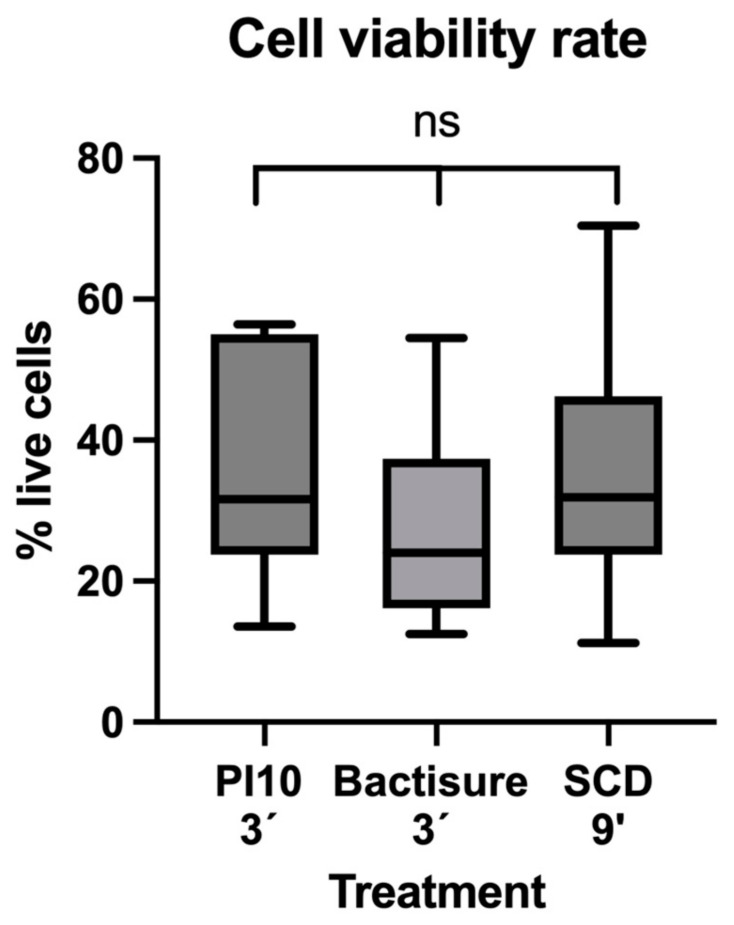
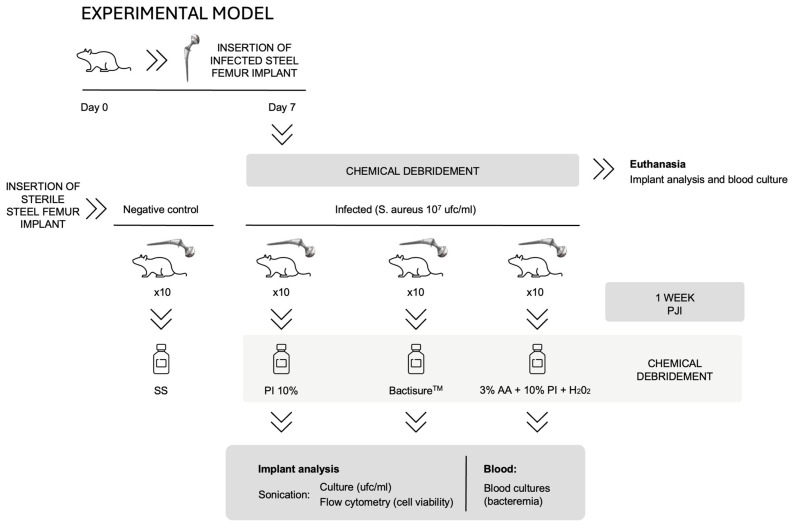
: Chemical debridement is a fundamental step during the surgical treatment of both acute and chronic periprosthetic joint infection (PJI). However, there is no consensus on the optimal solution, nor is there sufficient evidence on the optimal irrigation time and combination of solutions. In an in vitro study, our group recently demonstrated that sequential combination debridement (SCD) with 3% acetic acid (AA) followed by 10% povidone iodine (PI) and 5 mM hydrogen peroxide (HO) was the best strategy for reducing bacterial load. The present study aimed to validate these findings in an in vivo model. : The median (IQR) log CFU/mL was lower in the group of mice treated with SCD (2.85 [0.00-3.72]) than in the Bactisure™ group (4.02 [3.41-4.72], = 0.02). While this reduction was also greater than in the PI group (3.99 [1.11-4.33]), the difference did not reach statistical significance ( = 0.19). Cell viability assays showed no differences between treatments. bacteremia was detected in 10% of mice treated with SCD, compared to 30% in the PI group and 10% in the Bactisure™ group. The difference was not statistically significant ( = 0.36). : Our findings confirm that SCD significantly reduced bacterial load in an in vivo S. aureus PJI model, showing superior anti-biofilm activity compared to Bactisure™ and comparable performance to PI alone. These results highlight SCD's potential to serve as a standardized chemical debridement protocol, combining enhanced efficacy with clinical applicability. : We tested SCD with 3% AA for 3 min, 10% PI for 3 min, and HO for 3 min in a 7-day (ATCC29213)-based murine femur PJI model and compared the results with single treatments of 10% PI for 3 min or Bactisure™ solution for 3 min. A sterile steel implant with local administration of saline solution for 3 min was used as a non-infected control. After completing irrigation procedures, under anesthesia, mice were euthanized, and implants were analyzed for CFU/mL counts and cell viability rates. Blood cultures were obtained pre-euthanasia to detect bacteremia.
化学清创术是急性和慢性人工关节周围感染(PJI)外科治疗的基本步骤。然而,对于最佳解决方案尚无共识,关于最佳冲洗时间和溶液组合也没有足够的证据。在一项体外研究中,我们小组最近证明,先用3%醋酸(AA)进行序贯联合清创,然后用10%聚维酮碘(PI)和5 mM过氧化氢(HO)是降低细菌载量的最佳策略。本研究旨在在体内模型中验证这些发现。
接受序贯联合清创治疗的小鼠组的中位(IQR)log CFU/mL(2.85 [0.00 - 3.72])低于使用Bactisure™组(4.02 [3.41 - 4.72],P = 0.02)。虽然这种降低也大于PI组(3.99 [1.11 - 4.33]),但差异未达到统计学意义(P = 0.19)。细胞活力测定显示各治疗组之间无差异。接受序贯联合清创治疗的小鼠中有10%检测到菌血症,而PI组为30%,Bactisure™组为10%。差异无统计学意义(P = 0.36)。
我们的研究结果证实,序贯联合清创在体内金黄色葡萄球菌PJI模型中显著降低了细菌载量,与Bactisure™相比显示出更强的抗生物膜活性,与单独使用PI的性能相当。这些结果突出了序贯联合清创作为标准化化学清创方案的潜力,将增强的疗效与临床适用性相结合。
我们在基于7天的(ATCC29213)小鼠股骨PJI模型中测试了用3% AA进行3分钟、10% PI进行3分钟和HO进行3分钟的序贯联合清创,并将结果与10% PI单独处理3分钟或Bactisure™溶液处理3分钟进行了比较。使用局部注射3分钟生理盐水的无菌钢植入物作为未感染对照。完成冲洗程序后,在麻醉下对小鼠实施安乐死,并分析植入物的CFU/mL计数和细胞活力率。在安乐死前采集血培养以检测菌血症。