Unal Turhan Emel, Koca Esabil Emrah
Department of Food Technology, Faculty of Kadirli Applied Sciences, Osmaniye Korkut Ata University, 80760 Kadirli, Osmaniye, Turkey.
Foods. 2024 Dec 11;13(24):4002. doi: 10.3390/foods13244002.
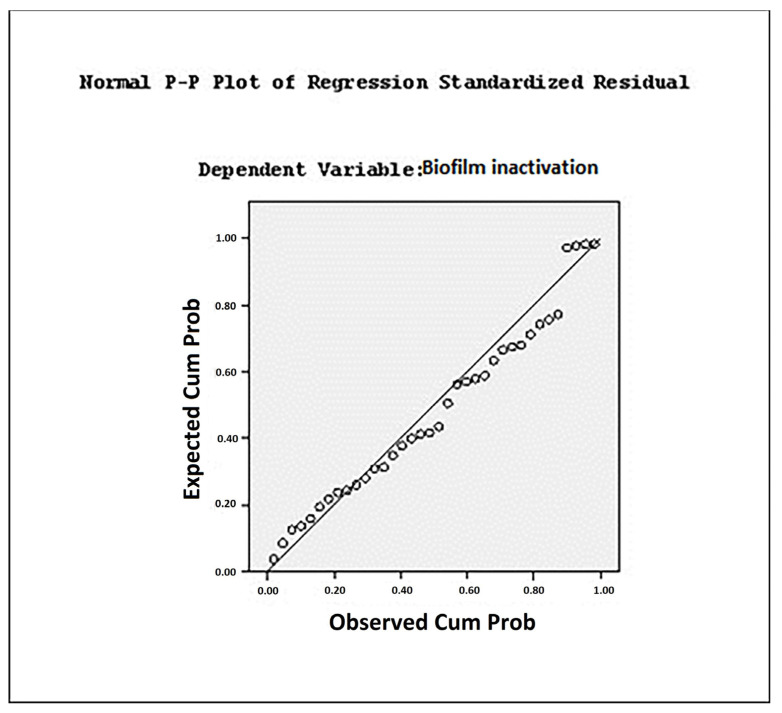
The present study aimed to evaluate the antibiofilm effect of combined sonication treatment with organic acids on polystyrene surfaces and to develop a predictive model for the inactivation of biofilms. Polystyrene plates containing biofilms were subjected to sonication using different inactivation solutions (PBS, lactic acid, and acetic acid) at varying temperatures (20 °C, 40 °C, and 50 °C) and durations (2 and 5 min). The effects of temperature, treatment duration, and inactivation solution on biofilm removal were statistically significant ( < 0.05). The use of organic acids, along with increased treatment time and temperature, led to a significant reduction in viable cell counts (0.43-6.21 log CFU/mL) and optical density (0.13-0.72 at OD600) of biofilms ( < 0.05). The highest biofilm inactivation, with a reduction of 6.21 CFU/mL and 0.72 OD, was achieved by combining organic acid and thermosonication at 50 °C for 5 min. A significant positive correlation was observed between test methods based on viable cell count and optical density (OD) measurements. According to multiple linear regression analysis results, the values of the predictive models for biofilm inactivation, based on viable cell count and OD measurements, were 0.84 and 0.80, respectively. Due to its higher accuracy, the predictive model developed using viable cell count data is recommended for applications in the food industry and processing sectors.
本研究旨在评估超声处理与有机酸联合作用对聚苯乙烯表面生物膜的抗生物膜效果,并建立生物膜失活的预测模型。含有生物膜的聚苯乙烯平板在不同温度(20℃、40℃和50℃)和持续时间(2分钟和5分钟)下,使用不同的失活溶液(磷酸盐缓冲液、乳酸和乙酸)进行超声处理。温度、处理持续时间和失活溶液对生物膜去除的影响具有统计学意义(P<0.05)。有机酸的使用,以及处理时间和温度的增加,导致生物膜的活菌计数(0.43 - 6.21 log CFU/mL)和光密度(OD600处为0.13 - 0.72)显著降低(P<0.05)。通过在50℃下将有机酸与热超声联合处理5分钟,实现了最高的生物膜失活,活菌计数降低了6.21 CFU/mL,光密度降低了0.72。基于活菌计数和光密度(OD)测量的测试方法之间观察到显著的正相关。根据多元线性回归分析结果,基于活菌计数和OD测量的生物膜失活预测模型的值分别为0.84和0.80。由于其更高的准确性,建议使用活菌计数数据开发的预测模型应用于食品工业和加工领域。