Schmitt Ramona, Schlett Christopher L, Sperl Jonathan I, Rapaka Saikiran, Jacob Athira J, Hein Manuel, Hagar Muhammad Taha, Ruile Philipp, Westermann Dirk, Soschynski Martin, Bamberg Fabian, Schuppert Christopher
Department of Cardiology and Angiology, University Heart Center Freiburg-Bad Krozingen, Medical Center-University of Freiburg, Faculty of Medicine, University of Freiburg, Südring 15, 79189 Bad Krozingen, Germany.
Department of Diagnostic and Interventional Radiology, Medical Center-University of Freiburg, Faculty of Medicine, University of Freiburg, Hugstetter Str. 55, 79106 Freiburg im Breisgau, Germany.
Diagnostics (Basel). 2024 Dec 21;14(24):2884. doi: 10.3390/diagnostics14242884.
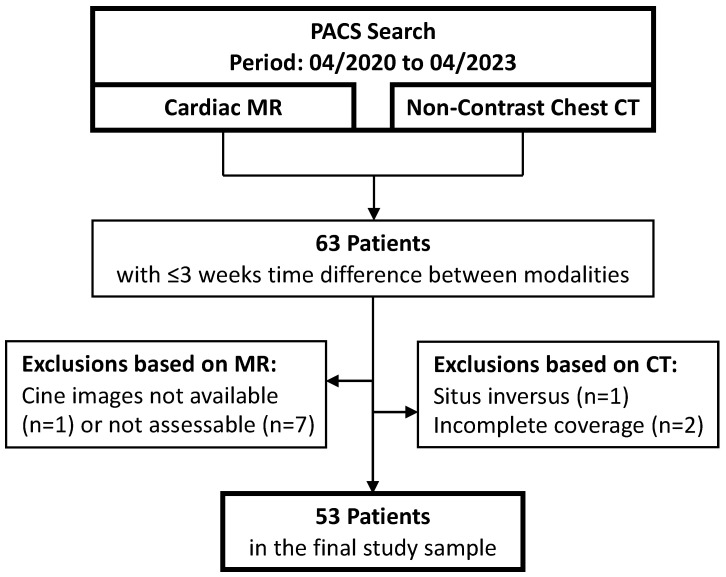
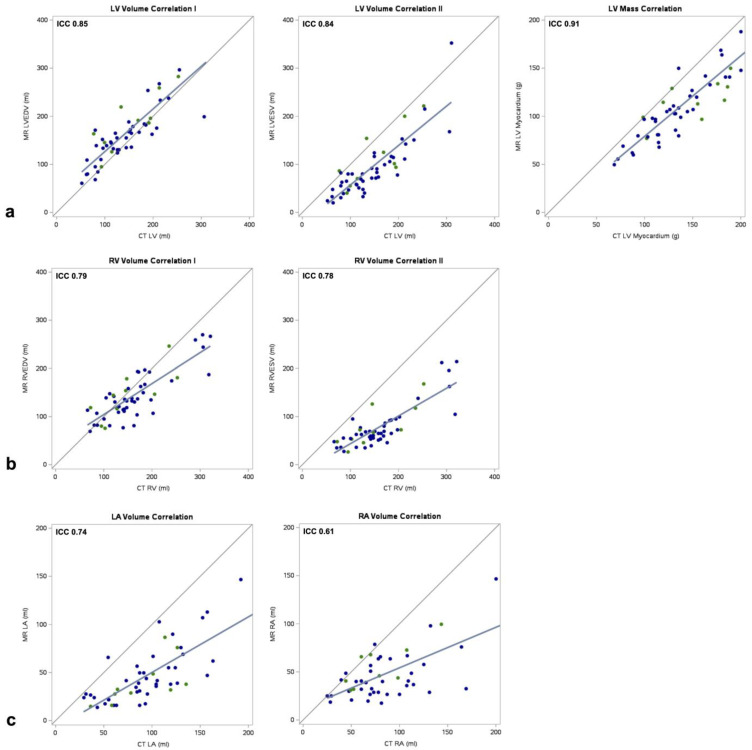
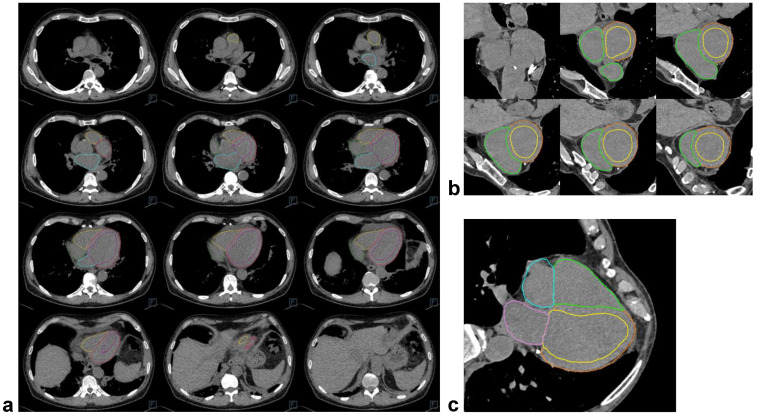
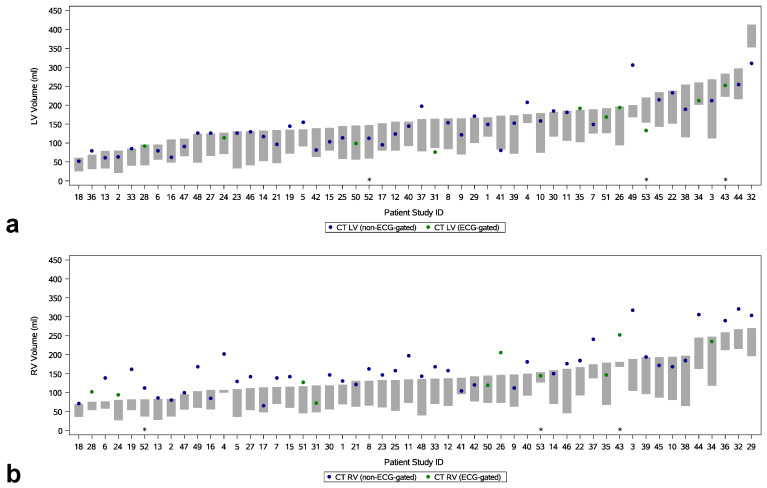
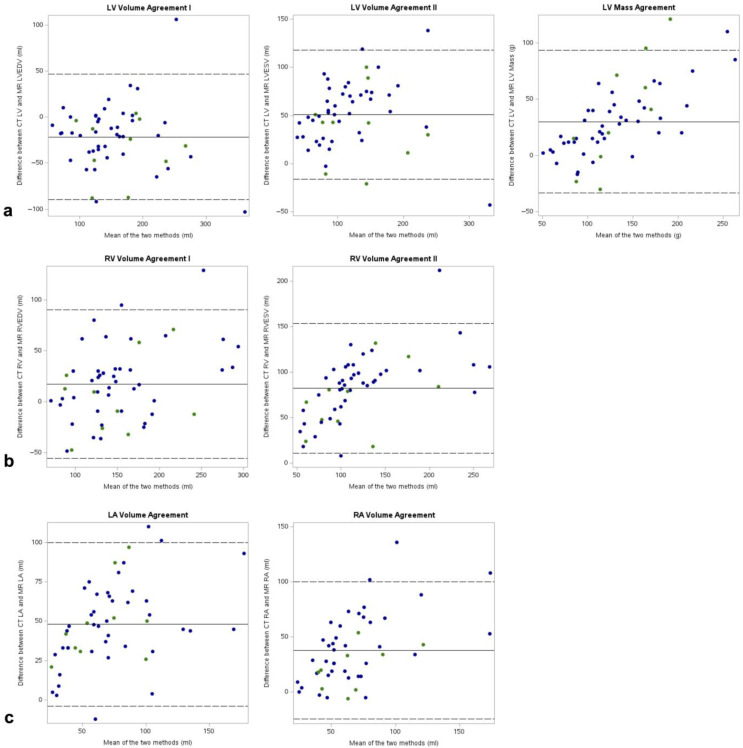
: To validate the automated quantification of cardiac chamber volumes and myocardial mass on non-contrast chest CT using cardiac MR (CMR) as a reference. : We retrospectively included 53 consecutive patients who received non-contrast chest CT and CMR within three weeks. A deep learning model created cardiac segmentations on axial soft-tissue reconstructions from CT, covering all four cardiac chambers and the left ventricular myocardium. Segmentations on CMR cine short-axis and long-axis images served as a reference. Standard estimates of diagnostic accuracy were calculated for ventricular volumes at end-diastole and end-systole (LVEDV, LVESV, RVEDV, RVESV), left ventricular mass (LVM), and atrial volumes (LA, RA) at ventricular end-diastole. A qualitative assessment noted segmentation issues. : The deep learning model generated CT measurements for 52 of the 53 patients (98%). Based on CMR measurements, the average LVEDV was 166 ± 64 mL, RVEDV was 144 ± 51 mL, and LVM was 115 ± 39 g. The CT measurements correlated well with CMR measurements for LVEDV, LVESV, and LVM (ICC = 0.85, ICC = 0.84, and ICC = 0.91; all < 0.001) and RVEDV and RVESV (ICC = 0.79 and ICC= 0.78; both < 0.001), and moderately well with LA and RA (ICC = 0.74 and ICC = 0.61; both < 0.001). Absolute agreements likewise favored LVEDV, LVM, and RVEDV. ECG-gating did not relevantly influence the results. The CT results correctly identified 7/15 LV and 1/1 RV as dilated (one and six false positives, respectively). Major qualitative issues were found in three cases (6%). : Automated cardiac chamber volume and myocardial mass quantification on non-contrast chest CT produced viable measurements in this retrospective sample. : An automated cardiac assessment on non-contrast chest CT provides quantitative morphological data on the heart, enabling a preliminary organ evaluation that aids in incidentally identifying at-risk patients who may benefit from a more targeted diagnostic workup.
以心脏磁共振成像(CMR)为参考,验证非增强胸部CT对心腔容积和心肌质量的自动定量分析。
我们回顾性纳入了53例在三周内接受非增强胸部CT和CMR检查的连续患者。一个深度学习模型在CT的轴向软组织重建图像上创建心脏分割,覆盖所有四个心腔和左心室心肌。CMR电影短轴和长轴图像上的分割作为参考。计算舒张末期和收缩末期心室容积(左心室舒张末期容积、左心室收缩末期容积、右心室舒张末期容积、右心室收缩末期容积)、左心室质量以及舒张末期心房容积(左心房、右心房)的诊断准确性标准估计值。进行定性评估以发现分割问题。
深度学习模型为53例患者中的52例(98%)生成了CT测量值。基于CMR测量值,平均左心室舒张末期容积为166±64 mL,右心室舒张末期容积为144±51 mL,左心室质量为115±39 g。CT测量值与CMR测量值在左心室舒张末期容积、左心室收缩末期容积和左心室质量方面相关性良好(组内相关系数ICC = 0.85、ICC = 0.84和ICC = 0.91;均P < 0.001),在右心室舒张末期容积和右心室收缩末期容积方面也相关性良好(ICC = 0.79和ICC = 0.78;均P < 0.001),与左心房和右心房的相关性中等(ICC = 0.74和ICC = 0.61;均P < 0.001)。绝对一致性同样有利于左心室舒张末期容积、左心室质量和右心室舒张末期容积。心电图门控对结果无显著影响。CT结果正确识别出7/15的左心室和1/1的右心室扩张(分别有1例和6例假阳性)。在3例(6%)中发现了主要的定性问题。
在这个回顾性样本中,非增强胸部CT上心腔容积和心肌质量的自动定量分析产生了可行的测量结果。
非增强胸部CT上的自动心脏评估提供了心脏的定量形态学数据,有助于进行初步的器官评估,从而有助于偶然识别可能从更有针对性的诊断检查中受益的高危患者。