Tsantzali Ioanna, Athanasaki Athanasia, Boufidou Fotini, Constantinides Vasilios C, Stefanou Maria-Ioanna, Moschovos Christos, Zompola Christina, Paraskevas Sotirios G, Bonakis Anastasios, Giannopoulos Sotirios, Tsivgoulis Georgios, Kapaki Elisabeth, Paraskevas George P
2nd Department of Neurology, "Attikon" General University Hospital, School of Medicine, National and Kapodistrian University of Athens, 12462 Athens, Greece.
Neurochemistry and Βiological Markers Unit, 1st Department of Neurology, "Eginition" Hospital, School of Medicine, National and Kapodistrian University of Athens, 11528 Athens, Greece.
Biomedicines. 2024 Dec 20;12(12):2904. doi: 10.3390/biomedicines12122904.
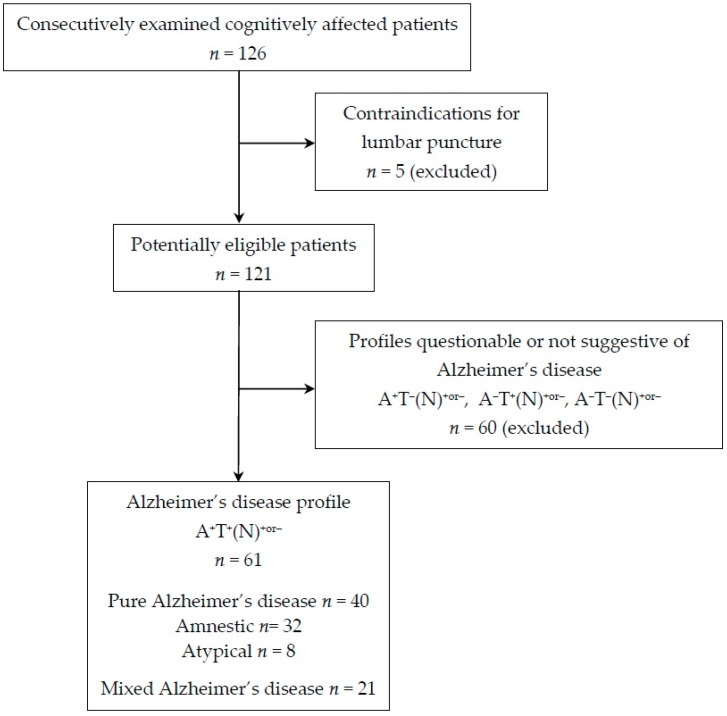
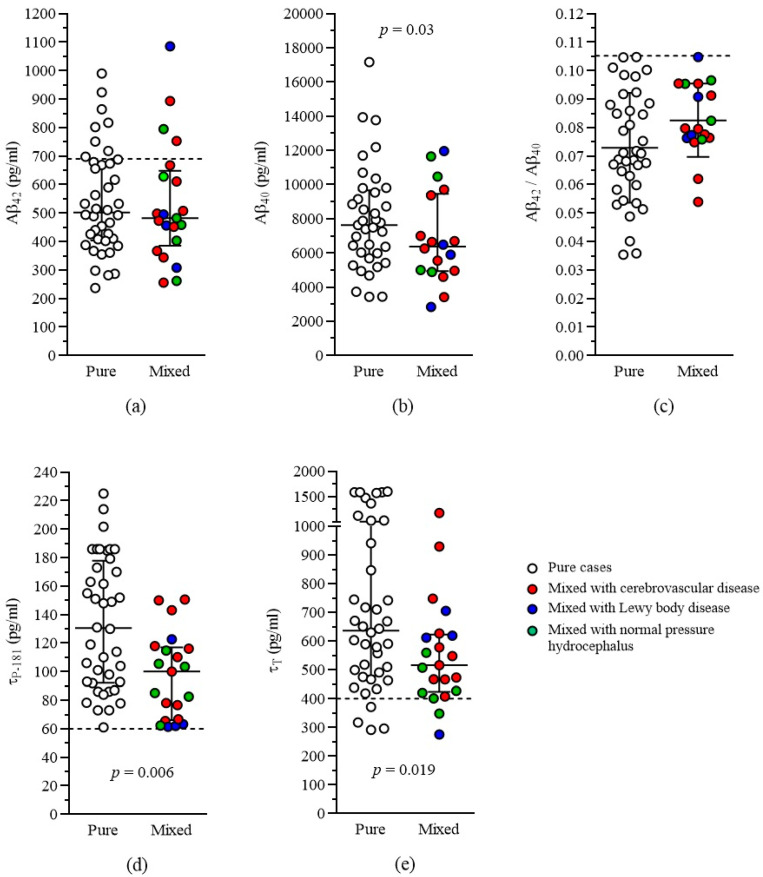
: Alzheimer's disease (AD) may present with pure (typical or atypical) and mixed phenotypes, sometimes causing difficulties in (differential) diagnosis. In order to achieve a diagnostic accuracy as high as possible, the diagnosis of AD during life depends on various biomarkers, including the cerebrospinal fluid (CSF) biomarkers. : Classical CSF AD biomarkers were determined in a total of 61 patients, classified as both beta amyloid- and tau-positive AT (or AT according to the recently revised Alzheimer Association criteria for diagnosis and staging of AD). Twenty one of these patients fulfilled the criteria for mixed AD (mixed with Lewy bodies, cerebrovascular disease, or normal pressure hydrocephalus), whilst 40 had pure AD. Results: Patients did not differ with respect to gender, education, disease duration, and cognitive status. After controlling for confounding factors, no difference was observed between mixed and pure AD groups in Aβ or Aβ/Aβ levels. Although by definition, patients of both groups had abnormal (increased) levels of phospho-tau, the mixed AD group presented with lower (less abnormal) levels of phospho-tau181 and total tau as compared to the pure group. Conclusions: In patients with AD of comparable cognitive status, mixed AD cases may present with lower levels of tau proteins and, if close to the cut-off values, diagnostic uncertainty may be increased.
阿尔茨海默病(AD)可能表现为单纯型(典型或非典型)和混合型表型,有时会给(鉴别)诊断带来困难。为了尽可能提高诊断准确性,生前对AD的诊断依赖于多种生物标志物,包括脑脊液(CSF)生物标志物。对总共61例患者测定了经典的CSF AD生物标志物,这些患者被归类为β淀粉样蛋白和tau蛋白均呈阳性的AT(或根据最近修订的阿尔茨海默病协会AD诊断和分期标准的AT)。其中21例患者符合混合型AD的标准(与路易体、脑血管疾病或正常压力脑积水混合),而40例患有单纯型AD。结果:患者在性别、教育程度、病程和认知状态方面无差异。在控制混杂因素后,混合型和单纯型AD组在Aβ或Aβ/Aβ水平上未观察到差异。虽然根据定义,两组患者的磷酸化tau水平均异常(升高),但与单纯型组相比,混合型AD组的磷酸化tau181和总tau水平较低(异常程度较轻)。结论:在认知状态相当的AD患者中,混合型AD病例的tau蛋白水平可能较低,如果接近临界值,可能会增加诊断的不确定性。