
乳房切除术后放疗的当代问题:简要综述
Contemporary Issues in Postmastectomy Radiotherapy: A Brief Review.
作者信息
Grace Caroline A, McKay Michael J
机构信息
Northwest Regional Hospital, Rural Clinical School, The University of Tasmania, Burnie, TAS 7320, Australia.
Northern Cancer Service, North West Cancer Centre, Burnie, TAS 7320, Australia.
出版信息
J Clin Med. 2024 Dec 11;13(24):7545. doi: 10.3390/jcm13247545.
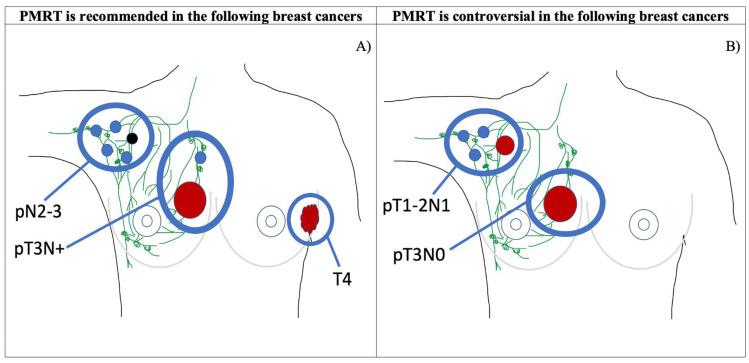
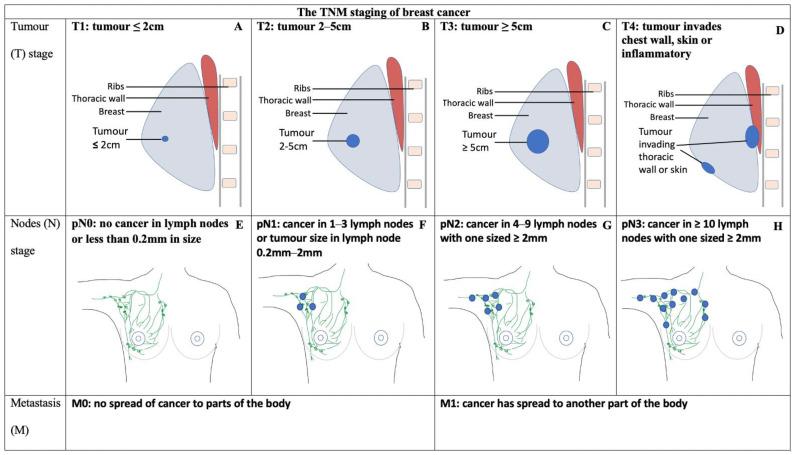
Breast cancer is the one of the most common cancers and causes a significant disease burden. Currently, postmastectomy radiotherapy (PMRT) is indicated for breast cancer patients with higher risk of recurrence, such as those with positive surgical margins or high-risk breast cancer (T3 with positive lymph nodes, ≥4 positive lymph nodes or T4 disease). Whether PMRT should be used in intermediate-risk breast cancer (T3 with no positive lymph nodes or T1-2 with 1-3 positive lymph nodes) is contentious. Rates of breast reconstruction postmastectomy are increasing in countries like Australia, and PMRT usage in such settings is another area of active research. Ongoing trials are also assessing the safety and efficacy of hypofractionated PMRT, a clinical scenario now widely accepted for early-stage breast cancer. This brief review is unique in that it aims to examine three current and controversial aspects of the PMRT field (PMRT in intermediate-risk breast cancer, PMRT in conjunction with breast reconstruction and its hypofractionation). To achieve this aim, we discuss available and emerging literature and guidelines to offer insights important to the PMRT field. Current literature suggests that PMRT could play a role in improving the overall survival rate and in reducing locoregional recurrence in intermediate-risk breast cancer. In terms of recommending a timing or type of breast reconstruction best suited to the setting of PMRT, we found that individual patient preferences and circumstances need to be considered alongside a multidisciplinary approach. Research into PMRT hypofractionation safety and efficacy is ongoing and its place remains to be elucidated.
乳腺癌是最常见的癌症之一,会造成重大的疾病负担。目前,乳房切除术后放疗(PMRT)适用于复发风险较高的乳腺癌患者,例如手术切缘阳性或高危乳腺癌(T3伴淋巴结阳性、≥4个淋巴结阳性或T4期疾病)患者。PMRT是否应用于中危乳腺癌(T3无淋巴结阳性或T1-2伴1-3个淋巴结阳性)存在争议。在澳大利亚等国家,乳房切除术后乳房重建的比例正在上升,在这种情况下PMRT的使用是另一个活跃的研究领域。正在进行的试验也在评估大分割PMRT的安全性和有效性,这一临床方案目前已被广泛应用于早期乳腺癌。这篇简短的综述的独特之处在于,它旨在探讨PMRT领域当前存在争议的三个方面(中危乳腺癌的PMRT、与乳房重建联合使用的PMRT及其大分割)。为实现这一目标,我们讨论了现有和新出现的文献及指南,以提供对PMRT领域重要的见解。目前的文献表明,PMRT可能在提高中危乳腺癌的总生存率和降低局部区域复发率方面发挥作用。在推荐最适合PMRT情况的乳房重建时机或类型方面,我们发现除了多学科方法外,还需要考虑患者的个人偏好和具体情况。关于PMRT大分割的安全性和有效性的研究正在进行,其地位仍有待阐明。
 Zotero 插件