Xing Cencan, Chen Hongyu, Bi Wangyu, Lei Tong, Hang Zhongci, Du Hongwu
Daxing Research Institute, University of Science and Technology Beijing, Beijing 100083, China.
School of Chemistry and Biological Engineering, University of Science and Technology Beijing, Beijing 100083, China.
Int J Mol Sci. 2024 Dec 15;25(24):13446. doi: 10.3390/ijms252413446.
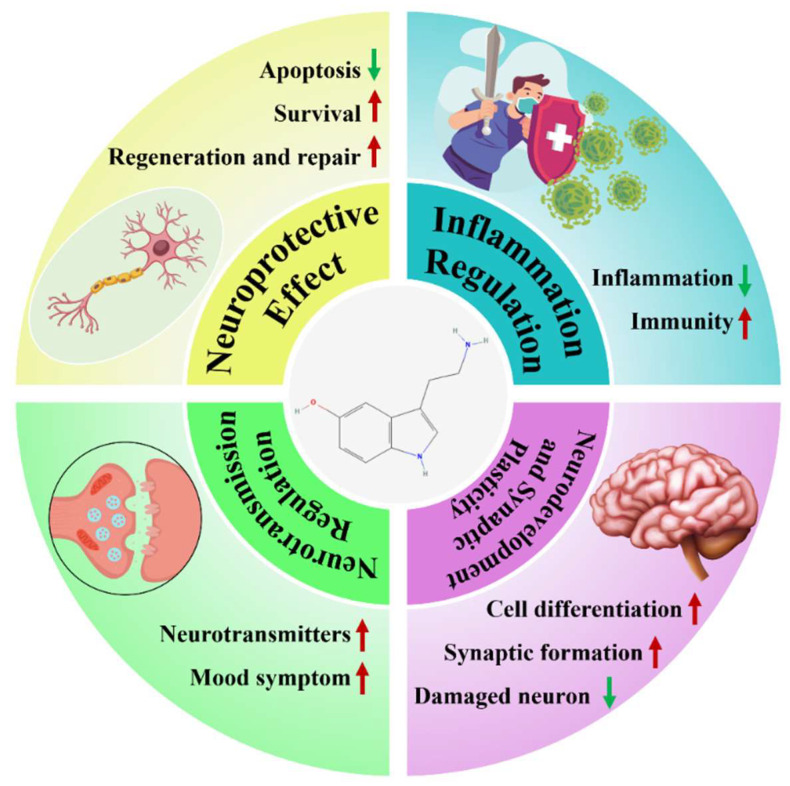
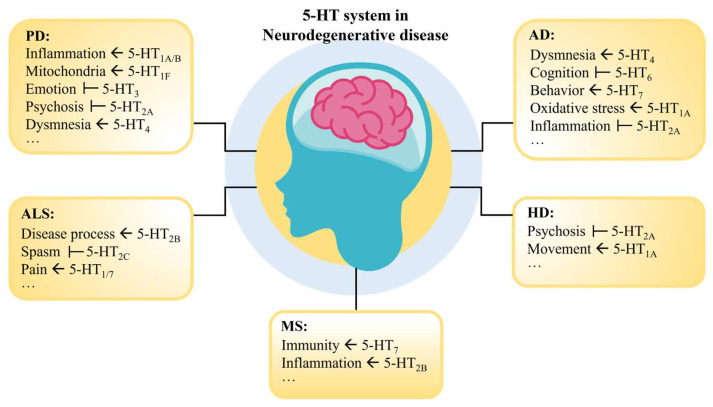
There is increasing interest in the potential therapeutic role of 5-HT (serotonin) in the treatment of neurodegenerative diseases, which are characterized by the progressive degeneration and death of nerve cells. 5-HT is a vital neurotransmitter that plays a central role in regulating mood, cognition, and various physiological processes in the body. Disruptions in the 5-HT system have been linked to several neurological and psychiatric disorders, making it an attractive target for therapeutic intervention. Although the exact causes of neurodegenerative diseases such as Alzheimer's disease (AD), Parkinson's disease (PD), and amyotrophic lateral sclerosis (ALS) are not fully understood, researchers believe that regulating the 5-HT system could help alleviate symptoms and potentially slow the progression of these diseases. Here, we delve into the potential of harnessing 5-HT as a therapeutic target for the treatment of neurodegenerative diseases. It is important to note that the current clinical drugs targeting 5-HT are still limited in the treatment of these complex diseases. Therefore, further research and clinical trials are needed to evaluate the feasibility and effectiveness of its clinical application.
5-羟色胺(血清素)在神经退行性疾病治疗中的潜在治疗作用正受到越来越多的关注,这些疾病的特征是神经细胞进行性退化和死亡。5-羟色胺是一种重要的神经递质,在调节情绪、认知和身体的各种生理过程中起着核心作用。5-羟色胺系统的紊乱与多种神经和精神疾病有关,使其成为治疗干预的一个有吸引力的靶点。尽管诸如阿尔茨海默病(AD)、帕金森病(PD)和肌萎缩侧索硬化症(ALS)等神经退行性疾病的确切病因尚未完全明确,但研究人员认为,调节5-羟色胺系统有助于缓解症状,并可能减缓这些疾病的进展。在此,我们深入探讨将5-羟色胺作为治疗神经退行性疾病的治疗靶点的潜力。需要注意的是,目前针对5-羟色胺的临床药物在治疗这些复杂疾病方面仍然有限。因此,需要进一步的研究和临床试验来评估其临床应用的可行性和有效性。