Atava Ivanna, Briviba Monta, Nesterovics Georgijs, Saripo Vita, Gilis Dainus, Meiere Ruta, Terauda Elizabete, Skudrina Gunda, Klovins Janis, Latkovskis Gustavs
Latvian Biomedical Research and Study Centre, LV-1067 Riga, Latvia.
Institute of Cardiology and Regenerative Medicine, University of Latvia, LV-1004 Riga, Latvia.
Int J Mol Sci. 2024 Dec 16;25(24):13466. doi: 10.3390/ijms252413466.
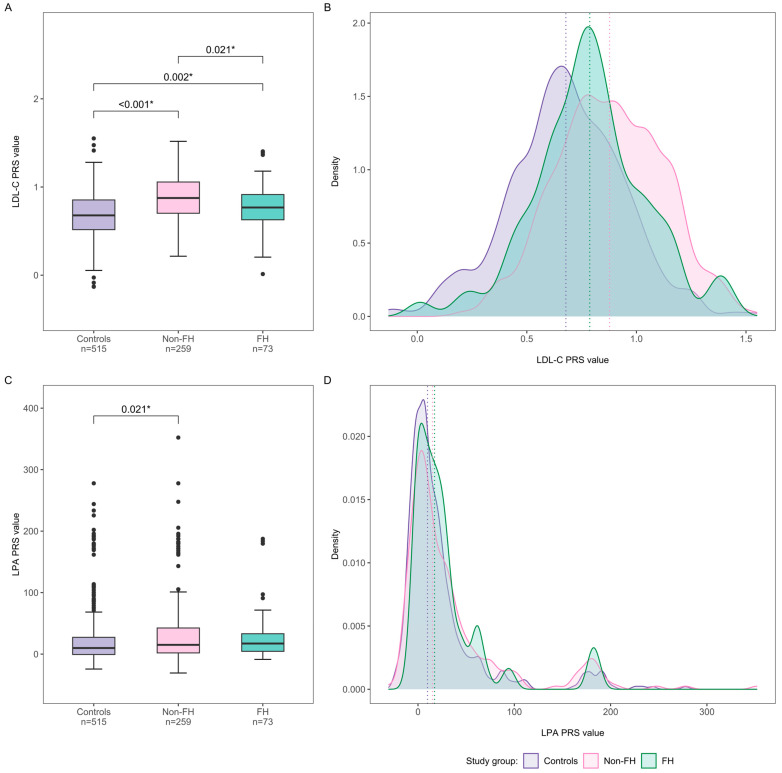
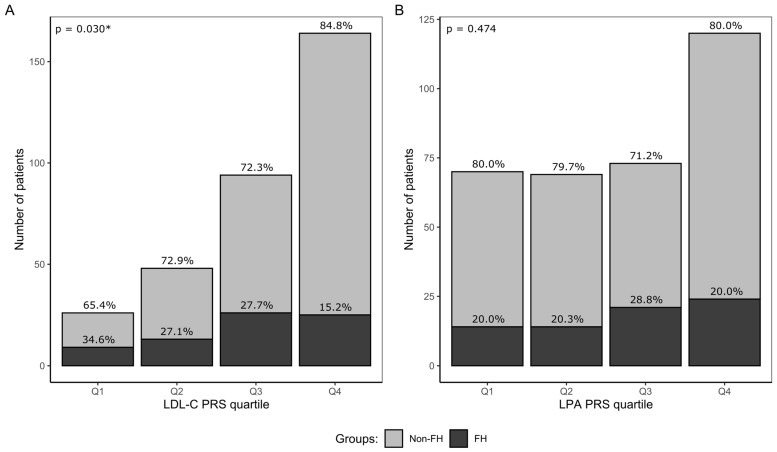
Despite the implementation of next-generation sequencing-based genetic testing on patients with clinical familial hypercholesterolemia (FH), most cases lack complete genetic characterization. We aim to investigate the utility of the polygenic risk score (PRS) in specifying the genetic background of patients from the Latvian Registry of FH (LRFH). We analyzed the whole-genome sequencing (WGS) data of the clinically diagnosed FH patients (n = 339) and controls selected from the Latvian reference population (n = 515). Variant pathogenicity in FH patients was classified according to the ACMG/AMP guidelines. The low-density lipoprotein cholesterol (LDL-C) and lipoprotein (a) (LPA) PRS were calculated based on the WGS data. We identified unique causative variants in 80 (23.6%) of the tested individuals (39 variants in FH genes and 4 variants in phenocopy genes, with 6 variants being novel). The LDL-C PRS was highly discriminative compared to the LPA PRS. Nevertheless, both PRS were able to explain the genetic cause of hypercholesterolemia in 26.3% of the remaining non-monogenic patients. The combined genetic analysis of monogenic and polygenic hypercholesterolemia resulted in 43.7% genetically explained hypercholesterolemia cases. Even though the application of PRS alone does not exclude monogenic testing in clinical FH patients, it is a valuable tool for diagnosis specification.
尽管对临床家族性高胆固醇血症(FH)患者实施了基于下一代测序的基因检测,但大多数病例仍缺乏完整的基因特征描述。我们旨在研究多基因风险评分(PRS)在明确拉脱维亚FH登记处(LRFH)患者基因背景方面的效用。我们分析了临床诊断为FH的患者(n = 339)和从拉脱维亚参考人群中选取的对照(n = 515)的全基因组测序(WGS)数据。根据美国医学遗传学与基因组学学会(ACMG)/分子病理学协会(AMP)指南对FH患者的变异致病性进行分类。基于WGS数据计算低密度脂蛋白胆固醇(LDL-C)和脂蛋白(a)(Lp(a))PRS。我们在80名(23.6%)受测个体中鉴定出独特的致病变异(39个变异位于FH基因,4个变异位于拟表型基因,其中6个变异为新发现)。与Lp(a) PRS相比,LDL-C PRS具有更高的区分度。然而,两种PRS都能够解释其余26.3%非单基因患者高胆固醇血症的遗传原因。单基因和多基因高胆固醇血症的联合基因分析使43.7%的高胆固醇血症病例得到了遗传解释。尽管单独应用PRS并不能排除对临床FH患者进行单基因检测,但它是诊断细化的一个有价值的工具。