Zhang Haobo, Li Qi, Liao Yun, Ma Danjing, Zeng Fengyuan, Zhang Zhenxiao, Yu Li, Yue Rong, Li Xinghang, Liao Yuansheng, Li Dandan, Jang Guorun, Zhao Heng, Zhao Xin, Zheng Huiwen, Li Heng, Liu Longding, Zhang Ying
Yunnan Key Laboratory of Vaccine Research and Development for Severe Infectious Diseases, Institute of Medical Biology, Chinese Academy of Medicine Sciences & Peking Union Medical College, Kunming 650118, China.
School of Life Sciences, Yunnan University, Kunming 650500, China.
Int J Mol Sci. 2024 Dec 16;25(24):13486. doi: 10.3390/ijms252413486.
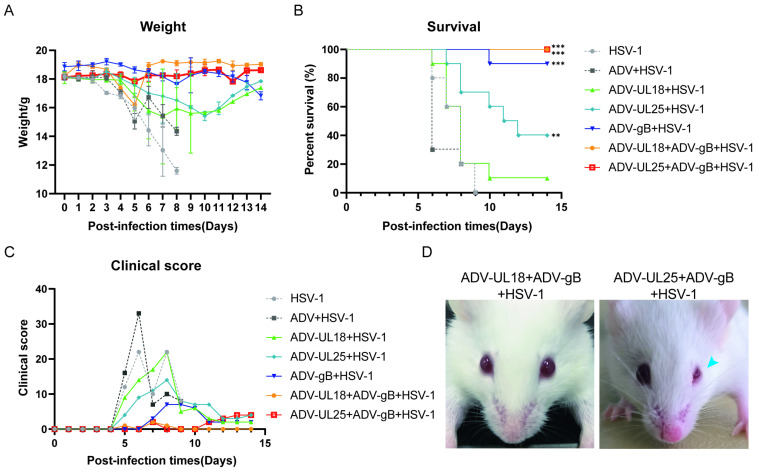
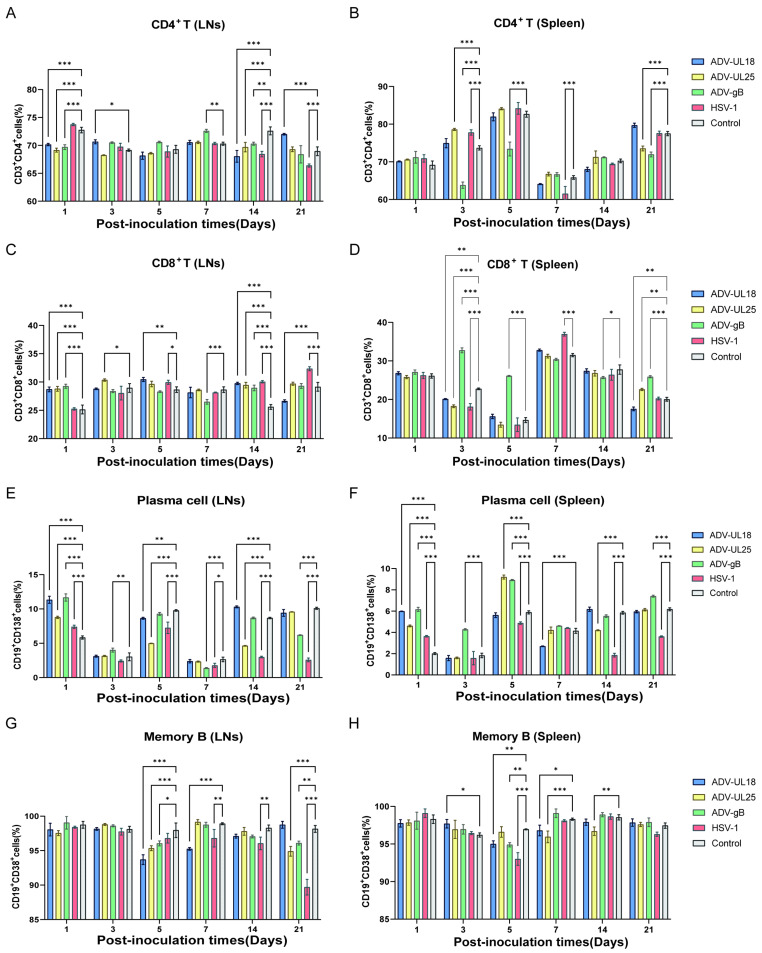
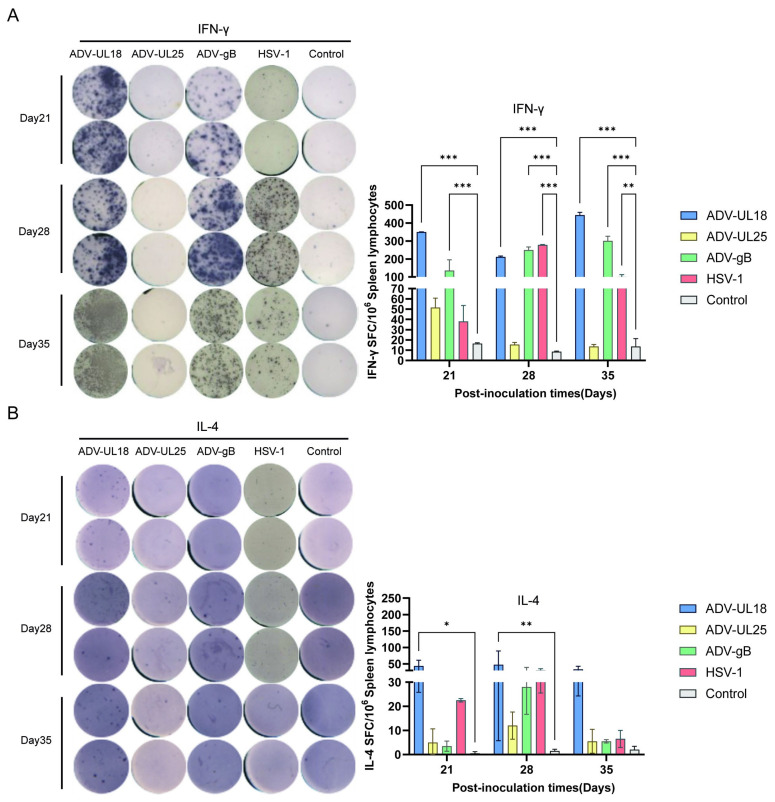
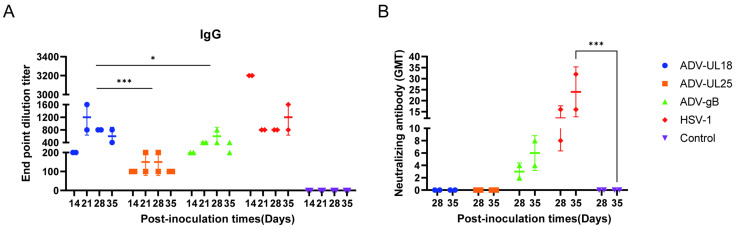
Due to the complex pathogenic and immune escape mechanisms of herpes simplex virus type 1 (HSV-1), especially the failure of induced immune responses to block the initial cell-to-cell transmission of the virus from skin cells to neurons, the body struggles to establish effective prevention and control methods, resulting in the failure of currently developed vaccines. Previous studies have highlighted the crucial roles of surface glycoproteins and nucleocapsid proteins in activating the body's immune defense system against HSV-1 infection. In this study, recombinant adenoviruses were used as vectors to generate adenoviruses carrying the nucleocapsid protein genes UL18 and UL25, as well as the surface glycoprotein gene gB. This approach aimed to mimic the protein expression process that occurs following viral infection of the host and to investigate the immune response characteristics induced by UL18, UL25, and gB proteins. The findings revealed that UL18, UL25, and gB proteins could all trigger the expression of genes associated with innate immune responses; however, the specific genes induced varied in type and level. Furthermore, all three proteins were capable of promoting the proliferation of CD8+ T cells in the lymph nodes. Notably, only UL18 and gB could elicit a Th1 cell immune response. Interestingly, among these proteins, only UL18 could also induce a relatively higher IL-4 level, indicating a Th2 cell immune response. In addition to cellular immunity, all three proteins stimulated the production of specific IgG antibodies. Notably, UL18 induced higher and more sustained levels of specific IgG antibodies in mice. By contrast, only glycoprotein gB induced lower levels of neutralizing antibodies in mice. Moreover, when these mice were challenged with HSV-1, the co-immunization with UL18 and gB provided better protection than gB alone. In conclusion, HSV-1 surface glycoproteins and nucleocapsid proteins exhibit differences in their ability to induce innate and adaptive immunity in the body, suggesting potential avenues for vaccine design by leveraging their complementary advantages.
由于单纯疱疹病毒1型(HSV-1)复杂的致病和免疫逃逸机制,尤其是诱导的免疫反应未能阻止病毒从皮肤细胞到神经元的初始细胞间传播,机体难以建立有效的防控方法,导致目前研发的疫苗失败。先前的研究强调了表面糖蛋白和核衣壳蛋白在激活机体针对HSV-1感染的免疫防御系统中的关键作用。在本研究中,重组腺病毒被用作载体来产生携带核衣壳蛋白基因UL18和UL25以及表面糖蛋白基因gB的腺病毒。该方法旨在模拟病毒感染宿主后发生的蛋白质表达过程,并研究由UL18、UL25和gB蛋白诱导的免疫反应特征。研究结果表明,UL18、UL25和gB蛋白均能触发与先天免疫反应相关的基因表达;然而,诱导的具体基因在类型和水平上有所不同。此外,这三种蛋白都能够促进淋巴结中CD8+T细胞的增殖。值得注意的是,只有UL18和gB能引发Th1细胞免疫反应。有趣的是,在这些蛋白中,只有UL18还能诱导相对较高水平的IL-4,表明存在Th2细胞免疫反应。除了细胞免疫外,这三种蛋白都刺激了特异性IgG抗体的产生。值得注意的是,UL18在小鼠中诱导产生的特异性IgG抗体水平更高且更持久。相比之下,只有糖蛋白gB在小鼠中诱导产生的中和抗体水平较低。此外,当用HSV-1对这些小鼠进行攻击时,联合免疫UL18和gB比单独免疫gB提供了更好的保护。总之,HSV-1表面糖蛋白和核衣壳蛋白在诱导机体先天免疫和适应性免疫的能力上存在差异,这为利用它们的互补优势进行疫苗设计提供了潜在途径。