Sosin Dmitry Vitalievich, Baranovskii Denis S, Nechaev Denis Nikolaevich, Sosina Mariya Aleksandrovna, Shaposhnikov Alexander Vladimirovich, Trusov Georgy Aleksandrovich, Titova Anastasia Germanovna, Krasnikov Boris Fedorovich, Lomov Alexey Nikolaevich, Makarov Valentin Vladimirovich, Yudin Vladimir Sergeevich, Keskinov Anton Arturovich, Yudin Sergey Mihailovich, Klabukov Ilya Dmitrievich
Federal State Budgetary Institution "Centre for Strategic Planning and Management of Biomedical Health Risks" of the Federal Medical Biological Agency, 119121 Moscow, Russia.
Department of Regenerative Medicine, National Medical Research Radiological Centre of the Ministry of Health of the Russian Federation, 249036 Obninsk, Russia.
Int J Mol Sci. 2024 Dec 18;25(24):13543. doi: 10.3390/ijms252413543.
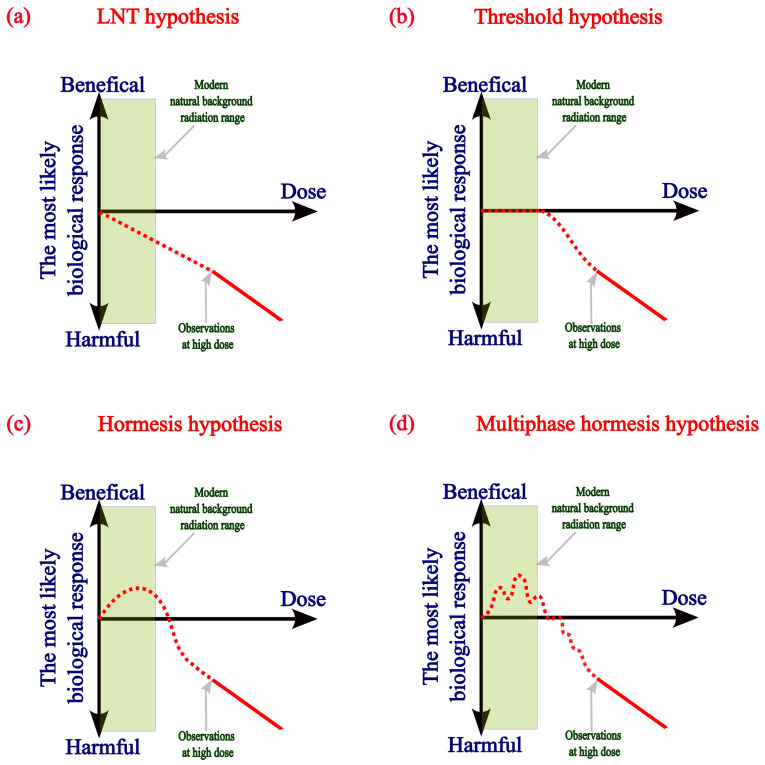
The evolution of man on Earth took place under conditions of constant exposure to background ionizing radiation (IR). From this point of view, it would be reasonable to hypothesize the existence of adaptive mechanisms that enable the human organism to safely interact with IR at levels approximating long-term natural background levels. In some situations, the successful operation of molecular mechanisms of protection against IR is observed at values significantly exceeding the natural background level, for example, in cancer cells. In 15-25% of cancer patients, cancer cells develop a phenotype that is resistant to high doses of IR. While further investigations are warranted, the current evidence suggests a strong probability of observing positive health effects, including an increased lifespan, a reduced cancer risk, and a decreased incidence of congenital pathologies, precisely at low doses of ionizing radiation. This review offers arguments primarily based on a phenomenological approach and critically reconsidering existing methodologies for assessing the biological risks of IR to human health. Currently, in the most economically developed countries, there are radiation safety rules that interpret low-dose radiation as a clearly negative environmental factor. Nowadays, this approach may pose significant challenges to the advancement of radiomedicine and introduce complexities in the regulation of IR sources. The review also examines molecular mechanisms that may play a key role in the formation of the positive effects of low-dose IR on human radioadaptive capabilities.
人类在地球上的进化是在持续暴露于背景电离辐射(IR)的条件下发生的。从这个角度来看,假设存在适应性机制使人体能够在接近长期自然背景水平的辐射强度下与IR安全相互作用是合理的。在某些情况下,例如在癌细胞中,观察到抗IR分子机制在显著超过自然背景水平的值下仍能成功运作。在15%至25%的癌症患者中,癌细胞会形成对高剂量IR具有抗性的表型。虽然有必要进一步研究,但目前的证据表明,恰恰在低剂量电离辐射下,很有可能观察到积极的健康影响,包括寿命延长、癌症风险降低以及先天性疾病发病率下降。本综述主要基于现象学方法提出论点,并批判性地重新审视评估IR对人类健康的生物风险的现有方法。目前,在经济最发达的国家,存在将低剂量辐射解释为明显负面环境因素的辐射安全规则。如今,这种方法可能给放射医学的发展带来重大挑战,并在IR源的监管方面引入复杂性。该综述还研究了可能在低剂量IR对人类放射适应能力的积极影响形成中起关键作用的分子机制。