Kalló Gergő, Zaman Khadiza, Potor László, Hendrik Zoltán, Méhes Gábor, Tóth Csaba, Gergely Péter, Tőzsér József, Balla György, Balla József, Prokai Laszlo, Csősz Éva
Proteomics Core Facility, Department of Biochemistry and Molecular Biology, Faculty of Medicine, University of Debrecen, 4032 Debrecen, Hungary.
Department of Pharmacology and Neuroscience, University of North Texas Health Science Center, Fort Worth, TX 76107, USA.
Int J Mol Sci. 2024 Dec 20;25(24):13665. doi: 10.3390/ijms252413665.
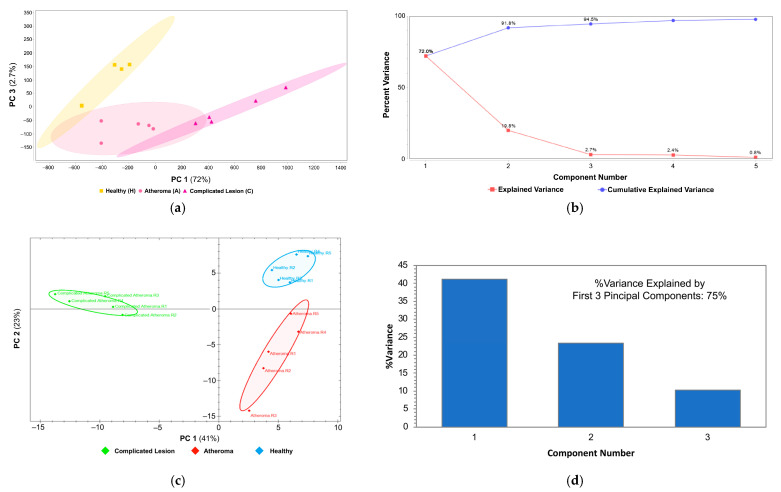
Vulnerable atherosclerotic plaques, especially hemorrhaged lesions, are the major cause of mortalities related to vascular pathologies. The early identification of vulnerable plaques helps to stratify patients at risk of developing acute vascular events. In this study, proteomics analyses of human carotid artery samples collected from patients with atheromatous plaques and complicated lesions, respectively, as well as from healthy controls were performed. The proteins isolated from the carotid artery samples were analyzed by a bottom-up shotgun approach that relied on nanoflow liquid chromatography-tandem mass spectrometry analyses (LC-MS/MS) using both data-dependent (DDA) and data-independent (DIA) acquisitions. The data obtained by high-resolution DIA analyses displayed a stronger distinction among groups compared to DDA analyses. Differentially expressed proteins were further examined using Ingenuity Pathway Analysis with focus on pathological and molecular processes driving atherosclerosis. From the more than 150 significantly regulated canonical pathways, atherosclerosis signaling and neutrophil extracellular trap signaling were verified by protein-targeted data extraction. The results of our study are expected to facilitate a better understanding of the disease progression's molecular drivers and provide inspiration for further multiomics and hypothesis-driven studies.
易损性动脉粥样硬化斑块,尤其是出血性病变,是与血管病变相关死亡的主要原因。早期识别易损斑块有助于对有发生急性血管事件风险的患者进行分层。在本研究中,分别对从患有动脉粥样硬化斑块和复杂病变的患者以及健康对照者采集的人颈动脉样本进行了蛋白质组学分析。从颈动脉样本中分离出的蛋白质通过一种自下而上的鸟枪法进行分析,该方法依靠纳流液相色谱-串联质谱分析(LC-MS/MS),采用数据依赖(DDA)和数据独立(DIA)采集方式。与DDA分析相比,高分辨率DIA分析获得的数据在各组之间显示出更强的区分度。使用 Ingenuity 通路分析进一步检查差异表达蛋白,重点关注驱动动脉粥样硬化的病理和分子过程。在150多个显著调控的经典通路中,通过蛋白质靶向数据提取验证了动脉粥样硬化信号传导和中性粒细胞胞外陷阱信号传导。我们的研究结果有望促进对疾病进展分子驱动因素的更好理解,并为进一步的多组学和假设驱动研究提供灵感。