Hu Yingxu, Peng Jingfeng, Liu Rui, Gao Jing, Hua Guancheng, Fan Xiangjiang, Wang Shengjie
College of Chemistry and Chemical Engineering, China University of Petroleum, Qingdao 266580, China.
Molecules. 2024 Dec 23;29(24):6063. doi: 10.3390/molecules29246063.
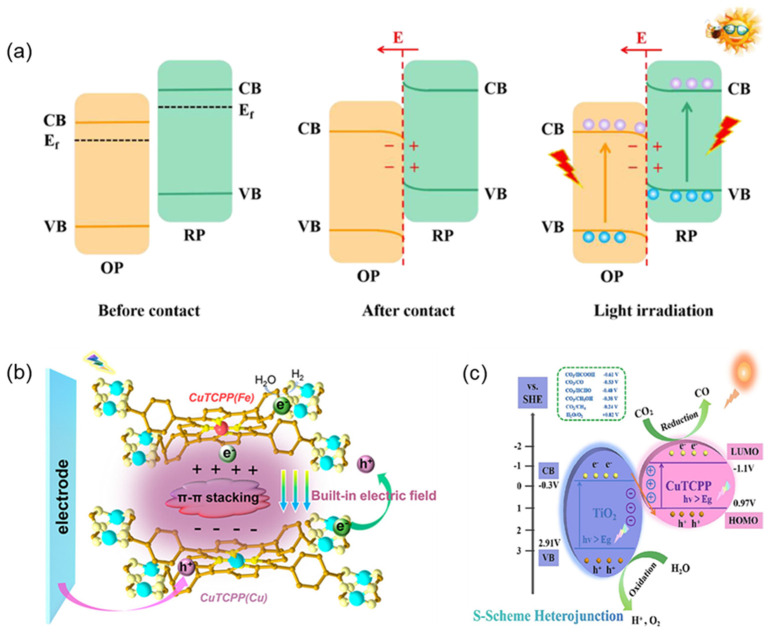
As a key means to solve energy and environmental problems, photocatalytic technology has made remarkable progress in recent years. Organic semiconductor materials offer structural diversity and tunable energy levels and thus attracted great attention. Among them, porphyrin and its derivatives show great potential in photocatalytic reactions and light therapy due to their unique large-π conjugation structure, high apparent quantum efficiency, tailorable functionality, and excellent biocompatibility. Compared to unassembled porphyrin molecules, supramolecular porphyrin assemblies facilitate the solar light absorption and improve the charge transfer and thus exhibit enhanced photocatalytic performance. Herein, the research progress of porphyrin-based supramolecular assemblies, including the construction, the regulation of charge separation and transfer, stability, and application in photocatalysis, was systematically reviewed. The construction strategy of porphyrin supramolecules, the mechanism of charge separation, and the intrinsic relationship of assembling structure-charge transfer-photocatalytic performance received special attention. Surfactants, peptide molecules, polymers, and metal ions were introduced to improve the stability of the porphyrin assemblies. Donor-acceptor structure and co-catalysts were incorporated to inhibit the recombination of the photoinduced charges. These increase the understanding of the porphyrin supramolecules and provide ideas for the design of high-performance porphyrin-based photocatalysts.
作为解决能源和环境问题的关键手段,光催化技术近年来取得了显著进展。有机半导体材料具有结构多样性和可调节的能级,因此受到了广泛关注。其中,卟啉及其衍生物因其独特的大π共轭结构、高表观量子效率、可定制的功能和优异的生物相容性,在光催化反应和光疗中显示出巨大潜力。与未组装的卟啉分子相比,超分子卟啉组装体有利于太阳光吸收,改善电荷转移,从而表现出增强的光催化性能。在此,系统综述了基于卟啉的超分子组装体的研究进展,包括其构建、电荷分离与转移的调控、稳定性以及在光催化中的应用。特别关注了卟啉超分子的构建策略、电荷分离机制以及组装结构 - 电荷转移 - 光催化性能的内在关系。引入表面活性剂、肽分子、聚合物和金属离子以提高卟啉组装体的稳定性。引入供体 - 受体结构和助催化剂以抑制光生电荷的复合。这些有助于加深对卟啉超分子的理解,并为高性能卟啉基光催化剂的设计提供思路。