Gonzaga Lucas Wamser Fonseca, Egito Beatriz Monte, Coelho João Bosco Costa, Souza Gabriela Pereira, Martins Frederico Severino, Ferrante Marcos
Department of Veterinary Medicine, Universidade Federal de Lavras, Lavras 37200-900, MG, Brazil.
Department of Clinical and Toxicological Analysis, Faculty of Pharmaceutical Sciences, Universidade de São Paulo, Av. Prof. Lineu Prestes, 580, Bl. 13B, São Paulo 05508-000, SP, Brazil.
Pharmaceuticals (Basel). 2024 Dec 19;17(12):1720. doi: 10.3390/ph17121720.
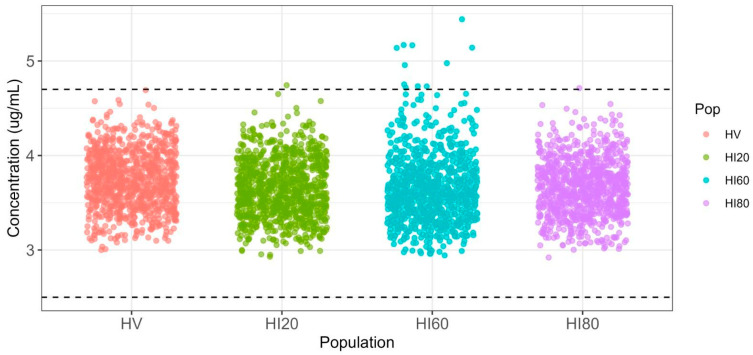
: A PBPK model allows the prediction of the concentration of drug amounts in different tissues and organs over time and can be used to simulate and optimize different therapeutic protocols in healthy and sick individuals. The objective of this work was to create a PBPK model to predict propofol doses for healthy canines and canines with hepatic impairment. : The study methodology was divided into two major phases, in which the first phase consisted of creating the PBPK model for healthy canines, and in the second phase, this model was adjusted for canines with hepatic impairment. The model for healthy canines presented good predictive performance, evidenced by the value of the performance measure of the geometric mean fold error that ranged from 0.8 to 1.25, meeting the double error criterion. The simulated regimen for healthy canines, i.e., of 5 mg/kg (administered as a bolus) followed by a continuous infusion at a rate of 0.13 mg/kg/min, was sufficient and ensured that all simulated subjects achieved the target plasma concentration. Canines with 60% and 40% liver function had infusion rate adjustments to ensure that individuals did not exceed the therapeutic window for maintenance of anesthesia. : The results presented in this manuscript are suggestive of the effectiveness and practicality of a PBPK model for propofol in canines, with a particular focus on hepatic impairment.
一个生理药代动力学(PBPK)模型能够预测不同组织和器官中药物量随时间的浓度变化,可用于模拟和优化健康个体及患病个体的不同治疗方案。本研究的目的是创建一个PBPK模型,以预测健康犬和肝功能受损犬的丙泊酚剂量。:研究方法分为两个主要阶段,第一阶段包括为健康犬创建PBPK模型,第二阶段针对肝功能受损犬对该模型进行调整。健康犬的模型表现出良好的预测性能,几何平均倍数误差性能指标值在0.8至1.25之间,证明符合双重误差标准。健康犬的模拟给药方案,即5mg/kg(静脉推注),随后以0.13mg/kg/min的速率持续输注,是足够的,并确保所有模拟对象达到目标血浆浓度。肝功能分别为60%和40%的犬对输注速率进行了调整,以确保个体不超过维持麻醉的治疗窗。:本手稿中呈现的结果表明,犬用丙泊酚的PBPK模型具有有效性和实用性,尤其关注肝功能受损情况。