Chen Hao, Fan Yingfang, Li Qiuchao, Peng Chang
Institute of Road and Bridge Engineering, Dalian Maritime University, Dalian 116026, China.
Polymers (Basel). 2024 Dec 13;16(24):3482. doi: 10.3390/polym16243482.
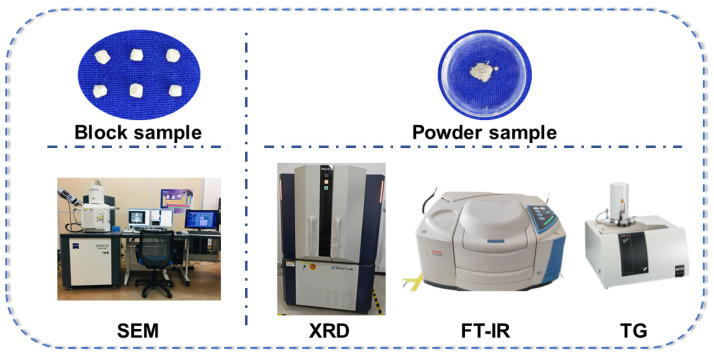
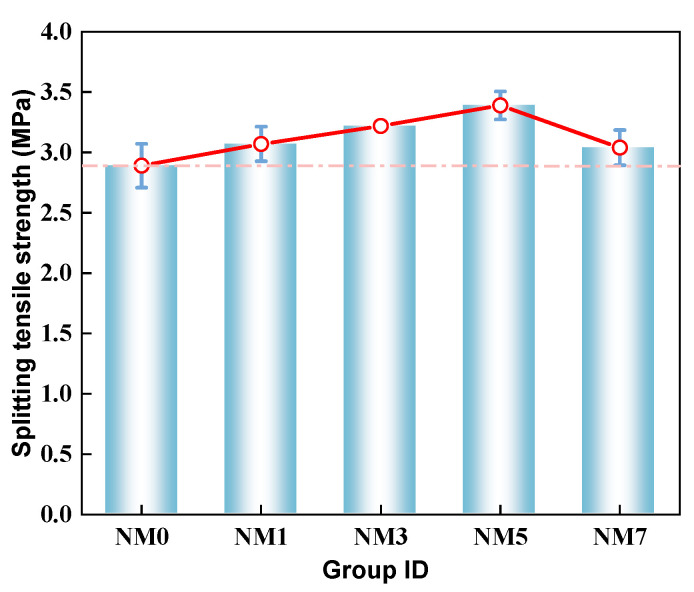
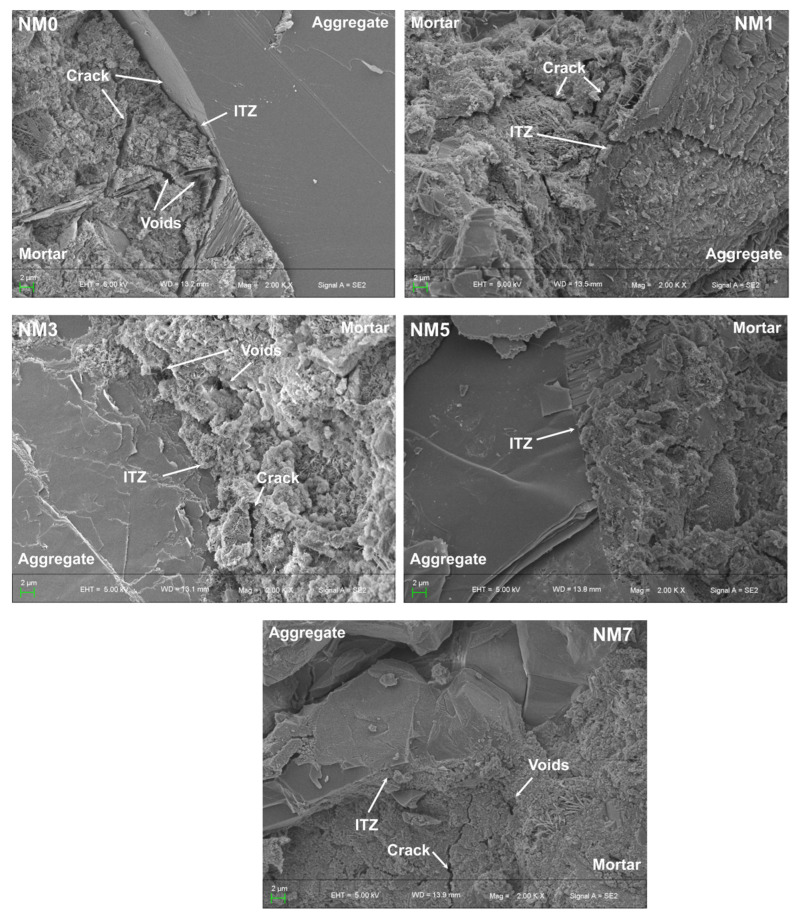
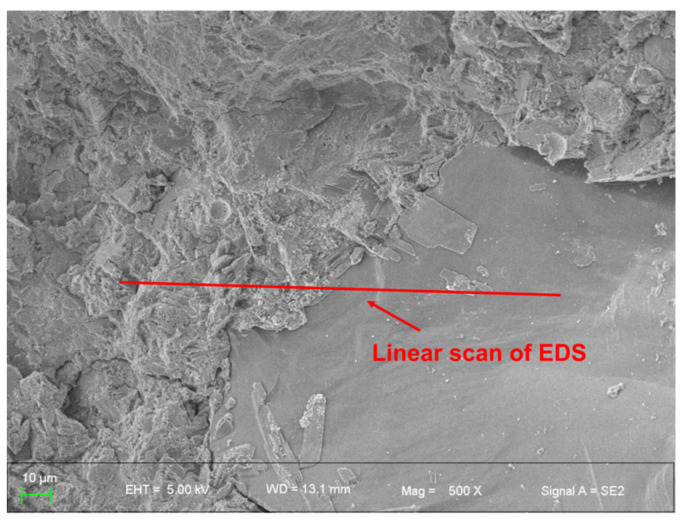
Nano metakaolin (NMK) has attracted considerable interest for its potential to improve the durability of cementitious materials. However, the effect of NMK on the splitting tensile performance of concrete has not been systematically investigated. This study investigates the splitting tensile performance of NMK concrete and analyzes its failure behavior under splitting load. Different NMK dosages (0%, 1%, 3%, 5%, and 7%) were considered, and splitting tensile tests were conducted. The crack propagation process, crack width, and crack growth rate on the surface of NMK concrete during the splitting tensile test are analyzed using the Digital Image Correlation (DIC) method. The mechanisms by which NMK affects the splitting tensile performance of concrete were examined using X-ray Diffraction (XRD), Fourier Transform Infrared Spectroscopy (FT-IR), Scanning Electron Microscopy/Energy Dispersive Spectroscopy (SEM/EDS), and Thermogravimetric Analysis (TG). The results indicate that the incorporation of NMK enhances the splitting tensile performance of concrete. Concrete with 5% NMK addition exhibited the highest splitting tensile strength, with an increase of 17.4% compared to ordinary concrete. NMK improved the cracking resistance and overall integrity under splitting tensile load. With 5% NMK addition, the surface crack length, width, and main crack propagation rate of the concrete decreased by 4.5%, 35.3%, and 29.6%, respectively. NMK contributed to a denser internal structure of the concrete, promoted the formation of C-S-H gel, and increased the degree of cement hydration. Moreover, a lower thickness and Ca/Si ratio of interfacial transition zone (ITZ) were observed in NMK concrete. The ITZ thickness and Ca/Si ratio of concrete with 5% NMK were reduced by 64.4% and 85.4%, respectively, compared to ordinary concrete. In summary, the influence mechanism of NMK addition on the splitting tensile strength and failure behavior of concrete is explored in this study, providing experimental data to support the application of NMK concrete in practical engineering.
纳米偏高岭土(NMK)因其改善胶凝材料耐久性的潜力而备受关注。然而,NMK对混凝土劈裂抗拉性能的影响尚未得到系统研究。本研究调查了NMK混凝土的劈裂抗拉性能,并分析了其在劈裂荷载下的破坏行为。考虑了不同的NMK掺量(0%、1%、3%、5%和7%),并进行了劈裂抗拉试验。采用数字图像相关(DIC)方法分析了NMK混凝土在劈裂抗拉试验过程中的裂纹扩展过程、裂纹宽度和裂纹扩展速率。利用X射线衍射(XRD)、傅里叶变换红外光谱(FT-IR)、扫描电子显微镜/能谱仪(SEM/EDS)和热重分析(TG)研究了NMK影响混凝土劈裂抗拉性能的机理。结果表明,掺入NMK可提高混凝土的劈裂抗拉性能。添加5%NMK的混凝土表现出最高的劈裂抗拉强度,与普通混凝土相比提高了17.4%。NMK提高了混凝土在劈裂抗拉荷载下的抗裂性和整体完整性。添加5%NMK时,混凝土的表面裂纹长度、宽度和主裂纹扩展速率分别降低了4.5%、35.3%和29.6%。NMK有助于使混凝土内部结构更致密,促进C-S-H凝胶的形成,并提高水泥水化程度。此外,在NMK混凝土中观察到界面过渡区(ITZ)的厚度和Ca/Si比更低。与普通混凝土相比,添加5%NMK的混凝土的ITZ厚度和Ca/Si比分别降低了64.4%和85.4%。总之,本研究探讨了添加NMK对混凝土劈裂抗拉强度和破坏行为的影响机制,为NMK混凝土在实际工程中的应用提供了试验数据。