
用于实时机器人系统的级联特征融合抓取网络
Cascaded Feature Fusion Grasping Network for Real-Time Robotic Systems.
作者信息
Li Hao, Zheng Lixin
机构信息
College of Information Science and Engineering, Huaqiao University, Xiamen 361021, China.
College of Engineering, Huaqiao University, Quanzhou 362021, China.
出版信息
Sensors (Basel). 2024 Dec 13;24(24):7958. doi: 10.3390/s24247958.
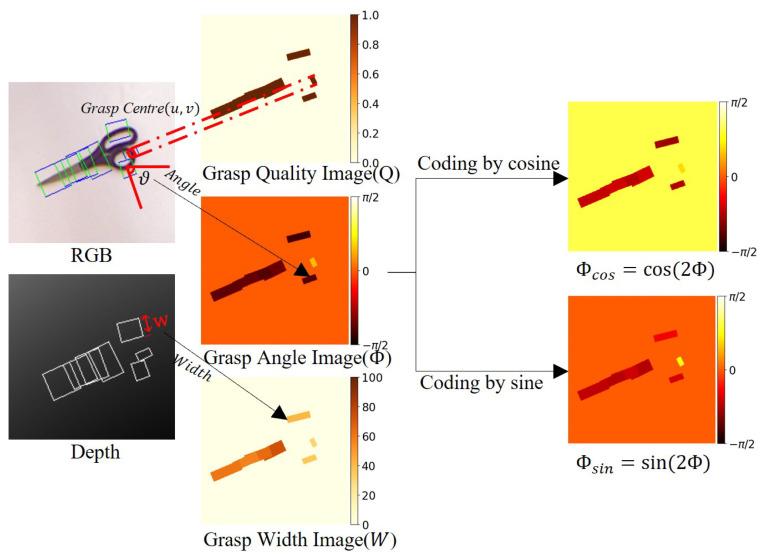
Grasping objects of irregular shapes and various sizes remains a key challenge in the field of robotic grasping. This paper proposes a novel RGB-D data-based grasping pose prediction network, termed Cascaded Feature Fusion Grasping Network (CFFGN), designed for high-efficiency, lightweight, and rapid grasping pose estimation. The network employs innovative structural designs, including depth-wise separable convolutions to reduce parameters and enhance computational efficiency; convolutional block attention modules to augment the model's ability to focus on key features; multi-scale dilated convolution to expand the receptive field and capture multi-scale information; and bidirectional feature pyramid modules to achieve effective fusion and information flow of features at different levels. In tests on the Cornell dataset, our network achieved grasping pose prediction at a speed of 66.7 frames per second, with accuracy rates of 98.6% and 96.9% for image-wise and object-wise splits, respectively. The experimental results show that our method achieves high-speed processing while maintaining high accuracy. In real-world robotic grasping experiments, our method also proved to be effective, achieving an average grasping success rate of 95.6% on a robot equipped with parallel grippers.
抓取形状不规则、大小各异的物体仍然是机器人抓取领域的一项关键挑战。本文提出了一种基于RGB-D数据的新型抓取姿态预测网络,称为级联特征融合抓取网络(CFFGN),旨在实现高效、轻量级和快速的抓取姿态估计。该网络采用了创新的结构设计,包括深度可分离卷积以减少参数并提高计算效率;卷积块注意力模块以增强模型关注关键特征的能力;多尺度扩张卷积以扩大感受野并捕获多尺度信息;以及双向特征金字塔模块以实现不同层次特征的有效融合和信息流。在康奈尔数据集上的测试中,我们的网络以每秒66.7帧的速度实现了抓取姿态预测,在图像级和物体级分割上的准确率分别为98.6%和96.9%。实验结果表明,我们的方法在保持高精度的同时实现了高速处理。在实际的机器人抓取实验中,我们的方法也被证明是有效的,在配备平行夹爪的机器人上实现了95.6%的平均抓取成功率。




 Zotero 插件