
迈向促进糖尿病自我管理的个性化数字体验:混合方法社会计算方法。
Toward Personalized Digital Experiences to Promote Diabetes Self-Management: Mixed Methods Social Computing Approach.
作者信息
Singh Tavleen, Roberts Kirk, Fujimoto Kayo, Wang Jing, Johnson Constance, Myneni Sahiti
机构信息
McWilliams School of Biomedical Informatics, The University of Texas Health Science Center, Houston, TX, United States.
School of Public Health, The University of Texas Health Science Center, Houston, TX, United States.
出版信息
JMIR Diabetes. 2025 Jan 7;10:e60109. doi: 10.2196/60109.
BACKGROUND
Type 2 diabetes affects nearly 34.2 million adults and is the seventh leading cause of death in the United States. Digital health communities have emerged as avenues to provide social support to individuals engaging in diabetes self-management (DSM). The analysis of digital peer interactions and social connections can improve our understanding of the factors underlying behavior change, which can inform the development of personalized DSM interventions.
OBJECTIVE
Our objective is to apply our methodology using a mixed methods approach to (1) characterize the role of context-specific social influence patterns in DSM and (2) derive interventional targets that enhance individual engagement in DSM.
METHODS
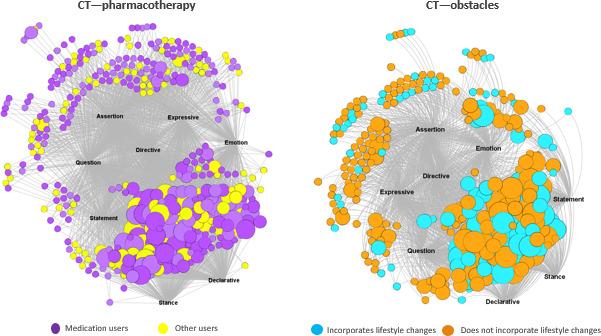
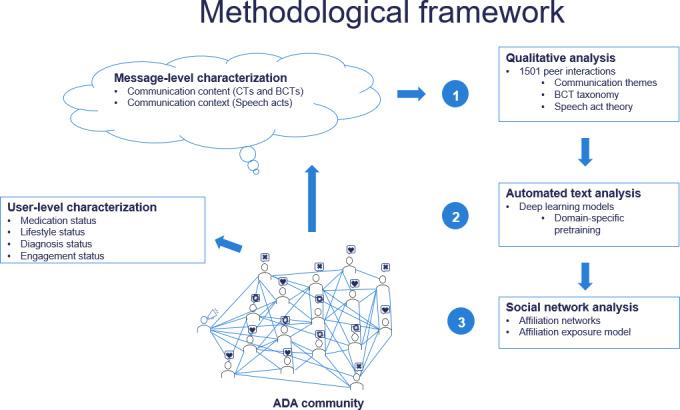
Using the peer messages from the American Diabetes Association support community for DSM (n=~73,000 peer interactions from 2014 to 2021), (1) a labeled set of peer interactions was generated (n=1501 for the American Diabetes Association) through manual annotation, (2) deep learning models were used to scale the qualitative codes to the entire datasets, (3) the validated model was applied to perform a retrospective analysis, and (4) social network analysis techniques were used to portray large-scale patterns and relationships among the communication dimensions (content and context) embedded in peer interactions.
RESULTS
The affiliation exposure model showed that exposure to community users through sharing interactive communication style speech acts had a positive association with the engagement of community users. Our results also suggest that pre-existing users with type 2 diabetes were more likely to stay engaged in the community when they expressed patient-reported outcomes and progress themes (communication content) using interactive communication style speech acts (communication context). It indicates the potential for targeted social network interventions in the form of structural changes based on the user's context and content exchanges with peers, which can exert social influence to modify user engagement behaviors.
CONCLUSIONS
In this study, we characterize the role of social influence in DSM as observed in large-scale social media datasets. Implications for multicomponent digital interventions are discussed.
背景
2型糖尿病影响着近3420万成年人,是美国第七大死因。数字健康社区已成为为参与糖尿病自我管理(DSM)的个人提供社会支持的途径。对数字同伴互动和社会联系的分析可以增进我们对行为改变背后因素的理解,这可为个性化DSM干预措施的制定提供信息。
目的
我们的目标是采用混合方法应用我们的方法,以(1)描述特定情境下的社会影响模式在DSM中的作用,以及(2)得出可增强个体参与DSM的干预目标。
方法
利用美国糖尿病协会DSM支持社区的同伴信息(2014年至2021年约73000次同伴互动),(1)通过人工标注生成一组带标签的同伴互动(美国糖尿病协会为1501次),(2)使用深度学习模型将定性编码扩展到整个数据集,(3)应用经过验证的模型进行回顾性分析,(4)使用社会网络分析技术描绘同伴互动中嵌入的沟通维度(内容和情境)之间大规模的模式和关系。
结果
归属暴露模型表明,通过分享互动式沟通风格言语行为接触社区用户与社区用户的参与度呈正相关。我们的结果还表明,患有2型糖尿病已有的用户在使用互动式沟通风格言语行为(沟通情境)表达患者报告的结果和进展主题(沟通内容)时,更有可能持续参与社区。这表明基于用户情境和与同伴的内容交流进行结构改变形式的定向社会网络干预具有潜力,这种干预可施加社会影响来改变用户参与行为。
结论
在本研究中,我们描述了在大规模社交媒体数据集中观察到的社会影响在DSM中的作用。讨论了对多成分数字干预的影响。
 Zotero 插件