Lin Susan, Gade Aravind R, Wang Hong-Gang, Niemeyer James E, Galante Allison, DiStefano Isabella, Towers Patrick, Nunez Jorge, Matsui Maiko, Schwartz Theodore H, Rajadhyaksha Anjali, Pitt Geoffrey S
Cardiovascular Research Institute, Weill Cornell Medicine, New York City, United States.
Department of Neurological Surgery and Brain and Mind Research Institute, Weill Cornell Medicine of Cornell University, New York Presbyterian Hospital, New York, United States.
Elife. 2025 Jan 8;13:RP98661. doi: 10.7554/eLife.98661.
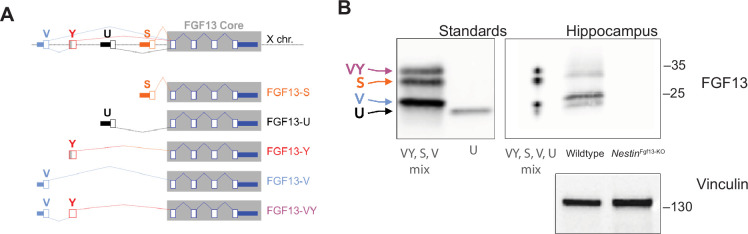
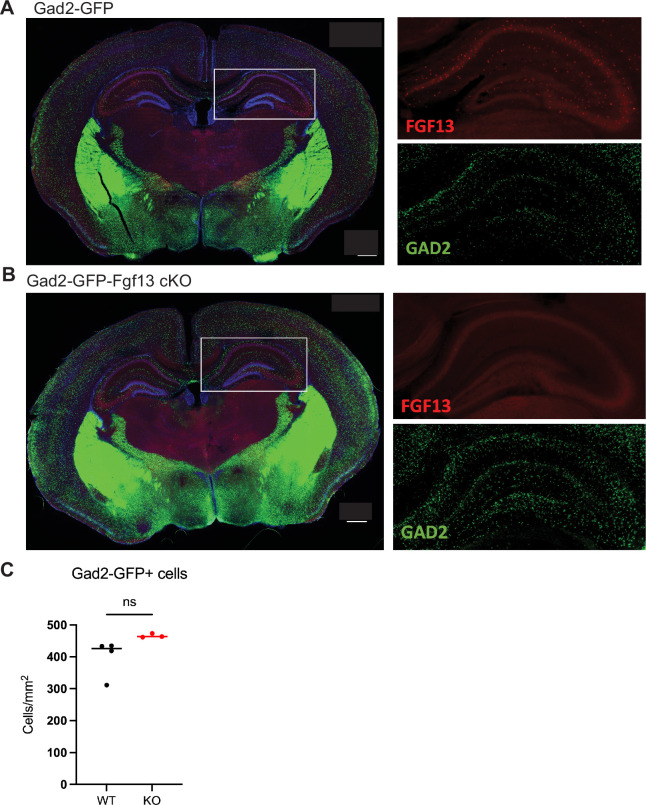
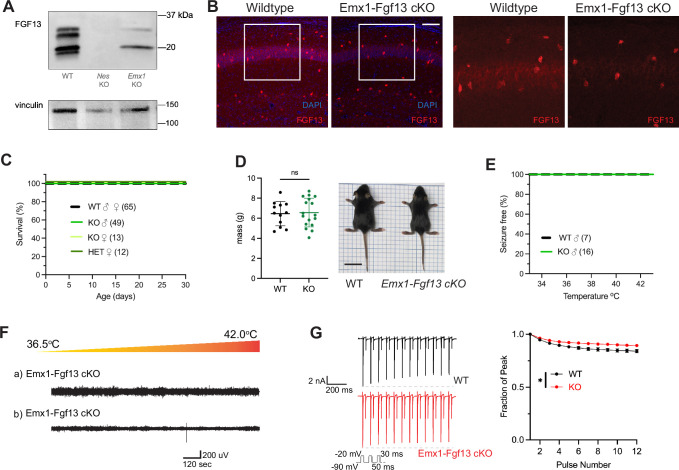
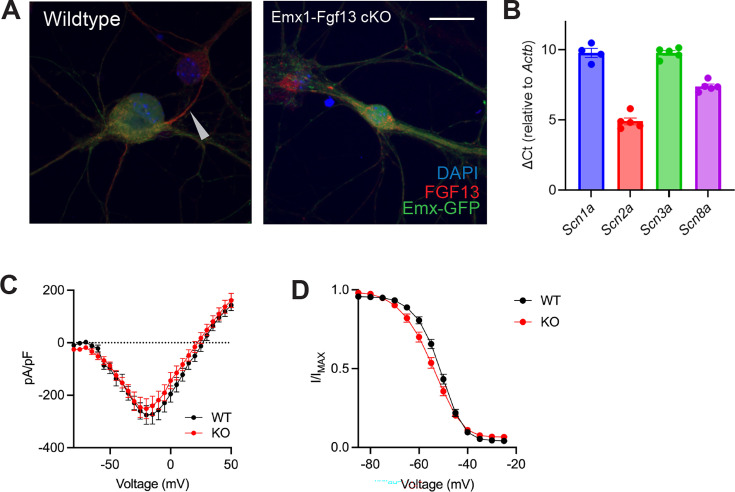
Developmental and epileptic encephalopathies (DEEs), a class of devastating neurological disorders characterized by recurrent seizures and exacerbated by disruptions to excitatory/inhibitory balance in the brain, are commonly caused by mutations in ion channels. Disruption of, or variants in, were implicated as causal for a set of DEEs, but the underlying mechanisms were clouded because is expressed in both excitatory and inhibitory neurons, undergoes extensive alternative splicing producing multiple isoforms with distinct functions, and the overall roles of FGF13 in neurons are incompletely cataloged. To overcome these challenges, we generated a set of novel cell-type-specific conditional knockout mice. Interneuron-targeted deletion of led to perinatal mortality associated with extensive seizures and impaired the hippocampal inhibitory/excitatory balance while excitatory neuron-targeted deletion of caused no detectable seizures and no survival deficits. While best studied as a voltage-gated sodium channel (Na) regulator, we observed no effect of ablation in interneurons on Nas but rather a marked reduction in K channel currents. Re-expressing different splice isoforms could partially rescue deficits in interneuron excitability and restore K channel current amplitude. These results enhance our understanding of the molecular mechanisms that drive the pathogenesis of related seizures and expand our understanding of FGF13 functions in different neuron subsets.
发育性和癫痫性脑病(DEEs)是一类严重的神经系统疾病,其特征为反复发作的癫痫,且因大脑兴奋性/抑制性平衡的破坏而加剧,通常由离子通道突变引起。[此处原文缺失具体基因名称]的破坏或变异被认为是一组DEEs的病因,但潜在机制尚不清楚,因为[该基因名称]在兴奋性和抑制性神经元中均有表达,会经历广泛的可变剪接产生多种具有不同功能的异构体,并且FGF13在神经元中的整体作用尚未完全明确。为了克服这些挑战,我们构建了一组新型的细胞类型特异性条件性敲除小鼠。对中间神经元进行靶向性敲除[该基因名称]导致围产期死亡,并伴有广泛的癫痫发作,同时损害了海马体的抑制性/兴奋性平衡,而对兴奋性神经元进行靶向性敲除[该基因名称]则未引发可检测到的癫痫发作,也没有生存缺陷。虽然FGF13作为电压门控钠通道(Na)调节剂的研究最为深入,但我们观察到在中间神经元中敲除FGF13对Na通道没有影响,而是显著降低了钾通道电流。重新表达不同的FGF13剪接异构体可以部分挽救中间神经元兴奋性的缺陷,并恢复钾通道电流幅度。这些结果加深了我们对驱动相关癫痫发病机制的分子机制的理解,并扩展了我们对FGF13在不同神经元亚群中功能的认识。