Beach Samuel J, Maselko Maciej
Applied BioSciences, Macquarie University, Sydney, NSW 2109, Australia.
ARC Centre of Excellence in Synthetic Biology, Macquarie University, Sydney, NSW, 2109, Australia.
Nat Commun. 2025 Jan 7;16(1):219. doi: 10.1038/s41467-024-54863-1.
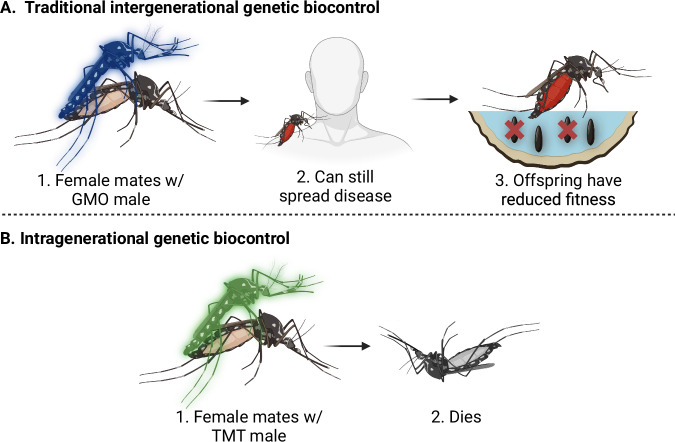
The emergence of insecticide resistance has increased the need for alternative pest management tools. Numerous genetic biocontrol approaches, which involve the release of genetically modified organisms to control pest populations, are in various stages of development to provide highly targeted pest control. However, all current mating-based genetic biocontrol technologies function by releasing engineered males which skew sex-ratios or reduce offspring viability in subsequent generations which leaves mated females to continue to cause harm (e.g. transmit disease). Here, we demonstrate intragenerational genetic biocontrol, wherein mating with engineered males reduces female lifespan. The toxic male technique (TMT) involves the heterologous expression of insecticidal proteins within the male reproductive tract that are transferred to females via mating. In this study, we demonstrate TMT in Drosophila melanogaster males, which reduce the median lifespan of mated females by 37 - 64% compared to controls mated to wild type males. Agent-based models of Aedes aegypti predict that TMT could reduce rates of blood feeding by a further 40 - 60% during release periods compared to leading biocontrol technologies like fsRIDL. TMT is a promising approach for combatting outbreaks of disease vectors and agricultural pests.
杀虫剂抗性的出现增加了对替代害虫管理工具的需求。许多遗传生物防治方法,包括释放转基因生物来控制害虫种群,正处于不同的开发阶段,以提供高度针对性的害虫防治。然而,目前所有基于交配的遗传生物防治技术都是通过释放经过基因改造的雄性来发挥作用,这些雄性会扭曲性别比例或降低后代的生存能力,从而使已交配的雌性继续造成危害(例如传播疾病)。在此,我们展示了代内遗传生物防治,即与经过基因改造的雄性交配会缩短雌性寿命。有毒雄性技术(TMT)涉及在雄性生殖道内异源表达杀虫蛋白,这些蛋白通过交配传递给雌性。在本研究中,我们在黑腹果蝇雄性中展示了TMT,与与野生型雄性交配的对照组相比,该技术使已交配雌性的平均寿命缩短了37%至64%。基于主体的埃及伊蚊模型预测,与fsRIDL等领先的生物防治技术相比,在释放期间TMT可使吸血率进一步降低40%至60%。TMT是一种对抗病媒和农业害虫爆发的有前景的方法。