Amaral de Andrade Leão Otávio, Flores Thaynã Ramos, de Oliveira Nava Daniela, Soares Pedro San Martin, Murray Joseph, Domingues Marlos Rodrigues, Hallal Pedro Curi
Department of Health and Kinesiology, College of Applied Health Sciences, University of Illinois Urbana Champaign, Champaign, Illinois, USA.
Postgraduate Program in Epidemiology, Federal University of Pelotas, Pelotas, Brazil.
Child Care Health Dev. 2025 Jan;51(1):e70033. doi: 10.1111/cch.70033.
Screen use has become nearly universal, especially in children. Therefore, it is important not only to comprehend its effects on health but also to understand its patterns of use. We aim to describe screen use patterns among children assessed at 2, 4, and 6-7 years, based on device, period of the day, and child/family characteristics.
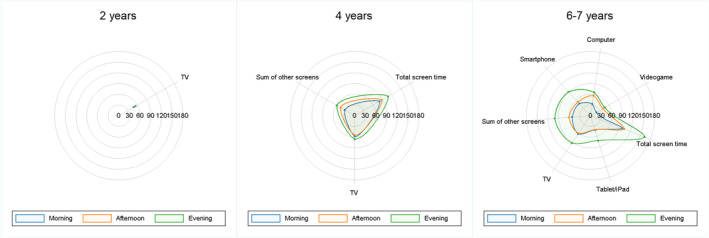
Longitudinal study, with participants of the 2015 Pelotas (Brazil) Birth Cohort, a population-based study including all living newborns in the city of Pelotas between 1 January and 31 December 2015. Child/family characteristics used in the study were sex, skin color, family income, and maternal education. Screen time at 2 years was evaluated by TV time. At age 4, TV time and other screens (computer and videogames) was assesed. At 6-7 years, screen use was collected for each device (TV, smartphone, tablet/iPad, computer, and videogames).
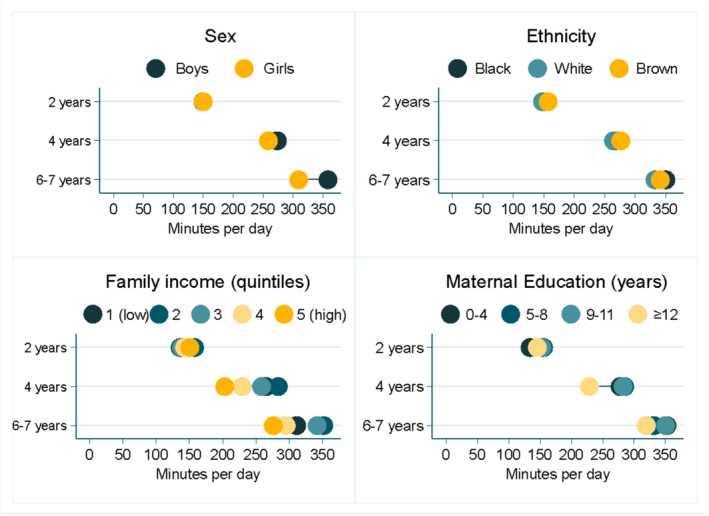
At 2, 4, and 6-7 years, 1420, 3963, and 3857 had valid screen time data, respectively. Mean total screen time ranged from ~ 2.5 h per day at age 2 to ~ 5.5 h per day at age 6-7. At 2 years, no difference in screen time was found according to child/family characteristics. In general, boys presented higher screen time values at 4 and 6-7 years. No differences for ethnicity were observed. For family income and maternal education, the extreme groups presented higher use. Higher values of screen time were also observed during the evening and for children who did not attend school nor had home activities during the Covid-19 pandemic.
The results suggest that children are exceeding current screen time guidelines, with different patterns of use according to child/family characteristics. The high use of screens and more concentrated use during the evenings raise concern considering its possible negative effects on health.
屏幕使用几乎已普及,尤其是在儿童中。因此,不仅要了解其对健康的影响,还要了解其使用模式,这很重要。我们旨在根据设备、一天中的时间段以及儿童/家庭特征,描述在2岁、4岁和6至7岁接受评估的儿童的屏幕使用模式。
纵向研究,参与者为2015年佩洛塔斯(巴西)出生队列,这是一项基于人群的研究,包括2015年1月1日至12月31日在佩洛塔斯市所有存活的新生儿。研究中使用的儿童/家庭特征包括性别、肤色、家庭收入和母亲教育程度。2岁时的屏幕时间通过看电视时间来评估。4岁时,评估看电视时间和其他屏幕(电脑和电子游戏)的使用时间。6至7岁时,收集每种设备(电视、智能手机、平板电脑/iPad、电脑和电子游戏)的屏幕使用情况。
在2岁、4岁和6至7岁时,分别有1420名、3963名和3857名儿童有有效的屏幕时间数据。平均总屏幕时间从2岁时每天约2.5小时到6至7岁时每天约5.5小时不等。2岁时,根据儿童/家庭特征未发现屏幕时间有差异。总体而言,男孩在4岁和6至7岁时的屏幕时间值更高。未观察到种族差异。对于家庭收入和母亲教育程度,极端组的使用量更高。在晚上以及在新冠疫情期间未上学且没有家庭活动的儿童,屏幕时间值也更高。
结果表明,儿童的屏幕使用时间超过了当前的指导标准,且根据儿童/家庭特征有不同的使用模式。考虑到屏幕使用可能对健康产生的负面影响,其高使用量以及在晚上更集中的使用令人担忧。