Donaghy Eddie, Sweeney Kieran D, Ng Lauren, Haines Holly, Thompson Alexandra, Henderson David, Wang Harry Hx, Thompson Andrew, Guthrie Bruce, Mercer Stewart W
PhD, Usher Institute, College of Medicine and Veterinary Medicine, University of Edinburgh, Edinburgh.
School of Public Health, Sun Yat-Sen University, Guangzhou, China.
Br J Gen Pract. 2025 Jun 2. doi: 10.3399/BJGP.2024.0500.
The 2018 Scottish GP contract established GP clusters and multidisciplinary team (MDT) expansion. Qualitative studies have suggested suboptimal progress with these initiatives.
To quantify progress since the introduction of the new contract.
A cross-sectional postal survey of all qualified GPs was undertaken in Scotland in 2023.
GPs' working lives, career intentions, and views on the new contract were compared with a similar survey conducted in 2018.
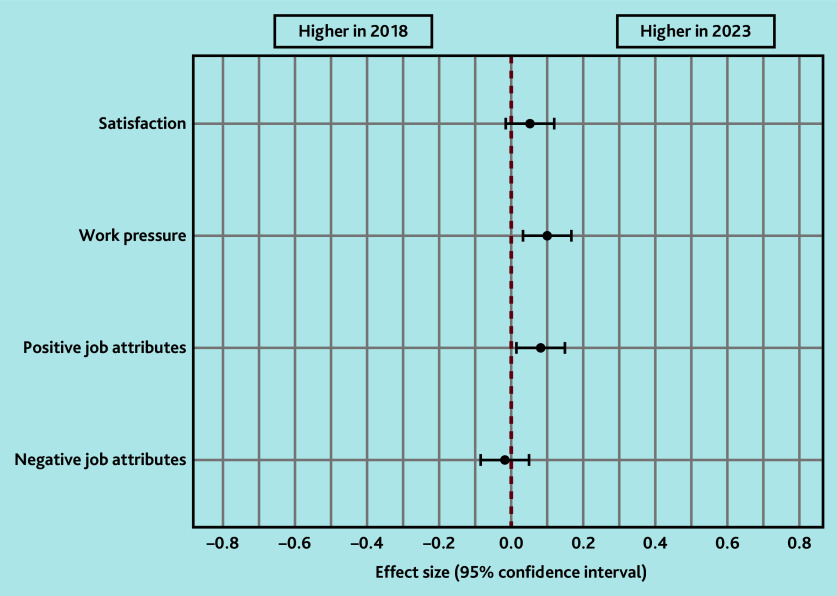
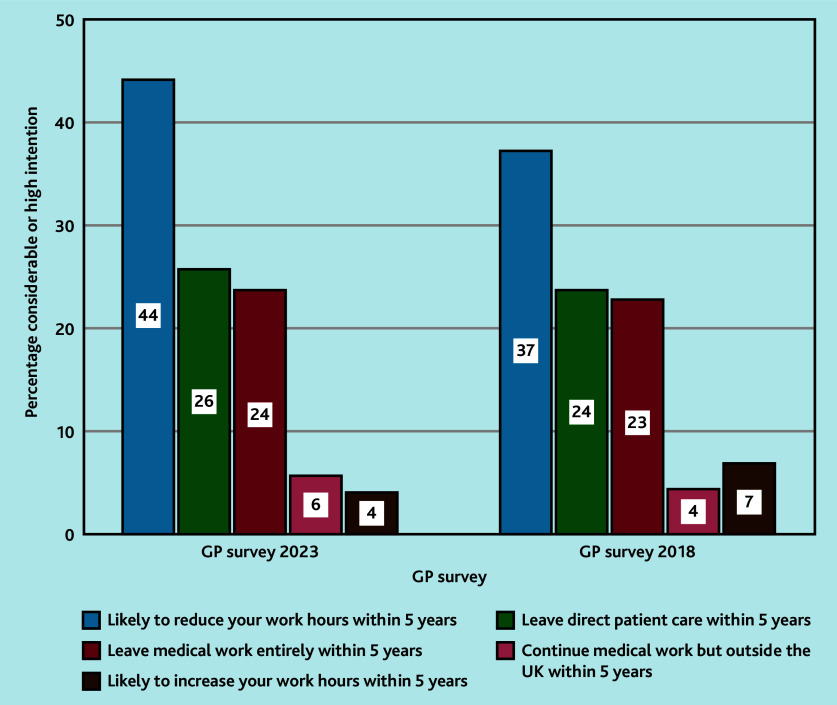
In total, 1385/4529 (31%) GPs responded to the 2023 survey compared with 2465/4371 (56%) in 2018. Job satisfaction and negative job attributes were similar in both surveys. Both positive job attributes ( = 0.011) and job pressures ( = 0.004) increased but the changes were small (effect sizes <0.2). Significantly more GPs were planning to reduce hours (<0.001) and leave direct patient care ( = 0.008) in 2023 than in 2018. Quality leads' views on cluster working were unchanged, with 70%-80% reporting insufficient support. Cluster knowledge and engagement was unchanged but there were small increases in knowledge of quality improvement. More than half of the GPs reported that access to MDT staff was insufficient to reduce their workload in all staff categories except vaccinations. Significantly more practices were trying to recruit GPs (<0.01), and GPs reported worsening NHS services, higher workload, and lower practice sustainability in 2023 (<0.001). Only 5% of GPs in the 2023 survey thought that the new contract had improved the care of patients with complex needs.
GPs report few improvements in working life 5 years after the new contract was introduced, and are responding by planning to reduce their hours or leave direct patient care.
2018年苏格兰全科医生合同确立了全科医生集群以及多学科团队(MDT)的扩张。定性研究表明这些举措的进展未达最佳状态。
量化新合同实施以来的进展。
2023年在苏格兰对所有合格的全科医生进行了一项横断面邮寄调查。
将全科医生的工作生活、职业意向以及对新合同的看法与2018年进行的一项类似调查进行比较。
2023年的调查中,共有1385/4529(31%)的全科医生做出回应,而2018年为2465/4371(56%)。两次调查中的工作满意度和负面工作属性相似。积极工作属性(P = 0.011)和工作压力(P = 0.004)均有所增加,但变化较小(效应量<0.2)。与2018年相比,2023年计划减少工作时长(P<0.001)和离开直接患者护理岗位(P = 0.008)的全科医生显著增多。质量负责人对集群工作的看法未变,70%-80%的人表示支持不足。集群知识和参与度未变,但质量改进知识略有增加。超过一半的全科医生报告称,除疫苗接种外,在所有员工类别中,获得多学科团队工作人员的帮助不足以减轻他们的工作量。试图招聘全科医生的诊所显著增多(P<0.01),全科医生报告2023年国民保健服务(NHS)服务恶化、工作量增加且诊所可持续性降低(P<0.001)。2023年调查中只有5%的全科医生认为新合同改善了对有复杂需求患者的护理。
全科医生报告称,新合同实施5年后工作生活几乎没有改善,他们正计划通过减少工作时长或离开直接患者护理岗位来应对。