Tarancon-Diez Laura, Iriarte-Gahete Marianela, Sanchez-Mingo Pilar, Muñoz-Fernandez Mª Ángeles, Navarro-Gomez Maria Luisa, Pacheco Yolanda M, Leal Manuel
Grupo de Infecciones en la Población Pediátrica, Health Research Institute Gregorio Marañón (IiSGM), Calle Dr. Esquerdo 46, 28007, Madrid, Spain.
Centro de Investigación Biomédica en Red de Enfermedades Infecciosas (CIBER-INFEC), Instituto de Salud Carlos III (ISCIII), Madrid, Spain.
Sci Rep. 2025 Jan 8;15(1):1343. doi: 10.1038/s41598-024-84498-7.
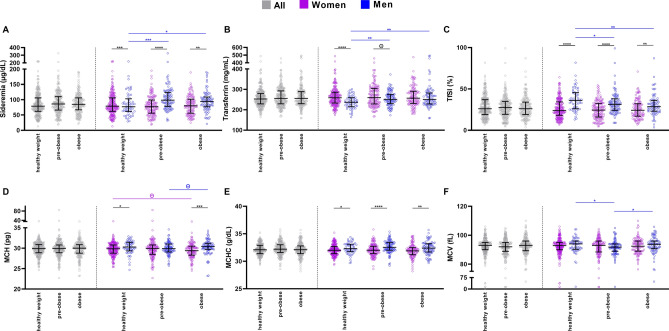
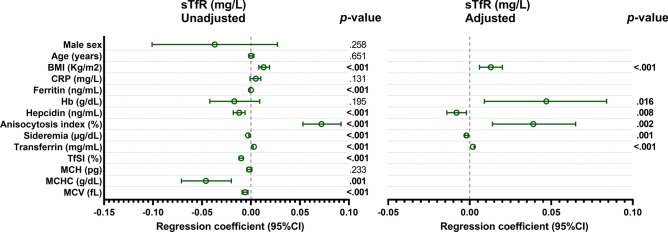
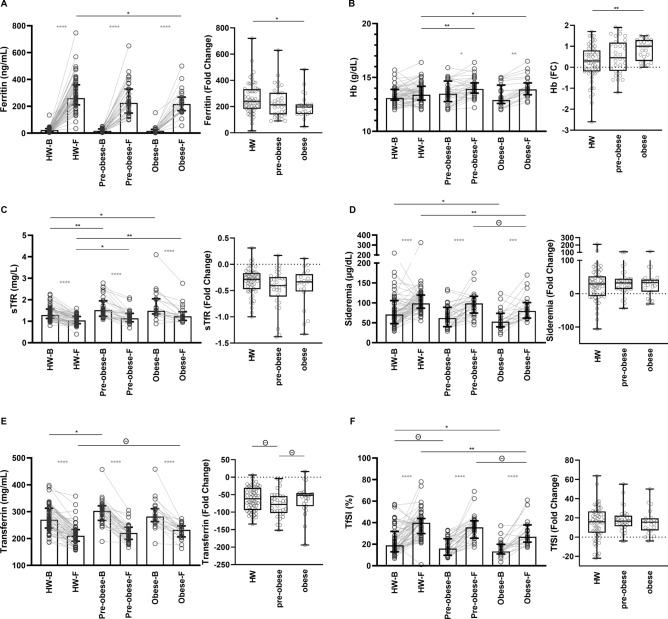
Obesity and iron deficiency (ID) are widespread health issues, with subclinical inflammation in obesity potentially contributing to ID through unclear mechanisms. The aim of the present work was to elucidate how obesity-associated inflammation disturb iron metabolism and to investigate the effect of intravenous (IV) iron supplementation on absolute iron deficient pre-obese (BMI 25.0-29.9 kg/m) and obese (BMI > 30 kg/m) individuals compared to healthy weight (HW) group (BMI 18.5-24.9 kg/m). Iron-related, hematological and inflammatory biomarkers along with erythropoietin (EPO) were studied based on body mass index (BMI) in a Spanish cohort of non-anemic participants (n = 721; 67% women; median age of 48 years [IQR: 39-57]) and in a subgroup of subjects (n = 110) with absolute ID (ferritin < 50 ng/mL) after completing an IV iron therapy. Obese group exhibited higher levels of ferritin, hemoglobin (Hb), soluble transferrin receptor (sTfR) and hepcidin compared to HW group. Elevated BMI was independently associated with increased sTfR levels. While no statistical differences were found in EPO among groups, obese showed increased levels that inversely correlated with Hb only in pre-obese and obese groups. IV iron therapy on obese participants had significant improvements on iron-related parameters and Hb levels. Notable obesity-associated disturbances in iron metabolism are described and indicate a mixed ID among both, women and men. These findings highlight the importance of tailored interventions to correctly address ID in obese population.
肥胖和缺铁是普遍存在的健康问题,肥胖中的亚临床炎症可能通过不明机制导致缺铁。本研究的目的是阐明肥胖相关炎症如何扰乱铁代谢,并调查静脉注射铁剂对肥胖前期(BMI 25.0 - 29.9 kg/m²)和肥胖(BMI > 30 kg/m²)的绝对缺铁个体与健康体重(HW)组(BMI 18.5 - 24.9 kg/m²)相比的影响。在一个西班牙非贫血参与者队列(n = 721;67%为女性;中位年龄48岁[四分位间距:39 - 57])中,基于体重指数(BMI)研究了铁相关、血液学和炎症生物标志物以及促红细胞生成素(EPO),并在完成静脉铁剂治疗后对一组绝对缺铁(铁蛋白<50 ng/mL)的受试者(n = 110)进行了研究。与HW组相比,肥胖组的铁蛋白、血红蛋白(Hb)、可溶性转铁蛋白受体(sTfR)和铁调素水平更高。BMI升高与sTfR水平升高独立相关。虽然各组间EPO无统计学差异,但肥胖组仅在肥胖前期和肥胖组中EPO水平升高,且与Hb呈负相关。对肥胖参与者进行静脉铁剂治疗后,铁相关参数和Hb水平有显著改善。描述了肥胖相关的显著铁代谢紊乱,表明男女均存在混合性缺铁。这些发现强调了针对性干预对正确解决肥胖人群缺铁问题的重要性。