Gouveia Rita, Madureira Sérgio, Elias Catarina, Ribeirinho-Soares Pedro, Soares-Carreira Marta, Pereira Joana, Almeida Jorge, Lourenço Patrícia
Internal Medicine Department, Unidade Local de Saúde São João, Porto, Portugal.
Department of Medicine, Faculty of Medicine, Porto University, Porto, Portugal.
Porto Biomed J. 2025 Jan 8;10(1):277. doi: 10.1097/j.pbj.0000000000000277. eCollection 2025 Jan-Feb.
Increased levels of platelet distribution width (PDW) can predict cardiac death and infarction recurrence in acute myocardial infarction. PDW appears to be a prognosis marker in acute heart failure (HF); however, its impact on chronic HF is still unknown. We investigated the impact of PDW on chronic HF.
We retrospectively analyzed outpatients with chronic HF with left ventricular systolic dysfunction (LVSD) from January 2012 to May 2018. Patients with no data on PDW levels or with preserved or recovered ejection fraction were excluded. The primary end point was all-cause mortality. Multivariable Cox regression analysis was used to evaluate the association between PDW and mortality. A multivariate model was built adjusting for age, sex, comorbidities, brain-type natriuretic peptide, New York Heart Association (NYHA) class, evidence-based therapy, and severity of LVSD.
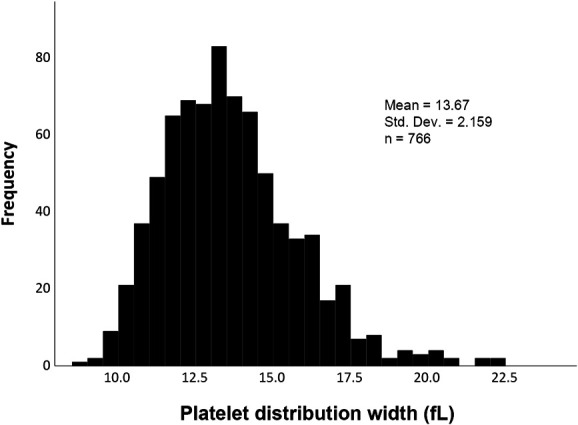
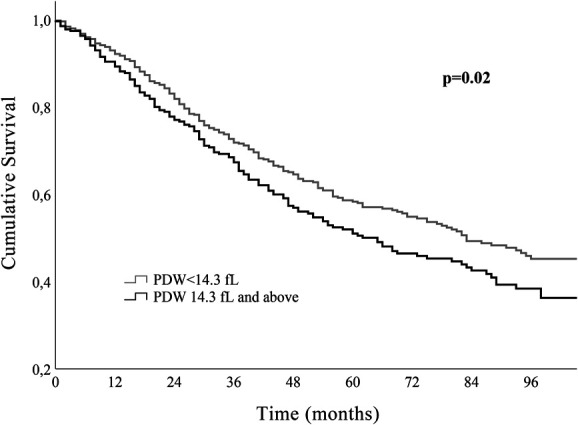
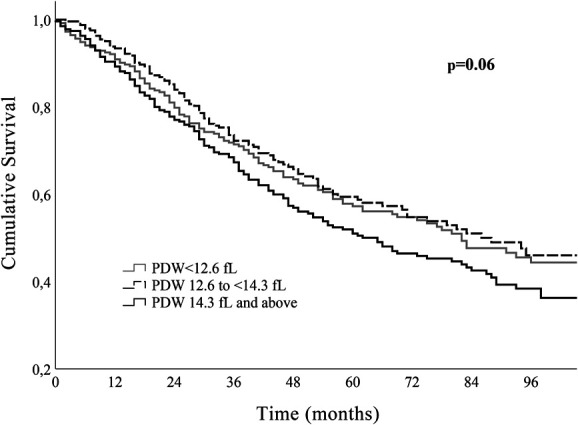
In our cohort of 766 patients, 65.7% were male, the mean age was 70 years, and 35.4% were in NYHA class I; 38.3% had diabetes mellitus, 51.4% had severe LVSD, and 3.9% had an inflammatory or autoimmune disease. The median (interquartile range) PDW was 13.5 (12.1-14.9) fL. During a median follow-up of 49 (30-79) months, 372 patients (48.6%) died. Patients with PDW ≥ 14.3 fL presented a multivariate-adjusted higher risk of all-cause death than those with lower values (hazard ratio: 1.32, 95% confidence interval [CI]: 1.05-1.64, = .2).
Patients with PDW ≥14.3 fL (upper tercile for PDW) presented a multivariate-adjusted 32% (95% CI: 5-64%) higher risk of all-cause death than those with lower values. PDW can help clinicians stratify patients with chronic HF; it is a practical, inexpensive, and widely available parameter.
血小板分布宽度(PDW)水平升高可预测急性心肌梗死患者的心源性死亡和梗死复发。PDW似乎是急性心力衰竭(HF)的一个预后标志物;然而,其对慢性HF的影响仍不清楚。我们研究了PDW对慢性HF的影响。
我们回顾性分析了2012年1月至2018年5月期间患有左心室收缩功能障碍(LVSD)的慢性HF门诊患者。排除PDW水平无数据或射血分数保留或恢复的患者。主要终点是全因死亡率。采用多变量Cox回归分析评估PDW与死亡率之间的关联。建立了一个多变量模型,对年龄、性别、合并症、脑钠肽、纽约心脏协会(NYHA)分级、循证治疗和LVSD严重程度进行了校正。
在我们的766例患者队列中,65.7%为男性,平均年龄为70岁,35.4%为NYHA I级;38.3%患有糖尿病,51.4%患有严重LVSD,3.9%患有炎症或自身免疫性疾病。PDW的中位数(四分位间距)为13.5(12.1 - 14.9)fL。在中位随访49(30 - 79)个月期间,372例患者(48.6%)死亡。PDW≥14.3 fL的患者与较低值患者相比,多变量校正后的全因死亡风险更高(风险比:1.32,95%置信区间[CI]:1.05 - 1.64,P = 0.02)。
PDW≥14.3 fL(PDW的上三分位数)的患者与较低值患者相比,多变量校正后的全因死亡风险高32%(95% CI:5 - 64%)。PDW可帮助临床医生对慢性HF患者进行分层;它是一个实用、廉价且广泛可用的参数。