Ceïde Mirnova E, Wang Sarah, Lootens Matthew R, Cantor Aviva, Verghese Joe, Lounsbury David W
Division of Cognitive and Motor Aging, Albert Einstein College of Medicine, Bronx, NY, USA.
Department of Psychiatry and Behavioral Sciences, Montefiore Einstein Bronx, NY, USA.
J Psychiatry Cogn Behav. 2024;8. Epub 2024 Mar 18.
Late-life psychological symptoms in older adults such as depression and apathy have been increasingly associated with increased risk of cognitive and functional decline. The goal of this study was to conduct a confirmatory factor analysis of the Geriatric Depression Scale (GDS), pooling 3 unique cohorts of older adults to 1) develop a novel measurement model that distinguishes apathy from other domains of depression including dysphoria and cognitive concern and 2) evaluate if the measurement model distinguishes older adult populations with varied risk for cognitive decline.
We pooled the baseline waves of three older adult cohorts (N=1421). With the aim of partitioning apathy from other constructs that compose the GDS and with a PCA suggesting 3-component solution, we then conducted a confirmatory factor analysis (CFA) using lavaan and less R.
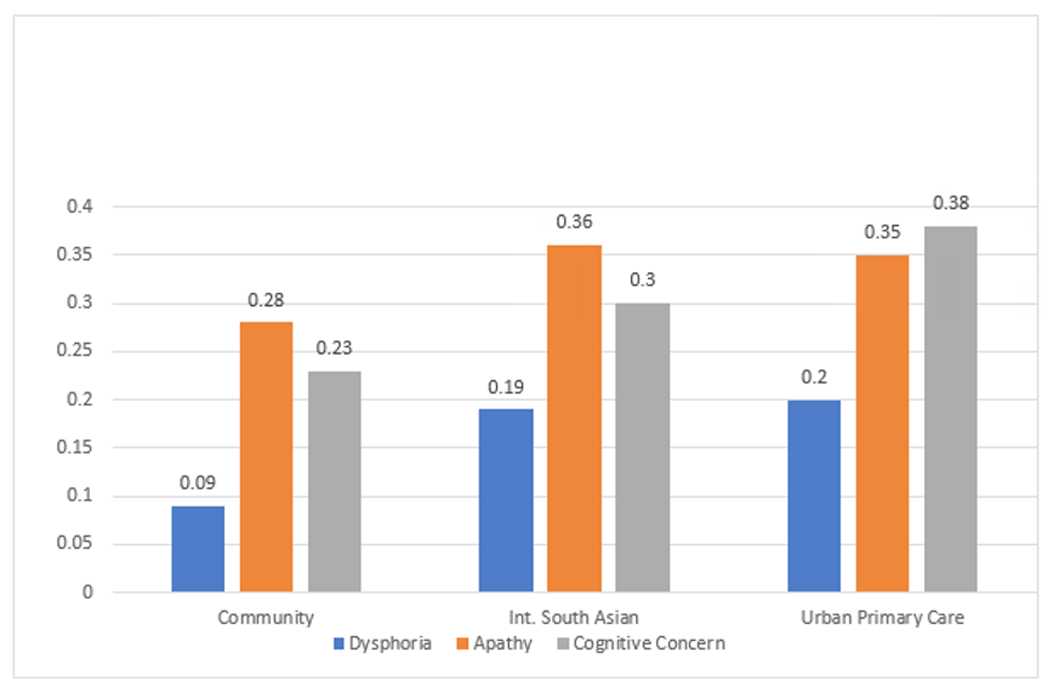
CFA yielded 3 factors: dysphoria, apathy, and cognitive concern. All the dysphoria, apathy, and cognitive concern factors showed acceptable unidimensionality with α=.76, .59, and .54, respectively. The Cognitive Risk Primary Care cohort had significantly higher mean dysphoria, apathy and cognitive concern scales.
This culturally, linguistically, and educationally diverse sample population yielded factors with acceptable reliability and good face validity. This strategy has resulted in a generalizable measurement model to identify people at risk for Alzheimer's disease and related dementia. In particular, the apathy scale score can be used to identify older adults at risk for cognitive and functional decline across research and clinical settings.
老年人晚年出现的抑郁和冷漠等心理症状与认知和功能衰退风险增加的关联日益密切。本研究的目的是对老年抑郁量表(GDS)进行验证性因素分析,将3个独特的老年人群队列合并,以1)开发一种新颖的测量模型,将冷漠与抑郁的其他领域(包括烦躁不安和认知担忧)区分开来;2)评估该测量模型是否能区分认知衰退风险不同的老年人群。
我们合并了三个老年人群队列的基线数据(N = 1421)。为了将冷漠与构成GDS的其他结构区分开来,且主成分分析表明为三成分解决方案,我们随后使用lavaan和less R进行了验证性因素分析(CFA)。
CFA产生了3个因素:烦躁不安、冷漠和认知担忧。所有的烦躁不安、冷漠和认知担忧因素均显示出可接受的单维性,α分别为0.76、0.59和0.54。认知风险初级保健队列的烦躁不安、冷漠和认知担忧量表的平均得分显著更高。
这个在文化、语言和教育方面具有多样性的样本群体得出了可靠性可接受且具有良好表面效度的因素。该策略产生了一个可推广的测量模型,用于识别患阿尔茨海默病及相关痴呆症风险的人群。特别是,冷漠量表得分可用于在研究和临床环境中识别有认知和功能衰退风险的老年人。