Ahmad Suleiman Idris, Aliyu Hafiz, Usman Rabi, Abubakar Ahmed, Maijawa Muhammad Abdullahi, Suleiman Bello Abdullahi, Balogun Muhammad Shakir, Olorukooba Abdulhakeem, Umeokonkwo Chukwuma David, Maiyaki Abubakar, Abubakar Muhammadu Sani, Abba Aisha Abdulazeez, Yisa Mohammed, Zubair Ismail, Onu Chinedu Hastings, Jatau Tenmuso David, Garba Fatima, Kabir Sabitu
Community Health, Usmanu Danfodiyo University College of Health Sciences, Sokoto, Nigeria
Garisun Nigeria Limited, Abuja, Nigeria.
BMJ Open. 2025 Jan 9;15(1):e083470. doi: 10.1136/bmjopen-2023-083470.
COVID-19 vaccine was rolled out for the public in August 2021 in Zamfara state, Northen Nigeria. We determined the factors influencing COVID-19 vaccine acceptance.
We executed a community-based analytical cross-sectional study during the first 4 months of the second phase of the COVID-19 (Oxford/AstraZeneca) mass vaccination campaign in Zamfara state.
We used multistage sampling to select 910 household heads.
We used a semistructured electronic questionnaire to collect data on sociodemographic characteristics, uptake and acceptance of COVID-19 vaccine between 12 October and 20 December 2021. We calculated frequencies, proportions, adjusted ORs and 95% CIs for factors influencing COVID-19 vaccine acceptance using logistic regression.
Our respondents had a median age of 48 years (IQR: 37-55), 78.1% (711) were men, a majority more than 30 years, and only 8.9% (81) had received COVID-19 vaccine. Of the 829 unvaccinated respondents, 10.1% (84) accepted to take the vaccine, the current week of the interview while 12.2% (101) rejected the vaccine. Individuals aged 30 years and older (adjusted OR (aOR)=2.39, 95% CI 1.16 to 4.94, p=0.018), who owned a mobile phone (aOR=25.35, 95% CI 11.23 to 57.23, p<0.001) and a television (aOR=3.72, 95% CI 1.09 to 12.69, p=0.036), with medium-high levels of trust (aOR=7.41, 95% CI 3.10 to 17.74, p<0.001), and those with a medium-high (positive) levels of attitude (aOR=1.82, 95% CI 1.06 to 3.11, p=0.029) were more likely to accept the COVID-19 vaccine. Also, those who had been vaccinated with other vaccines (aOR=2.2, 95% CI 1.09 to 4.43, p=0.027) and those previously tested for COVID-19 (aOR=2.0, 95% CI 1.10 to 3.66, p=0.023) were also more likely to accept it.
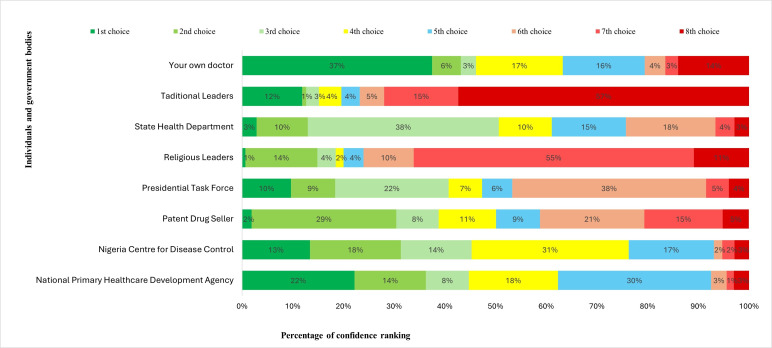
COVID-19 vaccine had a poor uptake and acceptance. Factors such as age, awareness, trust and previous vaccination experience played a significant role in COVID-19 vaccine acceptance. We recommended targeted public health campaigns, improving community engagement and building trust in community leaders, healthcare providers and public health institutions.
2021年8月,新冠疫苗在尼日利亚北部的赞法拉州向公众推出。我们确定了影响新冠疫苗接种意愿的因素。
在赞法拉州新冠(牛津/阿斯利康)大规模疫苗接种运动第二阶段的前4个月,我们开展了一项基于社区的分析性横断面研究。
我们采用多阶段抽样方法选取了910名户主。
我们使用半结构化电子问卷收集2021年10月12日至12月20日期间的社会人口学特征、新冠疫苗接种情况及接种意愿的数据。我们使用逻辑回归计算影响新冠疫苗接种意愿因素的频率、比例、调整后的比值比(aOR)和95%置信区间(CI)。
我们的受访者年龄中位数为48岁(四分位间距:37 - 55岁),78.1%(711人)为男性,大多数年龄超过30岁,只有8.9%(81人)接种过新冠疫苗。在829名未接种的受访者中,10.1%(84人)表示在访谈当周愿意接种疫苗,而12.2%(101人)拒绝接种。30岁及以上的个体(调整后的比值比[aOR]=2.39,95%置信区间1.16至4.94,p = 0.018)、拥有手机的个体(aOR=25.35,95%置信区间11.23至57.23,p<0.001)、拥有电视的个体(aOR=3.72,95%置信区间1.09至12.69,p = 0.036)、信任度处于中高水平的个体(aOR=7.41,95%置信区间3.10至17.74,p<0.001)以及态度处于中高(积极)水平的个体(aOR=1.82,95%置信区间1.06至3.11,p = 0.029)更有可能接受新冠疫苗。此外,接种过其他疫苗的个体(aOR=2.2,95%置信区间1.09至4.43,p = 0.027)以及之前接受过新冠病毒检测的个体(aOR=2.0,95%置信区间1.10至3.66,p = 0.023)也更有可能接受疫苗。
新冠疫苗的接种率和接受度较低。年龄、认知、信任和既往接种经验等因素在新冠疫苗接受度方面发挥了重要作用。我们建议开展有针对性的公共卫生宣传活动,加强社区参与,并增强对社区领袖、医疗服务提供者和公共卫生机构的信任。