Zhang Qian, Shi Yangmei, Cheng Jiawen, Chen Yan, Wang Jia, Wang Xianbin, Deng Luoyi, Wu Shuang
Department of Rehabilitation, Guizhou Medical University, Guiyang, Guizhou, China.
Department of Rehabilitation, The Affiliated Hospital of Guizhou Medical University, Guiyang, Guizhou, China.
Med Sci Monit. 2025 Jan 10;31:e944521. doi: 10.12659/MSM.944521.
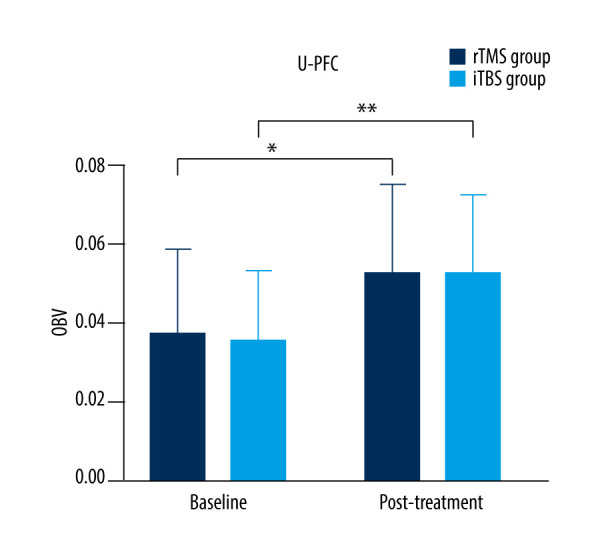
BACKGROUND Swallowing is a complex behavior involving the musculoskeletal system and higher-order brain functions. We investigated the effects of different modalities of repetitive transcranial magnetic stimulation (rTMS) on the unaffected hemisphere and observed correlation between suprahyoid muscle activity and cortical activation in unilateral stroke patients when swallowing saliva, based on functional near-infrared spectroscopy (fNIRS). MATERIAL AND METHODS From November 2022 to March 2023, twenty-five patients with unilateral stroke were screened using computed tomography or magnetic resonance imaging and identified via a video fluoroscopic swallow study. Finally, patients were divided into rTMS (n=10) and iTBS (n=10) groups. Both groups received 2 weeks of stimulation on unaffected suprahyoid motor cortex. Surface electromyographic measured peak amplitude and swallowing time of bilateral suprahyoid muscles, and penetration-aspiration scale was assessed at baseline and after treatment. fNIRS monitored oxyhemoglobin beta values (OBV) in the primary motor, sensory, and bilateral prefrontal cortex (PFC). RESULTS Both groups showed significant improvements in penetration-aspiration scale, peak amplitude, and swallowing time, compared with baseline (P<0.001), and increased OBV in unaffected regions (P<0.05), especially PFC (P<0.001). No significant OBV increases were seen in affected regions (P>0.05). After treatment, OBV in the unaffected PFC was significantly higher than in the unaffected primary sensory and motor cortex regions for both groups (P<0.05). No significant differences were observed between groups in outcome measures (P>0.05). CONCLUSIONS rTMS and iTBS significantly improved swallowing function in unilateral stroke, relying on compensation by the unaffected cortex, particularly the PFC. iTBS may outperform rTMS by shortening treatment sessions and improving efficiency.
吞咽是一种涉及肌肉骨骼系统和高级脑功能的复杂行为。我们基于功能近红外光谱(fNIRS)研究了不同模式的重复经颅磁刺激(rTMS)对未受影响半球的作用,并观察了单侧中风患者吞咽唾液时舌骨上肌群活动与皮质激活之间的相关性。
2022年11月至2023年3月,通过计算机断层扫描或磁共振成像对25例单侧中风患者进行筛查,并通过视频荧光吞咽造影检查进行确诊。最后,将患者分为rTMS组(n = 10)和iTBS组(n = 10)。两组均在未受影响的舌骨上运动皮质接受2周的刺激。表面肌电图测量双侧舌骨上肌群的峰值振幅和吞咽时间,并在基线和治疗后评估渗透-误吸量表。fNIRS监测初级运动、感觉和双侧前额叶皮质(PFC)中的氧合血红蛋白β值(OBV)。
与基线相比,两组的渗透-误吸量表、峰值振幅和吞咽时间均有显著改善(P < 0.001),未受影响区域的OBV增加(P < 0.05),尤其是PFC(P < 0.001)。受影响区域未观察到显著的OBV增加(P > 0.05)。治疗后,两组未受影响的PFC中的OBV均显著高于未受影响的初级感觉和运动皮质区域(P < 0.05)。两组间的结局指标无显著差异(P > 0.05)结论:rTMS和iTBS可显著改善单侧中风患者的吞咽功能,这依赖于未受影响皮质的代偿,尤其是PFC。iTBS可能通过缩短治疗疗程和提高效率而优于rTMS。