
血液系统癌症患者鞘内化疗后相关截瘫综合征:一项系统综述
Post-intrathecal chemotherapy-related paraplegia syndrome in hematological cancer patients: A systematic review.
作者信息
Monnikhof Matthijs, Hamming Gabriella, Crnko Sandra, Brandsma Rick, van Rhenen Anna, Monnikhof Thomas, Bovenschen Niels, Kaspers Gertjan, Flinsenberg Thijs W H
机构信息
Department of Pathology, University Medical Center Utrecht, Utrecht, The Netherlands.
Pediatric Oncology, Princes Maxima Center, Utrecht, The Netherlands.
出版信息
Neurooncol Adv. 2024 Dec 20;7(1):vdae217. doi: 10.1093/noajnl/vdae217. eCollection 2025 Jan-Dec.
BACKGROUND
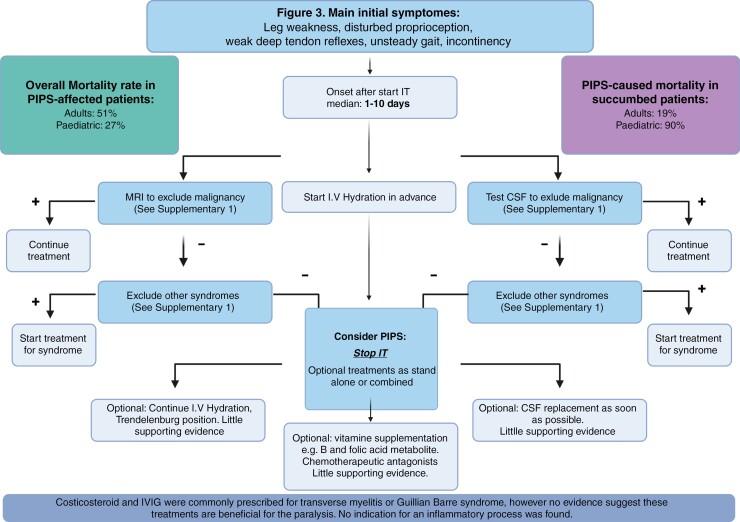
Intrathecal (IT) chemotherapy is essential in treating hematological malignancies, but it can lead to ascending paraplegia, a condition that currently lacks clear management guidelines.
METHODS
We conducted a systematic review, analyzing 1219 studies and 116 patients, adhering to PRISMA guidelines for individual patient data. The study, registered under PROSPERO (CRD42022362121), focused on the onset, diagnostic approaches, and therapeutic interventions associated with this complication, and management strategies to tackle the ascending paraplegia.
RESULTS
Paraplegia typically manifests approximately 10 days after chemotherapy, irrespective of injection frequency. In 95% of cases, paralysis stabilizes around the umbilical region, although some patients progress to upper limb involvement and respiratory compromise. Despite various diagnostic methods, consistent inflammatory markers in blood or cerebrospinal fluid are lacking, with approximately 60% of patients showing normal magnetic resonance imaging results at presentation. Misdiagnoses often include transverse myelitis, Guillain-Barré syndrome, and autoimmune radiculitis. Common treatments such as corticosteroids and intravenous immunoglobulins show limited effectiveness.
CONCLUSION
Our review delineates the clinical entity of ascending paraplegia following IT chemotherapy, aiming to increase clinician awareness and provide prognostic insight. We introduce the term post-IT paraplegia syndrome to facilitate accurate diagnosis and optimize treatment strategies for affected patients.
背景
鞘内化疗在治疗血液系统恶性肿瘤中至关重要,但可导致上行性截瘫,目前这种情况缺乏明确的管理指南。
方法
我们进行了一项系统评价,分析了1219项研究和116例患者,遵循PRISMA指南收集个体患者数据。该研究在PROSPERO(CRD42022362121)注册,重点关注与该并发症相关的发病情况、诊断方法和治疗干预措施,以及应对上行性截瘫的管理策略。
结果
截瘫通常在化疗后约10天出现,与注射频率无关。在95%的病例中,瘫痪在脐部区域附近稳定下来,尽管有些患者会进展到上肢受累和呼吸功能受损。尽管有各种诊断方法,但血液或脑脊液中缺乏一致的炎症标志物,约60%的患者在就诊时磁共振成像结果正常。误诊常包括横贯性脊髓炎、吉兰 - 巴雷综合征和自身免疫性神经根炎。常用治疗方法如皮质类固醇和静脉注射免疫球蛋白效果有限。
结论
我们的综述阐述了鞘内化疗后上行性截瘫的临床特征,旨在提高临床医生的认识并提供预后见解。我们引入“鞘内化疗后截瘫综合征”这一术语,以促进准确诊断并优化对受影响患者的治疗策略。


 Zotero 插件