Zhao Shangang, Zhu Qingzhang, Lee Wang-Hsin, Funcke Jan-Bernd, Zhang Zhuzhen, Wang May-Yun, Lin Qian, Field Bianca, Sun Xue-Nan, Li Guannan, Ekane Mbolle, Onodera Toshiharu, Li Na, Zhu Yi, Kusminski Christine M, Hinds Terry D, Scherer Philipp E
Touchstone Diabetes Center, University of Texas Southwestern Medical Center, Dallas, TX, USA; Sam and Ann Barshop Institute for Longevity and Aging Studies, Division of Endocrinology, Department of Medicine and Department of Cellular & Integrative Physiology, University of Texas Health Science Center at San Antonio, San Antonio, TX 78229, USA.
Touchstone Diabetes Center, University of Texas Southwestern Medical Center, Dallas, TX, USA; Barnstable Brown Diabetes and Obesity Center, University of Kentucky, Lexington, KY 40508, USA.
Cell Rep. 2025 Jan 28;44(1):115165. doi: 10.1016/j.celrep.2024.115165. Epub 2025 Jan 9.
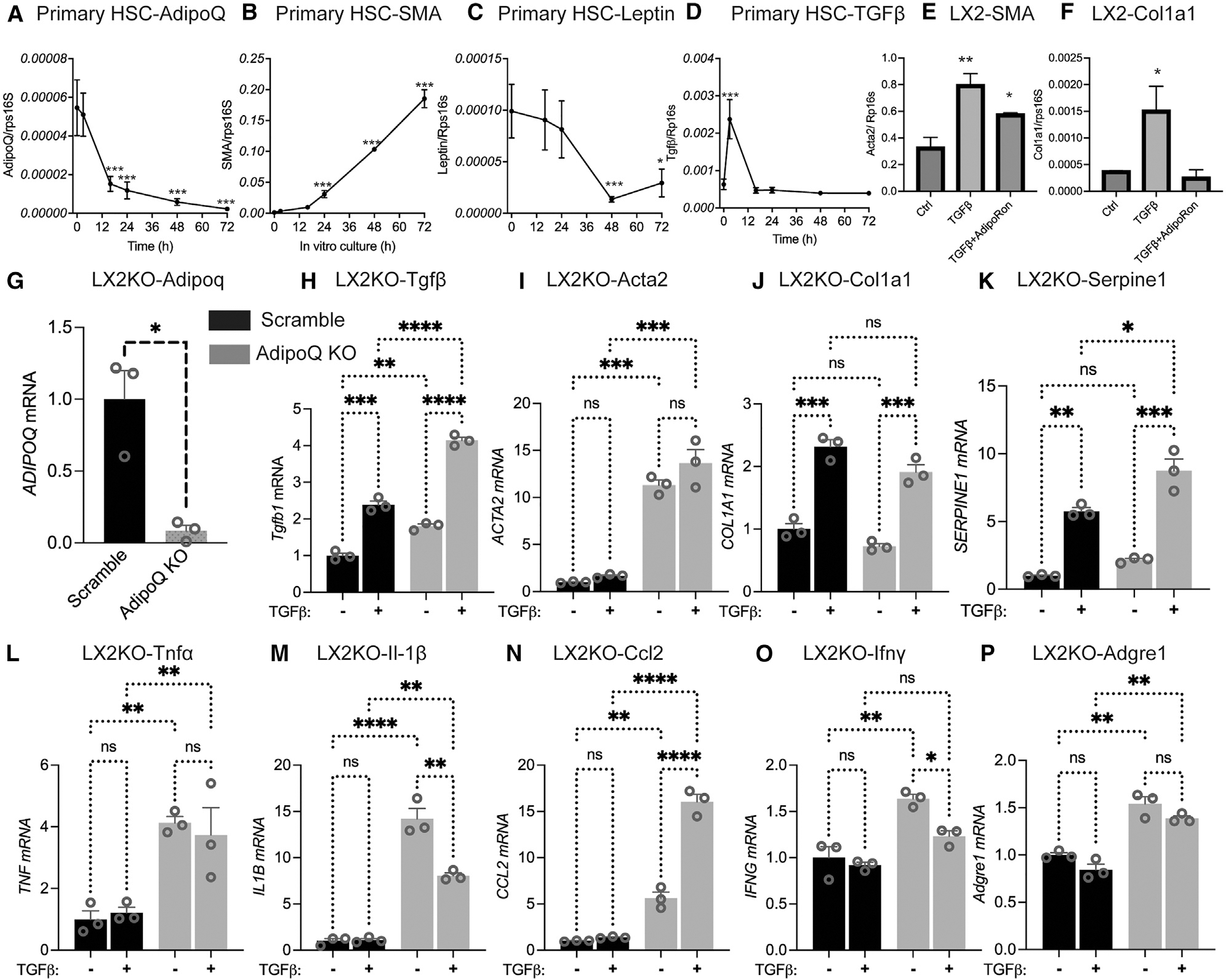
Hepatic stellate cells (HSCs) are key drivers of local fibrosis. Adiponectin, conventionally thought of as an adipokine, is also expressed in quiescent HSCs. However, the impact of its local expression on the progression of liver fibrosis remains unclear. We recently generated a transgenic mouse line (Lrat-rtTA) that expresses the doxycycline-responsive transcriptional activator rtTA under the control of the HSC-specific lecithin retinol acyltransferase (Lrat) promoter, which enables us to specifically and inducibly overexpress or eliminate genes in these cells. The inducible elimination of HSCs protects mice from methionine/choline-deficient (MCD) diet-induced liver fibrosis, confirming their causal involvement in fibrosis development. We generated HSC-specific adiponectin overexpression and null models that demonstrate that HSC-specific adiponectin overexpression dramatically reduces liver fibrosis, whereas HSC-specific adiponectin elimination accelerates fibrosis progression. We identify a local adiponectin-peroxisome proliferator-activated receptor gamma (PPARγ) axis in HSCs that exerts a marked influence on the progression of local fibrosis, independent of circulating adiponectin derived from adipocytes.
肝星状细胞(HSCs)是局部纤维化的关键驱动因素。脂联素,传统上被认为是一种脂肪因子,在静止的肝星状细胞中也有表达。然而,其局部表达对肝纤维化进展的影响仍不清楚。我们最近构建了一种转基因小鼠品系(Lrat-rtTA),该品系在肝星状细胞特异性卵磷脂视黄醇酰基转移酶(Lrat)启动子的控制下表达强力霉素反应性转录激活因子rtTA,这使我们能够在这些细胞中特异性地、可诱导地过表达或消除基因。肝星状细胞的可诱导消除保护小鼠免受蛋氨酸/胆碱缺乏(MCD)饮食诱导的肝纤维化,证实它们在纤维化发展中起因果作用。我们构建了肝星状细胞特异性脂联素过表达和缺失模型,结果表明肝星状细胞特异性脂联素过表达可显著减轻肝纤维化,而肝星状细胞特异性脂联素缺失则加速纤维化进展。我们在肝星状细胞中鉴定出一条局部脂联素-过氧化物酶体增殖物激活受体γ(PPARγ)轴,该轴对局部纤维化的进展有显著影响,独立于源自脂肪细胞的循环脂联素。