Department of Pediatrics, University of Cincinnati College of Medicine, Cincinnati, OH, United States.
Division of Immunobiology, Cincinnati Children's Hospital Medical Center, Cincinnati, OH, United States.
Front Immunol. 2023 Feb 17;14:1095132. doi: 10.3389/fimmu.2023.1095132. eCollection 2023.
Inflammation is a common unifying factor in experimental models of non-alcoholic fatty liver disease (NAFLD) progression. Recent evidence suggests that housing temperature-driven alterations in hepatic inflammation correlate with exacerbated hepatic steatosis, development of hepatic fibrosis, and hepatocellular damage in a model of high fat diet-driven NAFLD. However, the congruency of these findings across other, frequently employed, experimental mouse models of NAFLD has not been studied.
Here, we examine the impact of housing temperature on steatosis, hepatocellular damage, hepatic inflammation, and fibrosis in NASH diet, methionine and choline deficient diet, and western diet + carbon tetrachloride experimental models of NAFLD in C57BL/6 mice.
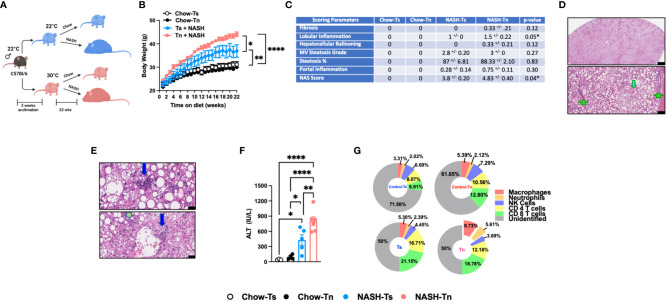
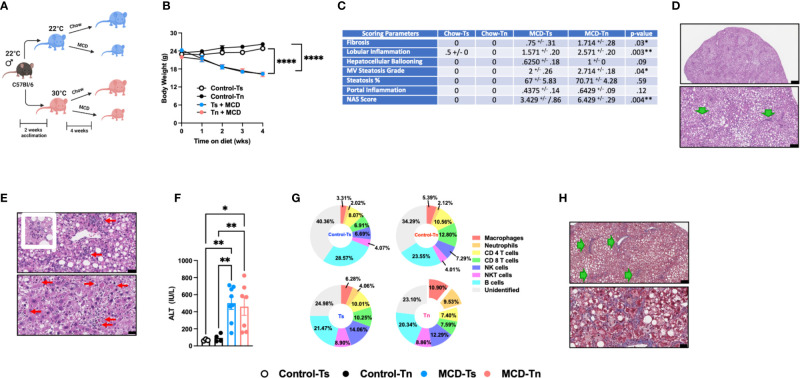
We show that differences relevant to NAFLD pathology uncovered by thermoneutral housing include: (i) augmented NASH diet-driven hepatic immune cell accrual, exacerbated serum alanine transaminase levels and increased liver tissue damage as determined by NAFLD activity score; (ii) augmented methionine choline deficient diet-driven hepatic immune cell accrual and increased liver tissue damage as indicated by amplified hepatocellular ballooning, lobular inflammation, fibrosis and overall NAFLD activity score; and (iii) dampened western diet + carbon tetrachloride driven hepatic immune cell accrual and serum alanine aminotransferase levels but similar NAFLD activity score.
Collectively, our findings demonstrate that thermoneutral housing has broad but divergent effects on hepatic immune cell inflammation and hepatocellular damage across existing experimental NAFLD models in mice. These insights may serve as a foundation for future mechanistic interrogations focused on immune cell function in shaping NAFLD progression.
炎症是实验性非酒精性脂肪性肝病(NAFLD)进展模型中的常见统一因素。最近的证据表明,肝脏炎症的住房温度驱动变化与高脂肪饮食驱动的 NAFLD 模型中肝脂肪变性加剧、肝纤维化发展和肝细胞损伤相关。然而,这些发现与其他常用的 NAFLD 实验小鼠模型是否一致尚未研究。
在这里,我们研究了住房温度对 NASH 饮食、蛋氨酸和胆碱缺乏饮食以及西方饮食+四氯化碳实验性 NAFLD 模型中 C57BL/6 小鼠的脂肪变性、肝细胞损伤、肝炎症和纤维化的影响。
我们表明,通过热中性住房发现的与 NAFLD 病理学相关的差异包括:(i)增加 NASH 饮食驱动的肝脏免疫细胞积累,加剧血清丙氨酸氨基转移酶水平,并通过 NAFLD 活动评分增加肝脏组织损伤;(ii)增加蛋氨酸胆碱缺乏饮食驱动的肝脏免疫细胞积累和增加肝脏组织损伤,如肝细胞气球样变、小叶炎症、纤维化和整体 NAFLD 活动评分所示;和(iii)减弱西方饮食+四氯化碳驱动的肝脏免疫细胞积累和血清丙氨酸氨基转移酶水平,但 NAFLD 活动评分相似。
总的来说,我们的发现表明,热中性住房对现有的实验性 NAFLD 小鼠模型中的肝脏免疫细胞炎症和肝细胞损伤具有广泛但不同的影响。这些见解可以为未来以免疫细胞功能为重点的机制研究提供基础,以研究 NAFLD 的进展。