Kozielczyk Marek, Mencel Kinga, Kowalczyk Jakub, Paczkowska Marta
Faculty of Civil and Transport Engineering, Institute of Machines and Motor Vehicles, Poznan University of Technology, 60-965 Poznan, Poland.
Faculty of Mechanical Engineering, Institute of Material Technology, Poznan University of Technology, 60-965 Poznan, Poland.
Materials (Basel). 2024 Dec 26;18(1):44. doi: 10.3390/ma18010044.
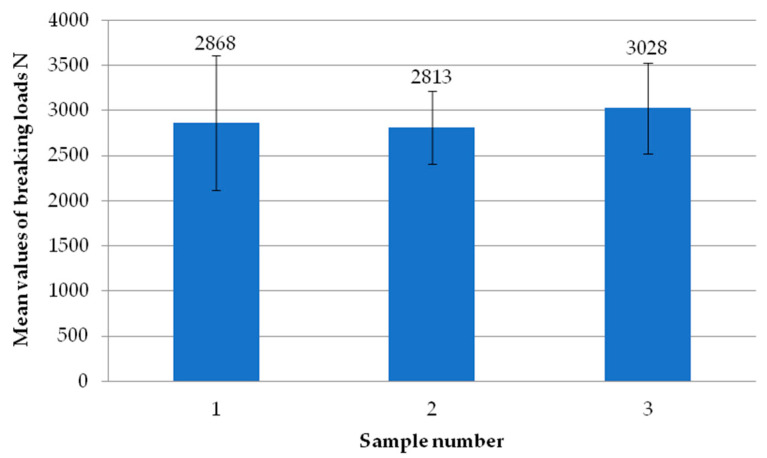
In the study of structural materials, the analysis of fracture and deformation resistance plays an important role, particularly in materials widely used in the construction industry, such as poly(vinyl chloride) (PVC). PVC is a popular material used, among others, in the manufacture of window profiles, doors, pipes, and many other structural components. The aim of this research was to define the influence of the degree of milling of the glass-fibre-reinforced composite on the strength of the window frame welds, and in the next step, to propose new welding parameters to obtain sufficient strength properties that allow reducing the cost of the technological welding operation. During the tests, it was found that the average failure load of the composite samples was highest at a milling depth of 1 mm and lowest at 6 mm. Up to a depth of 1 mm, the values of destructive loads show an increasing trend, while above this depth, a decreasing trend. A clear reduction in strength was observed when milling to a depth of 1.5 mm, which is related to material discontinuity and the lack of a visible weld joint caused by milling too deep. The differences in average failure loads between the samples of 0 mm, 0.5 mm, and 1 mm milling are minimal.
在结构材料的研究中,断裂和抗变形分析起着重要作用,特别是在建筑行业广泛使用的材料中,如聚氯乙烯(PVC)。PVC是一种常用材料,尤其用于制造窗户型材、门、管道和许多其他结构部件。本研究的目的是确定玻璃纤维增强复合材料的铣削程度对窗框焊缝强度的影响,接下来,提出新的焊接参数以获得足够的强度性能,从而降低工艺焊接操作的成本。在测试过程中发现,复合材料样品的平均破坏载荷在铣削深度为1mm时最高,在6mm时最低。在1mm深度以内,破坏载荷值呈上升趋势,而超过该深度则呈下降趋势。当铣削深度达到1.5mm时,强度明显降低,这与材料的不连续性以及铣削过深导致看不见焊缝有关。铣削深度为0mm、0.5mm和1mm的样品之间平均破坏载荷的差异最小。