Jeon Sohyun, Lee Heaji, Kim Sun-Yeou, Lee Choong-Hwan, Lim Yunsook
Department of Food and Nutrition, Kyung Hee University, 26 Kyunghee-Daero, Dongdaemun-Gu, Seoul 02447, Republic of Korea.
College of Pharmacy, Gachon University, Incheon 21936, Republic of Korea.
Nutrients. 2024 Dec 24;17(1):7. doi: 10.3390/nu17010007.
BACKGROUND/OBJECTIVES: Type 2 diabetes mellitus (T2DM) is considered a serious risk to public health since its prevalence is rapidly increasing worldwide despite numerous therapeutics. Insulin resistance in T2DM contributes to chronic inflammation and other metabolic abnormalities that generate fat accumulation in the liver, eventually leading to the progression of metabolic dysfunction-associated fatty liver disease (MAFLD). Recently, the possibility that microbial-derived metabolites may alleviate MAFLD through enterohepatic circulation has emerged, but the underlying mechanism remains unclear. In this research, we utilized metabolites obtained from the fermentation of guava leaf extract, which is well-known for its antidiabetic activity, to investigate their effects and mechanisms on MAFLD.
Diabetes was induced by a high-fat diet and streptozotocin injection (80 mg/kg body weight) twice in mice. Subsequently, mice whose fasting blood glucose levels were measured higher than 300 mg/dL were administered with metabolites of (LF) (50 mg/kg/day) or guava leaf extract fermented by (GFL) (50 mg/kg/day) by gavage for 15 weeks.
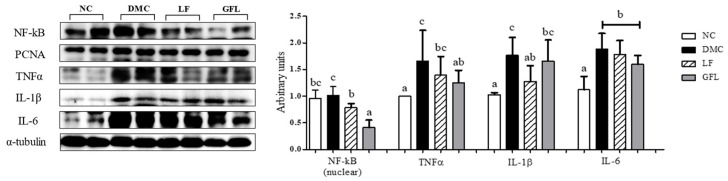
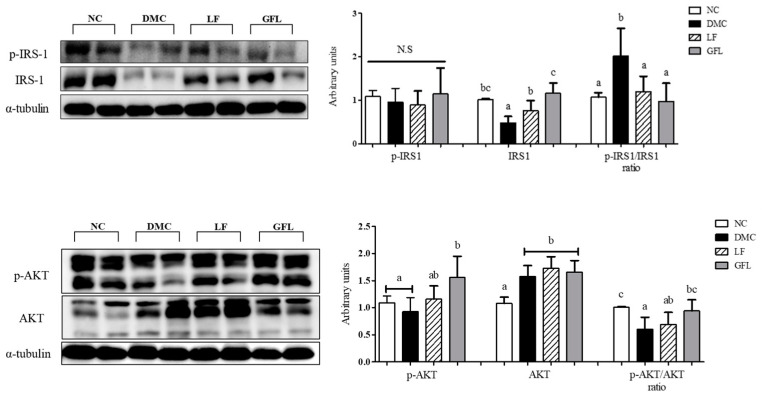
GFL supplementation mitigated hyperglycemia and hepatic insulin resistance. Moreover, GFL regulated abnormal hepatic histological changes and lipid profiles in diabetic mice. Furthermore, GFL enhanced energy metabolism by activating the sirtuin1 (SIRT1)/proliferator-activated receptor γ coactivator 1α (PGC1α)/peroxisome proliferator-activated receptor (PPAR)-α pathway in diabetic mice. Meanwhile, GFL supplementation suppressed hepatic inflammation in diabetic mice.
Taken together, the current study elucidated that GFL could be a potential therapeutic to ameliorate hyperglycemia and hepatic steatosis by improving SIRT1/PGC-1α/ PPAR-α-related energy metabolism in T2DM.
背景/目的:2型糖尿病(T2DM)被认为是对公众健康的严重威胁,因为尽管有多种治疗方法,但其在全球的患病率仍在迅速上升。T2DM中的胰岛素抵抗会导致慢性炎症和其他代谢异常,进而导致肝脏脂肪堆积,最终导致代谢功能障碍相关脂肪性肝病(MAFLD)的进展。最近,微生物衍生代谢产物可能通过肠肝循环减轻MAFLD的可能性已经出现,但其潜在机制仍不清楚。在本研究中,我们利用从番石榴叶提取物发酵中获得的代谢产物,该提取物以其抗糖尿病活性而闻名,来研究它们对MAFLD的影响及其机制。
通过高脂饮食和链脲佐菌素注射(80mg/kg体重)诱导小鼠患糖尿病两次。随后,对空腹血糖水平高于300mg/dL的小鼠通过灌胃给予罗伊氏乳杆菌发酵的番石榴叶代谢产物(LF)(50mg/kg/天)或罗伊氏乳杆菌发酵的番石榴叶提取物(GFL)(50mg/kg/天),持续15周。
补充GFL可减轻高血糖和肝脏胰岛素抵抗。此外,GFL调节了糖尿病小鼠肝脏组织学变化和脂质谱异常。此外,GFL通过激活糖尿病小鼠的沉默信息调节因子1(SIRT1)/过氧化物酶体增殖物激活受体γ共激活因子1α(PGC1α)/过氧化物酶体增殖物激活受体(PPAR)-α途径增强能量代谢。同时,补充GFL可抑制糖尿病小鼠的肝脏炎症。
综上所述,本研究阐明了GFL可能是一种潜在的治疗药物,通过改善T2DM中SIRT1/PGC-1α/PPAR-α相关的能量代谢来改善高血糖和肝脏脂肪变性。