Zouridis Andreas, Kashif Ammara, Darwish Ahmed, Pappa Christina, Ferrari Federico, Smyth Sarah Louise, Sadeghi Negin, Sattar Alisha, Damato Stephen, Abdalla Mostafa, Kehoe Sean, Addley Susan, Soleymani Majd Hooman
Oxford University Hospitals NHS Foundation Trust, Oxford OX3 7LE, UK.
Department of Clinical and Experimental Sciences, University of Brescia, 25136 Brescia, Italy.
Cancers (Basel). 2025 Jan 3;17(1):127. doi: 10.3390/cancers17010127.
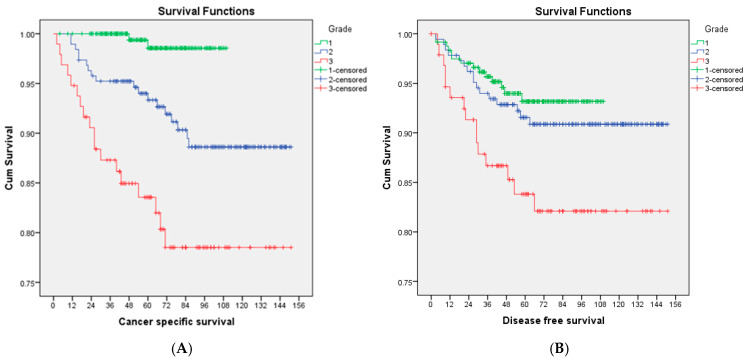
Although grade is a well-recognised prognostic factor for endometrioid endometrial cancer (EEC), in more studies grade 1 (G1) and grade 2 (G2) EEC are combined and compared together with grade 3 (G3) tumours. The aim of our study is to separately investigate the outcomes, prognostic factors and recurrence patterns of G2 EEC and whether the differentiation between G1 and G2 EEC is clinically useful. we retrospectively reviewed 523 patients with EEC treated with primary surgery over a decade (March 2010-January 2020) at Oxford University Hospitals NHS Trust, focusing on those with G2 disease. Patients with G2 EEC had worse 5-year cancer-specific survival (93.3% vs. 98.5%, < 0.01) compared to patients with G1 EEC, but a favourable prognosis compared to G3 EEG, both in terms of disease-free survival (91.6 vs. 83.8%, = 0.04) and cancer-specific survival (93.3% vs. 78.5%, < 0.01). Both stage and grade are independent risk factors for cancer-specific mortality in EEC. Cervical stromal involvement, parametrial involvement and distant metastatic disease are all independent risk factors for cancer-related mortality in G2 ECC. Only 12.5% of recurrences of G2 EEC were diagnosed with examination in routine follow up in asymptomatic patients. our results suggest that the grading system should continue to differentiate G1 EEC and G2 EEC for better prognosis interpretation.
尽管分级是子宫内膜样子宫内膜癌(EEC)公认的预后因素,但在更多研究中,1级(G1)和2级(G2)EEC被合并在一起,并与3级(G3)肿瘤进行比较。我们研究的目的是分别调查G2 EEC的结局、预后因素和复发模式,以及G1和G2 EEC之间的分化在临床上是否有用。我们回顾性分析了牛津大学医院国民保健服务信托基金在十年间(2010年3月至2020年1月)接受初次手术治疗的523例EEC患者,重点关注G2疾病患者。与G1 EEC患者相比,G2 EEC患者的5年癌症特异性生存率更差(93.3%对98.5%,<0.01),但与G3 EEC相比,在无病生存率(91.6%对83.8%,=0.04)和癌症特异性生存率(93.3%对78.5%,<0.01)方面预后较好。分期和分级都是EEC中癌症特异性死亡率的独立危险因素。宫颈间质受累、宫旁组织受累和远处转移疾病都是G2 ECC中癌症相关死亡率的独立危险因素。G2 EEC复发患者中只有12.5%是在无症状患者的常规随访检查中被诊断出来的。我们的结果表明,分级系统应继续区分G1 EEC和G2 EEC,以便更好地解释预后。