Haby Michelle M, Reveiz Ludovic, Thomas Rebekah, Jordan Helen
Department of Chemical and Biological Sciences, Faculty of Biological and Health Sciences, Universidad de Sonora, Hermosillo, Mexico.
Melbourne School of Population and Global Health, The University of Melbourne, Parkville, Australia.
J Public Health Policy. 2025 Mar;46(1):193-210. doi: 10.1057/s41271-024-00535-9. Epub 2025 Jan 11.
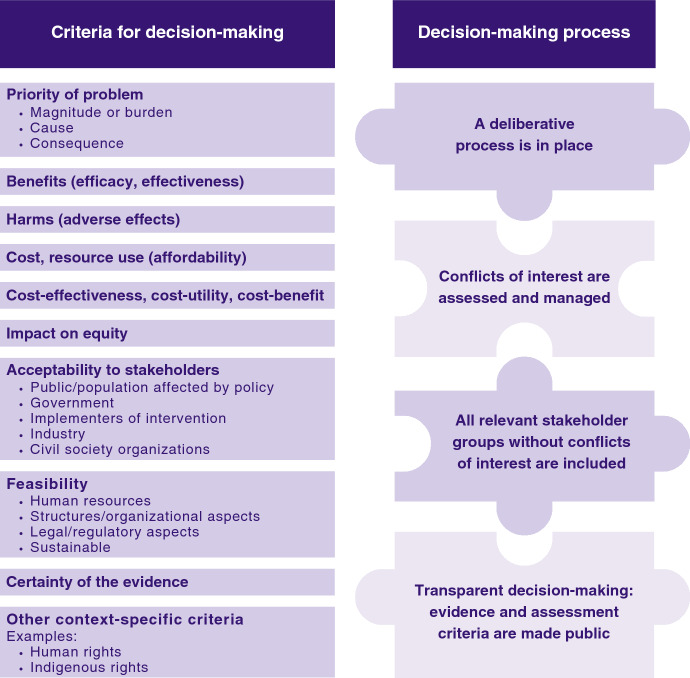
Evidence-informed policymaking emphasizes that policy decisions should be informed by the best available evidence from research and follow a systematic and transparent approach. For public health policymaking we can learn from existing practices of transparent, evidence-informed decision-making for clinical practice, medicines, and medical technology. We review existing evidence-to-decision frameworks, as well as frameworks and theories for policymaking to address the political dimension of policymaking, and use this analysis to propose an integrated framework to guide evidence-informed policymaking. The framework includes nine decision-making criteria and allows for the addition of other context-specific criteria. It also emphasizes elements of the decision-making process that can give greater legitimacy, fairness, and transparency to the policy decision, such as the use of deliberative processes and assessment of conflicts of interest. We offer the framework as a tool to help government policy makers use evidence in a structured and transparent way when making decisions about public health policy options.
循证决策强调政策决策应以研究中可得的最佳证据为依据,并遵循系统且透明的方法。对于公共卫生决策而言,我们可以借鉴临床实践、药品及医疗技术领域现有的透明、循证决策实践经验。我们回顾了现有的证据到决策框架,以及用于解决决策政治维度的决策框架和理论,并利用这一分析结果提出一个综合框架,以指导循证决策。该框架包含九个决策标准,并允许添加其他特定情境标准。它还强调决策过程中的一些要素,这些要素能够使政策决策更具合法性、公平性和透明度,比如采用审议程序以及评估利益冲突。我们提供该框架作为一种工具,以帮助政府政策制定者在对公共卫生政策选项进行决策时,以结构化且透明的方式运用证据。