Tang Yiman, Wang Juan, Qiu Lixin, Yu Huajie
4th Division, Peking University School and Hospital of Stomatology & National Center for Stomatology & National Clinical Research Center for Oral Diseases & National Engineering Research Center of Oral Biomaterials and Digital Medical Devices, No. 22, Zhongguancun South Avenue, Haidian District, Beijing, 100081, People's Republic of China.
BMC Oral Health. 2025 Jan 11;25(1):61. doi: 10.1186/s12903-025-05426-3.
The stability of soft and hard tissues surrounding the implant is not only a matter of aesthetics, but also affects the long-term stability of the implant. The present study was to explore the influence of buccal mucosa width/height (W/H) ratio, emergence profile and buccal bone width on peri-implant soft and hard tissue changes in the posterior region.
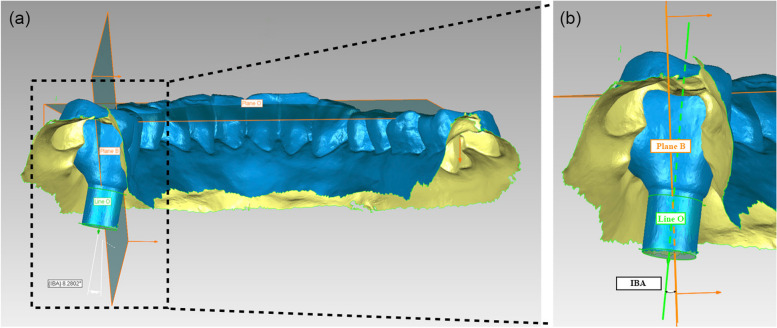
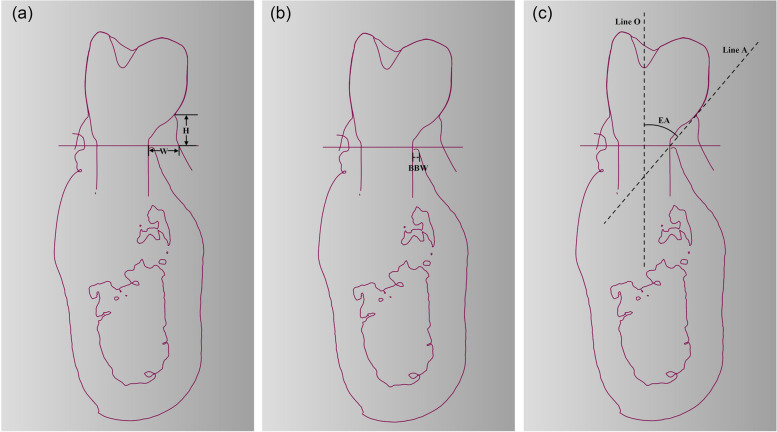
Fifty-eight posterior implant restoration cases were recruited in this study. Evaluations were performed at the time of restoration placement (T0), and 1 year later (T1). Buccal mucosa width (BMW), buccal bone width (BBW), implant buccal inclination angle, and emergence angle were evaluated. The variables that may affect buccal mucosa recession (MR) as well as vertical bone loss (VBL) were analyzed.
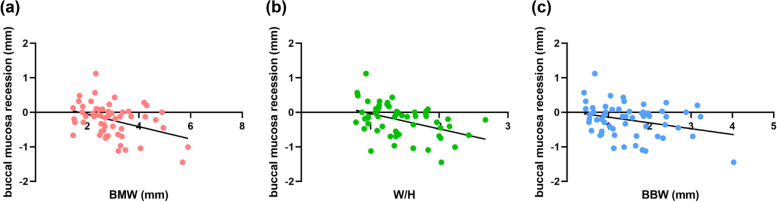
The BMW at baseline was 2.93 ± 1.01 mm. The BBW at baseline was 1.50 ± 0.82 mm. The buccal mucosa W/H ratio at 1 year (1.23 ± 0.38) was significantly lower than that at baseline (1.42 ± 0.45). Buccal MR was - 0.22 ± 0.47 mm while VBL was 0.81 ± 0.80 mm. The correlation between MR and initial BMW (r=-0.381), initial W/H ratio (r=-0.422), BBW (r=-0.290) was statistically significant. The correlation between VBL and initial BMW (r=-0.421), initial W/H ratio (r=-0.305), implant buccal inclination angle (r = 0.507), BBW (r=-0.556) was statistically significant.
Within the scope of this study, implant sites in the posterior region presenting a thin BMW, a thin BBW, and a small W/H ratio are more prone to exhibit buccal mucosa recession and vertical bone loss.
种植体周围软硬组织的稳定性不仅关乎美观,还会影响种植体的长期稳定性。本研究旨在探讨颊侧黏膜宽度/高度(W/H)比值、龈缘轮廓及颊侧骨宽度对后牙区种植体周围软硬组织变化的影响。
本研究纳入58例后牙种植修复病例。在修复体植入时(T0)及1年后(T1)进行评估。评估颊侧黏膜宽度(BMW)、颊侧骨宽度(BBW)、种植体颊侧倾斜角度及龈缘角度。分析可能影响颊侧黏膜退缩(MR)以及垂直骨吸收(VBL)的变量。
基线时BMW为2.93±1.01mm。基线时BBW为1.50±0.82mm。1年时颊侧黏膜W/H比值(1.23±0.38)显著低于基线时(1.42±0.45)。颊侧MR为-0.22±0.47mm,而VBL为0.81±0.80mm。MR与初始BMW(r=-0.381)、初始W/H比值(r=-0.422)、BBW(r=-0.290)之间的相关性具有统计学意义。VBL与初始BMW(r=-0.421)、初始W/H比值(r=-0.305)、种植体颊侧倾斜角度(r=0.507)、BBW(r=-0.556)之间的相关性具有统计学意义。
在本研究范围内,后牙区种植位点若呈现BMW薄、BBW薄及W/H比值小的情况,则更易出现颊侧黏膜退缩和垂直骨吸收。