Dragon Anna Christina, Bonifacius Agnes, Lienenklaus Stefan, Verboom Murielle, Gerhards Jan-Phillipp, Ius Fabio, Hinze Christian, Hudecek Michael, Figueiredo Constanca, Blasczyk Rainer, Eiz-Vesper Britta
Institute of Transfusion Medicine and Transplant Engineering, Hannover Medical School, 30625 Hannover, NI, Germany; nextGENERATION Medical Scientist Program, Dean's Office for Academic Career Development, Hannover Medical School, 30625 Hannover, NI, Germany.
Institute of Laboratory Animal Science, Hannover Medical School, 30625 Hannover, NI, Germany.
Mol Ther. 2025 Mar 5;33(3):1031-1047. doi: 10.1016/j.ymthe.2025.01.009. Epub 2025 Jan 11.
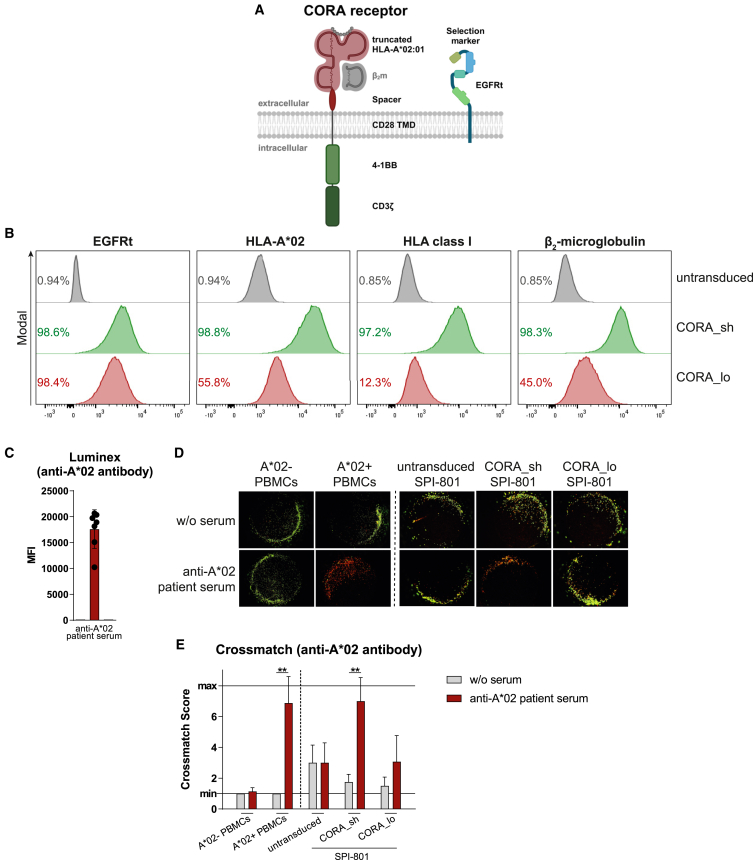
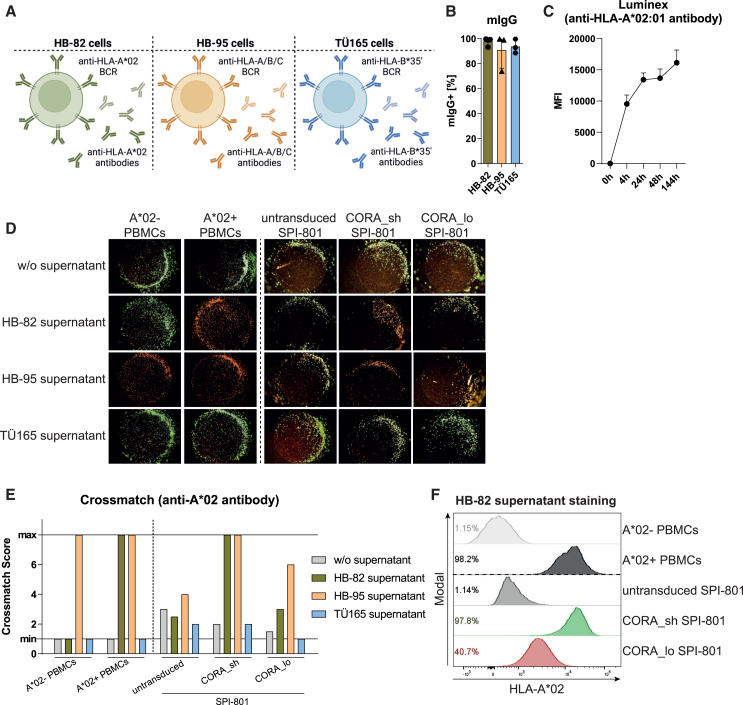
Antibody-mediated rejection (AMR) remains a major complication after solid organ transplantation (SOT). Current treatment options are inefficient and result in drastic impairment of the general immunity. To selectively eliminate responsible alloreactive B cells characterized by anti-donor-HLA B cell receptors (BCRs), we generated T cells overcoming rejection by antibodies (CORA-Ts) engineered with a novel chimeric receptor comprising a truncated donor-HLA molecule as antigen recognition domain. As proof-of-concept, CORA receptors based on HLA-A∗02 were developed. In co-cultures with anti-HLA-A∗02 B cell lines, CORA-Ts were specifically activated, released pro-inflammatory mediators, and exhibited strong cytotoxicity resulting in an effective reduction of anti-HLA-A∗02 antibody release. Significant reduction of growth of an anti-HLA-A∗02 B cell line could be confirmed using an in vivo mouse model. Modification of the CORA receptor effectively abrogated T cell binding, thereby avoiding T cell sensitization. Additionally, using CRISPR-Cas9-mediated knockout of the FKBP12 gene, CORA-Ts were able to resist immunosuppressive treatment with tacrolimus, thereby allowing high efficiency in transplant patients. Our results demonstrate that CORA-Ts are able to specifically eliminate alloreactive, anti-HLA B cells, thus selectively preventing anti-HLA antibody release even under immunosuppressive conditions. This suggests CORA-Ts as potent approach to combat AMR and improve long-term graft survival in SOT patients while preserving their overall B cell immunity.
抗体介导的排斥反应(AMR)仍然是实体器官移植(SOT)后的主要并发症。目前的治疗方案效率低下,会导致全身免疫力严重受损。为了选择性清除以抗供体 HLA B 细胞受体(BCR)为特征的同种异体反应性 B 细胞,我们构建了一种通过抗体克服排斥反应的 T 细胞(CORA-Ts),其工程化的新型嵌合受体包含一个截短的供体 HLA 分子作为抗原识别结构域。作为概念验证,开发了基于 HLA-A∗02 的 CORA 受体。在与抗 HLA-A∗02 B 细胞系的共培养中,CORA-Ts 被特异性激活,释放促炎介质,并表现出强烈的细胞毒性,从而有效减少抗 HLA-A∗02 抗体的释放。使用体内小鼠模型可以证实抗 HLA-A∗02 B 细胞系的生长显著减少。CORA 受体的修饰有效消除了 T 细胞结合,从而避免了 T 细胞致敏。此外,通过 CRISPR-Cas9 介导敲除 FKBP12 基因,CORA-Ts 能够抵抗他克莫司的免疫抑制治疗,从而在移植患者中实现高效治疗。我们的结果表明,CORA-Ts 能够特异性清除同种异体反应性、抗 HLA B 细胞,从而即使在免疫抑制条件下也能选择性地防止抗 HLA 抗体的释放。这表明 CORA-Ts 是对抗 AMR 和提高 SOT 患者长期移植物存活率同时保留其整体 B 细胞免疫力的有效方法。