Franco Israel, Schwartz Marc, Cline Kevin, Glazier David, Patel Anand
Department of Urology, Yale School of Medicine, New Haven, Connecticut, USA.
MS Biostatistics LLC, Clermont, Florida, USA.
Low Urin Tract Symptoms. 2025 Jan;17(1):e70004. doi: 10.1111/luts.70004.
To evaluate possible predictors of elevated postvoid residual volume (PVR) following onabotulinumtoxinA administration in patients with idiopathic overactive bladder (OAB), a condition that may include urinary urgency, frequency, and nocturia, without any identifiable cause or underlying neurological or metabolic condition.
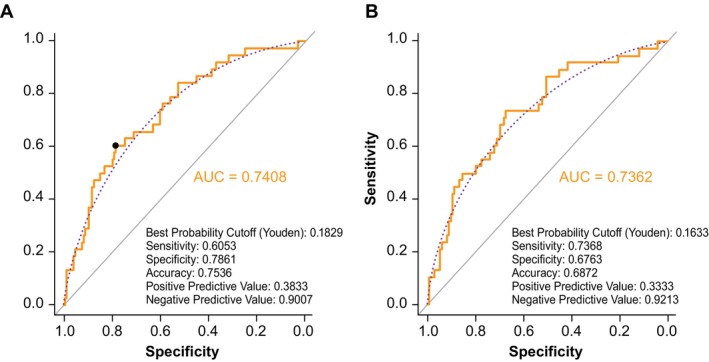
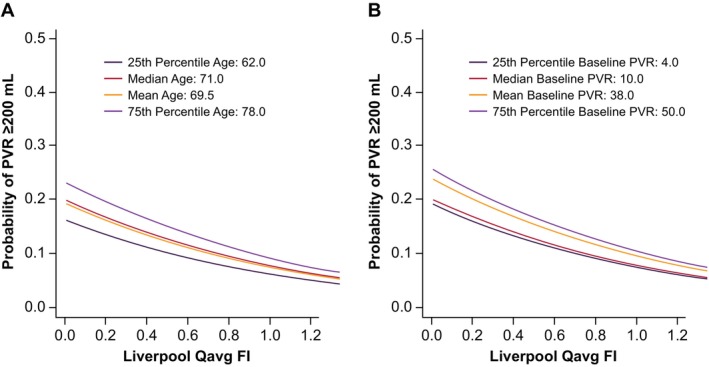
Adults who had been treated with 100-200 U onabotulinumtoxinA for OAB and had previous failure of other OAB treatments were identified by retrospective review of medical chart data from three urology clinics in the United States treating patients with a variety of urological conditions. A total of 211 patients were allocated to cohorts based on posttreatment PVR < 200 mL (n = 173) and ≥ 200 mL (n = 38). Logistic regression analyses were performed to evaluate potential predictors of posttreatment PVR ≥ 200 mL, including pretreatment peak urine flow rate (Qmax), average urine flow rate (Qavg), and Modified Liverpool Qmax and Qavg flow index (FI), and to determine whether patient age and baseline PVR were associated with the likelihood of PVR ≥ 200 mL. Patients were excluded if symptoms of OAB were secondary to a neurological condition, they had a PVR > 200 mL within 2 weeks prior to the index therapy or had been treated with other botulinum toxin formulations for a urinary condition.
In the predictor analyses, neither Qmax nor Qavg alone was a likely predictor. Odds ratios of PVR ≥ 200 mL for Modified Liverpool Qmax FI and Qavg were 0.30 (95% CI: 0.08-0.91; p = 0.0488) and 0.07 (95% CI 0.01-0.40; p = 0.0045), respectively. When patient age and baseline PVR were incorporated into the analyses, results suggested that Qmax, Qavg, Qmax FI, and Qavg FI, as well as increased age and baseline PVR, were likely predictors of elevated posttreatment PVR.
Patients who are older, have high pretreatment PVR values, and have lower pretreatment urine flow indexes and flows may be at increased risk of developing elevated PVR after receiving onabotulinumtoxinA treatment for OAB.
评估在特发性膀胱过度活动症(OAB)患者中,注射A型肉毒毒素后残余尿量(PVR)升高的可能预测因素。OAB是一种可能包括尿急、尿频和夜尿症的病症,无任何可识别的病因或潜在的神经或代谢疾病。
通过回顾美国三家治疗各种泌尿系统疾病的泌尿外科诊所的病历数据,确定曾接受100 - 200 U A型肉毒毒素治疗OAB且之前其他OAB治疗失败的成年人。根据治疗后PVR < 200 mL(n = 173)和≥200 mL(n = 38)将总共211名患者分配到不同队列。进行逻辑回归分析以评估治疗后PVR≥200 mL的潜在预测因素,包括治疗前最大尿流率(Qmax)、平均尿流率(Qavg)以及改良利物浦Qmax和Qavg流率指数(FI),并确定患者年龄和基线PVR是否与PVR≥200 mL的可能性相关。如果OAB症状继发于神经系统疾病、在索引治疗前2周内PVR > 200 mL或曾接受其他肉毒毒素制剂治疗泌尿系统疾病,则将患者排除。
在预测因素分析中,单独的Qmax和Qavg都不太可能是预测因素。改良利物浦Qmax FI和Qavg的PVR≥200 mL的优势比分别为0.30(95% CI:0.08 - 0.91;p = 0.0488)和0.07(95% CI 0.01 - 0.40;p = 0.0045)。当将患者年龄和基线PVR纳入分析时,结果表明Qmax、Qavg、Qmax FI和Qavg FI,以及年龄增加和基线PVR升高,可能是治疗后PVR升高的预测因素。
年龄较大、治疗前PVR值较高、治疗前尿流指数和尿流较低的患者,在接受A型肉毒毒素治疗OAB后发生PVR升高的风险可能增加。