Thomas Davis C, Kodaganallur Pitchumani Priyanka, Barmak Abdul Basir, Talluri Sandeep, Jiang Weiran
Center for Temporomandibular Disorders and Orofacial Pain, Department of Diagnostic Sciences, Rutgers School of Dental Medicine, Newark, NJ 07102, USA.
Department of Periodontics, University of Iowa College of Dentistry and Dental Clinics, Iowa City, IA 52241, USA.
J Oral Facial Pain Headache. 2024 Sep;38(3):15-31. doi: 10.22514/jofph.2024.023. Epub 2024 Sep 12.
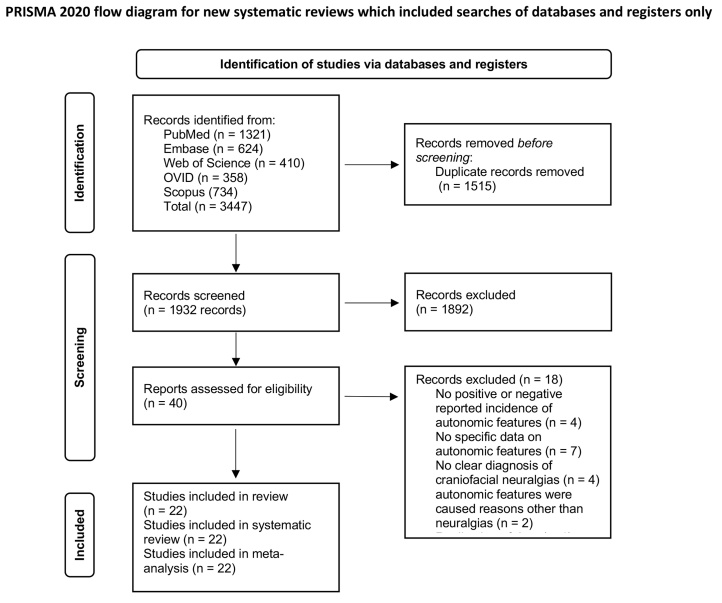
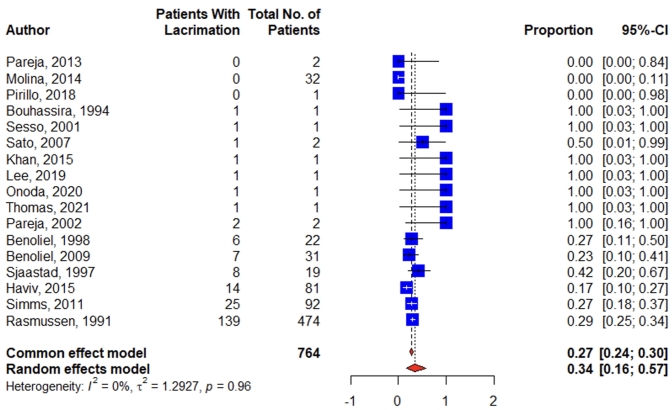
The aim of the study is to describe the severity, temporal characteristics, and types of autonomic features as they relate to the characteristics of pain of the neuralgias. Also, to describe, based on literature, how these autonomic features can affect the treatment outcomes of patients with craniofacial neuralgias. We carried out a literature search using five databases, PubMed, Embase, OVID, Scopus and Web of Science. The search was executed in accordance with Preferred Reporting Items for Systematic Reviews and Meta-Analyses (PRISMA). The protocol for this systematic review and meta-analysis was registered on PROSPERO CRD42021235319. 40% of all patients with craniofacial neuralgias had at least one autonomic feature. Out of the craniofacial neuralgias, trigeminal neuralgia was the most reported, with lacrimation being the most prevalent concomitant autonomic feature. There was also differences in the occurrence of the autonomic features dependent on which branch of a nerve such as the trigeminal nerve, was afflicted. When trigeminal neuralgia is excluded, the rest of the craniofacial neuralgias had reported autonomic features 28% of the pain events. (95% Confidence Interval: 2-90%). Contrary to the conventional belief, we found certain autonomic features to be more predominant than others, in specific craniofacial neuralgias. The prevalence of the autonomic features for all craniofacial neuralgias in the descending order is as follows, lacrimation, conjunctival injection, nasal congestion, rhinorrhea, flushing, edema/swelling, salivation, ptosis and sweating. With trigeminal neuralgia, the most common autonomic feature was lacrimation, and the least common was nasal congestion.
本研究的目的是描述自主神经特征的严重程度、时间特征和类型,及其与神经痛疼痛特征的关系。此外,基于文献描述这些自主神经特征如何影响颅面部神经痛患者的治疗结果。我们使用五个数据库进行了文献检索,即PubMed、Embase、OVID、Scopus和Web of Science。检索按照系统评价和Meta分析的首选报告项目(PRISMA)进行。本系统评价和Meta分析的方案已在PROSPERO CRD42021235319上注册。40%的颅面部神经痛患者至少有一项自主神经特征。在颅面部神经痛中,三叉神经痛的报告最多,流泪是最常见的伴随自主神经特征。自主神经特征的出现也因受累神经(如三叉神经)的分支不同而有所差异。排除三叉神经痛后,其余颅面部神经痛患者报告有自主神经特征的疼痛事件占28%(95%置信区间:2%-90%)。与传统观念相反,我们发现在特定的颅面部神经痛中,某些自主神经特征比其他特征更突出。所有颅面部神经痛自主神经特征的患病率从高到低依次为:流泪、结膜充血、鼻塞、流涕、潮红、水肿/肿胀、流涎、上睑下垂和出汗。对于三叉神经痛,最常见的自主神经特征是流泪,最不常见的是鼻塞。