Nure Misra, Dechasa Abebe, Ifa Meseret, Bedane Jamel
Department of Nursing, College of Health Science, Salale University, Fiche, Ethiopia.
Department of Nursing, College of medicine and Health Science, Ambo University, Ambo, Ethiopia.
Int J Nurs Stud Adv. 2024 Dec 10;8:100281. doi: 10.1016/j.ijnsa.2024.100281. eCollection 2025 Jun.
Catheter associated urinary tract infection is the most common nosocomial infection that is associated with serious systemic infections that imply prolonged hospital stay, financial costs for hospitalization, and increased morbidity, and mortality. There is a dearth of evidence related to nurse's knowledge and practice of catheter associated urinary tract infection prevention in Oromia, Ethiopia. Determining the nurse's knowledge and preventive practice of catheter associated urinary tract infections and their associated factors is important for developing strategies of its prevention.
To assess the knowledge and practice of catheter associated urinary tract infection prevention and its associated factors among nurses working at public hospitals in the Oromia region, Ethiopia.
Institution-based cross-sectional study was conducted among 422 nurses working at public hospitals in the Oromia, Ethiopia. The respondents were selected by a simple random sampling technique. A structured self-administered questionnaire was used to collect the data. Data analysis was done to describe the knowledge and practice of catheter associated urinary tract infection prevention and its associated factors.
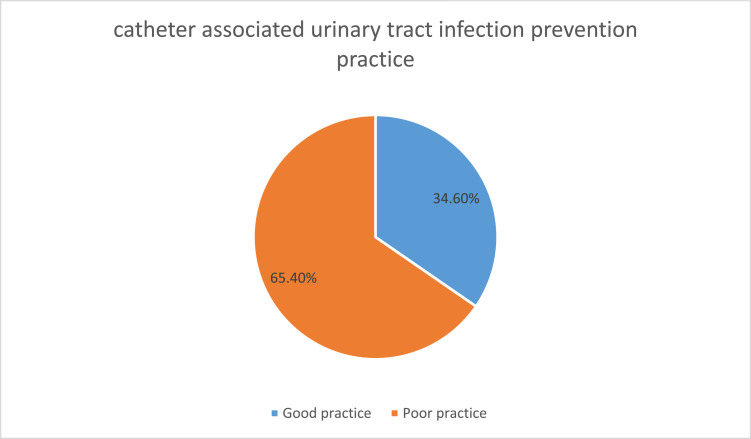
Of the 422 nurses surveyed, 408 (96.7 %) returned their questionnaire. The result shows that 63.5 % of nurses had adequate knowledge while 34.6 % of them had good practice of catheter associated urinary tract infection prevention. In-service training (adjusted odds ratio: 1.862, 95 % confidence interval (1.11-3.14)), working in an intensive care unit (adjusted odds ratio: 3.148, 95 % confidence interval (1.13-8.75)) perceived availability of library (adjusted odds ratio: 2.97, 95 % confidence interval (1.78-4.96)) and access to guideline (adjusted odds ratio: 2.78, 95 % confidence interval (1.49-5.16)) were factors found to be statistically significantly associated with the nurses' knowledge. Years of experience (adjusted odds ratio: 3.63, 95 % confidence interval (1.55-8.47)), working unit (operating theatre room) (adjusted odds ratio: 2.37, 95 % confidence interval (1.08-5.19)), in-service training (adjusted odds ratio: 1.905, 95 % confidence interval (1.21-3.24)), internet access (adjusted odds ratio: 5.82, 95 % confidence interval (2.45-11.30)) and favourable attitude (adjusted odds ratio: 1.89, 95 % confidence interval (1.07-3.15) were statistically significantly associated with the nurses practice of catheter associated urinary tract infection prevention.
More than one-third of the respondents have inadequate knowledge while less than two-thirds of the respondents have inadequate practices which suggests the presence of knowledge to practice gap in catheter associated urinary tract infection prevention. In-service training, nurse's current working unit, and the presence of a guideline were significantly associated with both the knowledge and practice of nurses toward catheter associated urinary tract infection prevention.
导尿管相关尿路感染是最常见的医院感染,与严重的全身感染相关,这意味着住院时间延长、住院费用增加以及发病率和死亡率上升。在埃塞俄比亚奥罗米亚地区,缺乏与护士关于预防导尿管相关尿路感染的知识和实践相关的证据。确定护士对导尿管相关尿路感染的知识和预防实践及其相关因素对于制定预防策略很重要。
评估埃塞俄比亚奥罗米亚地区公立医院护士对预防导尿管相关尿路感染的知识和实践及其相关因素。
在埃塞俄比亚奥罗米亚地区公立医院工作的422名护士中进行了基于机构的横断面研究。通过简单随机抽样技术选择受访者。使用结构化的自填式问卷收集数据。进行数据分析以描述预防导尿管相关尿路感染的知识和实践及其相关因素。
在接受调查的422名护士中,408名(96.7%)返回了问卷。结果显示,63.5%的护士有足够的知识,而其中34.6%的护士在预防导尿管相关尿路感染方面有良好的实践。在职培训(调整后的优势比:1.862,95%置信区间(1.11 - 3.14))、在重症监护病房工作(调整后的优势比:3.148,95%置信区间(1.13 - 8.75))、认为有图书馆资源(调整后的优势比:2.97,95%置信区间(1.78 - 4.96))和获取指南(调整后的优势比:2.78,95%置信区间(1.49 - 5.16))被发现与护士的知识在统计学上有显著关联。工作年限(调整后的优势比:3.63,95%置信区间(1.55 - 8.47))、工作单位(手术室)(调整后的优势比:2.37,95%置信区间(1.08 - 5.19))、在职培训(调整后的优势比:1.905,95%置信区间(1.21 - 3.24))、互联网接入(调整后的优势比:5.82,95%置信区间(2.45 - 11.30))和积极态度(调整后的优势比:1.89,95%置信区间(1.07 - 3.15))与护士预防导尿管相关尿路感染的实践在统计学上有显著关联。
超过三分之一的受访者知识不足,不到三分之二的受访者实践不足,这表明在预防导尿管相关尿路感染方面存在知识与实践的差距。在职培训、护士当前的工作单位以及指南的存在与护士对预防导尿管相关尿路感染的知识和实践均显著相关。
