Ye Yanyue, Zhang Zheng, Tao Zhen, Liping Cui, Wang Yuxin, Chen Hui, Li Sihong, Chen Xianliang, Tang Huajia, Zhou Jiawei, Zhou Jiansong
Department of Psychiatry, the Second Xiangya Hospital of Central South University, National Center for Mental Disorders, National Clinical Research Center for Mental Disorders, Changsha, People's Republic of China.
Human Resources Department, Hebei Vocational University of Technology and Engineering, Hebei, People's Republic of China.
Psychol Res Behav Manag. 2025 Jan 7;18:15-23. doi: 10.2147/PRBM.S498606. eCollection 2025.
The purpose of this study was to explore how the congruence between academic pressure and psychological imbalance affects depressive symptoms in adolescents and to further explore grade-level differences in these effects among high school students.
The study population consisted of 29,975 high school students from 20 schools in Liuyang City, Hunan Province. The Mental Health Scale for Secondary School Students (MSSMHS) and Self-Depression Scale (SDS) were used to assess academic pressure, psychological imbalance and depressive symptoms. The effects of academic pressure and psychological imbalance were examined by polynomial regression and response surface analysis.
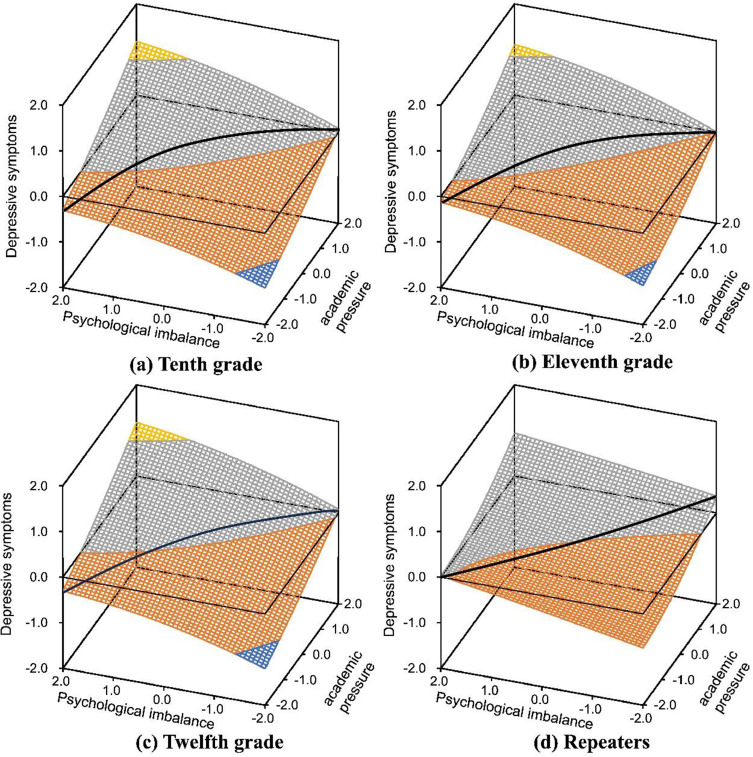
The results showed that the lowest level of academic pressure (F = 35.99, p < 0.001), psychological imbalance (F = 54.50, p < 0.001), and depressive symptoms (F = 9.36, p < 0.001) was found in repeaters, while the highest level was found in twelfth graders. Academic pressure was positively associated with psychological disequilibrium, and both were positively associated with adolescent depressive symptoms. Furthermore, when academic pressure and psychological imbalance are aligned, adolescent depressive symptoms increase with the first two. In addition, adolescent depressive symptoms decreased as the difference between academic pressure and psychological imbalance increased.
This study elucidates the non-linear relationship between academic pressure, psychological imbalance and depressive symptoms, and that adopting appropriate strategies to reduce academic pressure and adjust psychological balance is crucial for the prevention of depression in adolescents.
本研究旨在探讨学业压力与心理失衡之间的一致性如何影响青少年的抑郁症状,并进一步探讨高中生在这些影响方面的年级差异。
研究对象为湖南省浏阳市20所学校的29975名高中生。采用中学生心理健康量表(MSSMHS)和自评抑郁量表(SDS)评估学业压力、心理失衡和抑郁症状。通过多项式回归和响应面分析检验学业压力和心理失衡的影响。
结果显示,复读生的学业压力(F = 35.99,p < 0.001)、心理失衡(F = 54.50,p < 0.001)和抑郁症状(F = 9.36,p < 0.001)水平最低,而高三学生的水平最高。学业压力与心理失衡呈正相关,二者均与青少年抑郁症状呈正相关。此外,当学业压力和心理失衡一致时,青少年抑郁症状会随着前两者的增加而增加。另外,青少年抑郁症状随着学业压力与心理失衡之间差异的增加而减少。
本研究阐明了学业压力、心理失衡与抑郁症状之间的非线性关系,采取适当策略减轻学业压力和调节心理平衡对预防青少年抑郁症至关重要。