Fan Xiaoyi, Li Wanyu, Oros Jessica, Plung Jesse S, Plante Jessica A, Basu Himanish, Nagappan-Chettiar Sivapratha, Boeckers Joshua M, Tjang Laurentia V, Mann Colin J, Brusic Vesna, Buck Tierra K, Varnum Haley, Yang Pan, Malcolm Linzy M, Choi So Yoen, de Souza William M, Chiu Isaac M, Umemori Hisashi, Weaver Scott C, Plante Kenneth S, Abraham Jonathan
Department of Microbiology, Blavatnik Institute, Harvard Medical School, Boston, MA, USA.
World Reference Center for Emerging Viruses and Arboviruses, University of Texas Medical Branch, Galveston, TX, USA.
bioRxiv. 2025 Jan 2:2025.01.01.631009. doi: 10.1101/2025.01.01.631009.
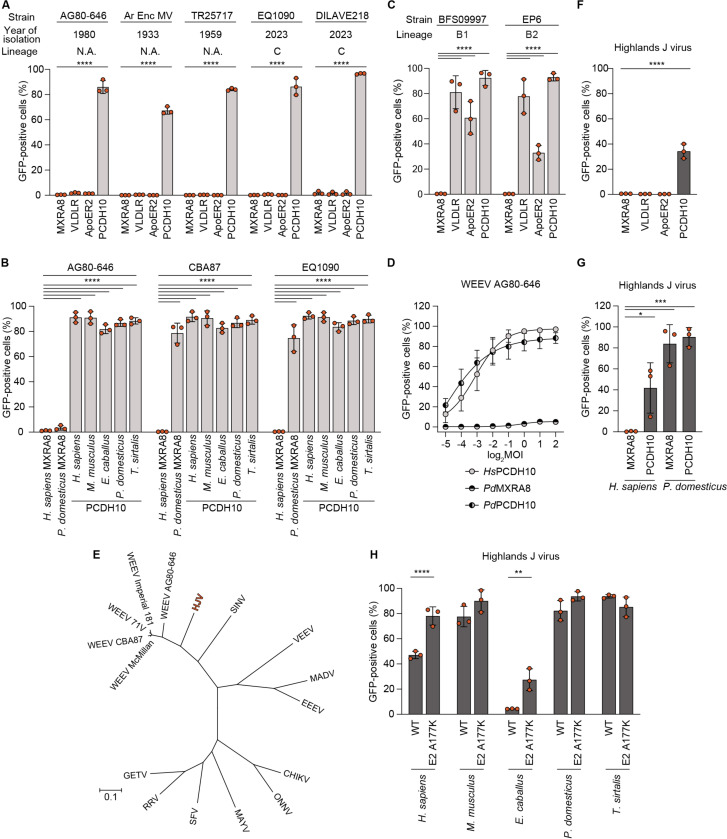
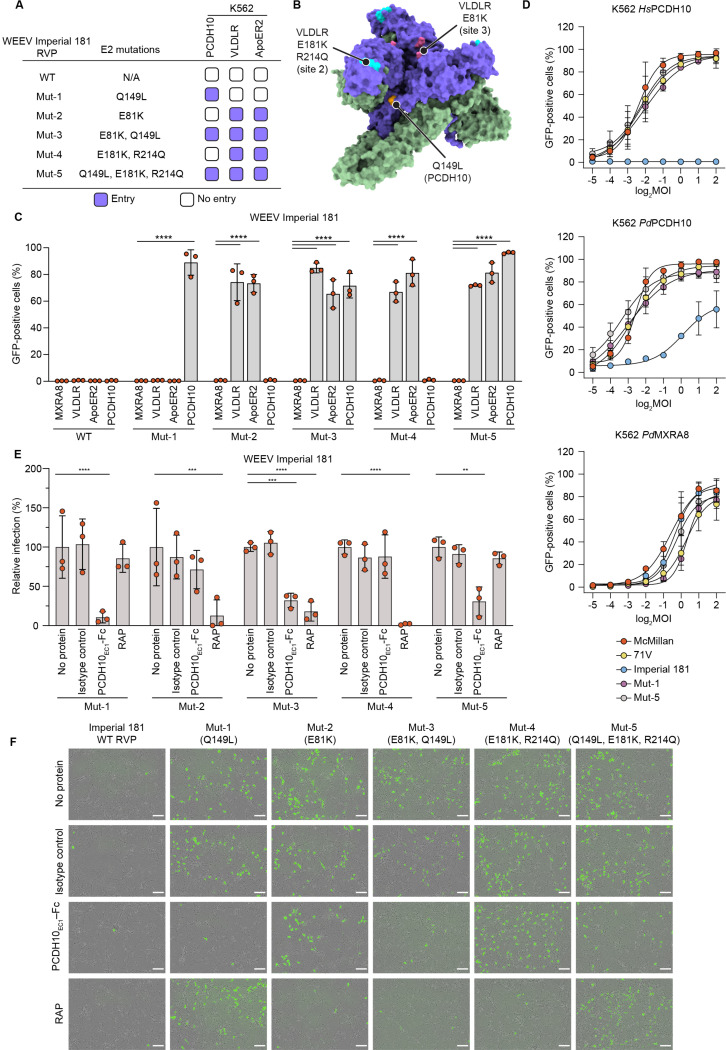
After decades of inactivity throughout the Americas, western equine encephalitis virus (WEEV) recently re-emerged in South America, causing a large-scale outbreak in humans and horses. WEEV binds protocadherin 10 (PCDH10) as a receptor; however, nonpathogenic strains no longer bind human or equine PCDH10 but retain the ability to bind avian receptors. Highly virulent WEEV strains can also bind the very low-density lipoprotein receptor (VLDLR) and apolipoprotein E receptor 2 (ApoER2) as alternative receptors. Here, by determining cryo-electron microscopy structures of WEEV strains isolated from 1941-2005 bound to mammalian receptors, we identify polymorphisms in the WEEV spike protein that explain shifts in receptor dependencies and that can allow nonpathogenic strains to infect primary cortical neurons. We predict the receptor dependencies of additional strains and of a related North American alphavirus. Our findings have implications for outbreak preparedness and enhance understanding of arbovirus neurovirulence through virus receptor binding patterns.
在整个美洲数十年未出现活动后,西部马脑炎病毒(WEEV)最近在南美洲重新出现,导致人类和马匹大规模疫情爆发。WEEV将原钙黏蛋白10(PCDH10)作为受体结合;然而,非致病性毒株不再与人或马的PCDH10结合,但保留了与禽类受体结合的能力。高毒力的WEEV毒株还可以结合极低密度脂蛋白受体(VLDLR)和载脂蛋白E受体2(ApoER2)作为替代受体。在这里,通过确定1941年至2005年分离的与哺乳动物受体结合的WEEV毒株的冷冻电子显微镜结构,我们鉴定出WEEV刺突蛋白中的多态性,这些多态性解释了受体依赖性的变化,并使非致病性毒株能够感染原代皮质神经元。我们预测了其他毒株以及一种相关的北美甲病毒的受体依赖性。我们的研究结果对疫情防范具有重要意义,并通过病毒受体结合模式增强了对虫媒病毒神经毒力的理解。