Lang Iain A, King Angela, Boddy Kate, Stein Ken, Asare Lauren, Day Jo, Liabo Kristin
Department of Health and Community Sciences, University of Exeter Medical School, University of Exeter, Exeter, United Kingdom.
J Med Internet Res. 2025 Jan 13;27:e50862. doi: 10.2196/50862.
The idea of making science more accessible to nonscientists has prompted health researchers to involve patients and the public more actively in their research. This sometimes involves writing a plain language summary (PLS), a short summary intended to make research findings accessible to nonspecialists. However, whether PLSs satisfy the basic requirements of accessible language is unclear.
We aimed to assess the readability and level of jargon in the PLSs of research funded by the largest national clinical research funder in Europe, the United Kingdom's National Institute for Health and Care Research (NIHR). We also aimed to assess whether readability and jargon were influenced by internal and external characteristics of research projects.
We downloaded the PLSs of all NIHR National Journals Library reports from mid-2014 to mid-2022 (N=1241) and analyzed them using the Flesch Reading Ease (FRE) formula and a jargon calculator (the De-Jargonizer). In our analysis, we included the following study characteristics of each PLS: research topic, funding program, project size, length, publication year, and readability and jargon scores of the original funding proposal.
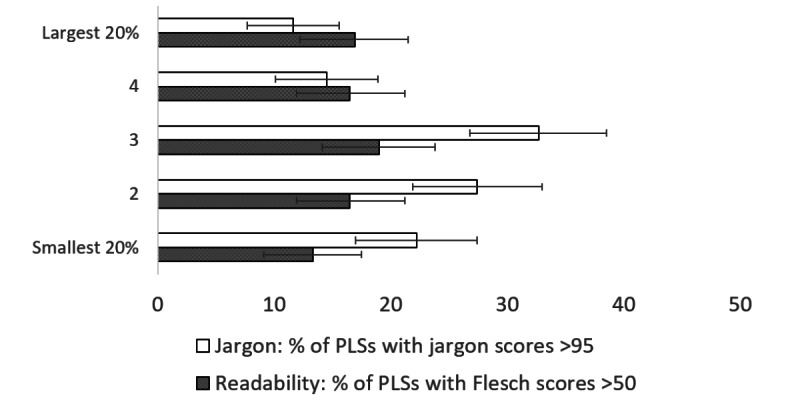
Readability scores ranged from 1.1 to 70.8, with an average FRE score of 39.0 (95% CI 38.4-39.7). Moreover, 2.8% (35/1241) of the PLSs had an FRE score classified as "plain English" or better; none had readability scores in line with the average reading age of the UK population. Jargon scores ranged from 76.4 to 99.3, with an average score of 91.7 (95% CI 91.5-91.9) and 21.7% (269/1241) of the PLSs had a jargon score suitable for general comprehension. Variables such as research topic, funding program, and project size significantly influenced readability and jargon scores. The biggest differences related to the original proposals: proposals with a PLS in their application that were in the 20% most readable were almost 3 times more likely to have a more readable final PLS (incidence rate ratio 2.88, 95% CI 1.86-4.45). Those with the 20% least jargon in the original application were more than 10 times as likely to have low levels of jargon in the final PLS (incidence rate ratio 13.87, 95% CI 5.17-37.2). There was no observable trend over time.
Most of the PLSs published in the NIHR's National Journals Library have poor readability due to their complexity and use of jargon. None were readable at a level in keeping with the average reading age of the UK population. There were significant variations in readability and jargon scores depending on the research topic, funding program, and other factors. Notably, the readability of the original funding proposal seemed to significantly impact the final report's readability. Ways of improving the accessibility of PLSs are needed, as is greater clarity over who and what they are for.
让科学知识更易于非专业人士理解的想法促使健康研究人员让患者和公众更积极地参与到他们的研究中。这有时需要撰写一份通俗易懂的总结(PLS),即一份简短的总结,旨在让非专业人士能够理解研究结果。然而,尚不清楚PLS是否满足通俗易懂语言的基本要求。
我们旨在评估由欧洲最大的国家临床研究资助机构——英国国家卫生与保健研究机构(NIHR)资助的研究项目的PLS的可读性和专业术语水平。我们还旨在评估可读性和专业术语是否受到研究项目的内部和外部特征的影响。
我们下载了2014年年中至2022年年中所有NIHR国家期刊图书馆报告的PLS(N = 1241),并使用弗莱什易读性公式(FRE)和一个专业术语计算器(去术语化器)对其进行分析。在我们的分析中,我们纳入了每个PLS的以下研究特征:研究主题、资助计划、项目规模、长度、出版年份以及原始资助申请的可读性和专业术语得分。
可读性得分范围为1.1至70.8,平均FRE得分为39.0(95%置信区间38.4 - 39.7)。此外,2.8%(35/1241)的PLS的FRE得分被归类为“通俗易懂的英语”或更高;没有一个的可读性得分与英国人口的平均阅读年龄相符。专业术语得分范围为76.4至99.3,平均得分为91.7(95%置信区间91.5 - 91.9),21.7%(269/1241)的PLS的专业术语得分适合一般理解。研究主题、资助计划和项目规模等变量显著影响可读性和专业术语得分。与原始申请的最大差异在于:申请中带有PLS且在最易读的20%中的那些,其最终PLS更易读的可能性几乎是其他的3倍(发病率比2.88,95%置信区间1.86 - 4.45)。原始申请中专业术语最少的20%中的那些,其最终PLS中专业术语水平低的可能性是其他的10倍多(发病率比13.87,95%置信区间5.17 - 37.2)。随着时间推移没有可观察到的趋势。
NIHR国家期刊图书馆发表的大多数PLS由于其复杂性和专业术语的使用而可读性较差。没有一个能达到与英国人口平均阅读年龄相符的可读水平。根据研究主题、资助计划和其他因素,可读性和专业术语得分存在显著差异。值得注意的是,原始资助申请的可读性似乎对最终报告的可读性有显著影响。需要改进PLS可及性的方法,同时也需要更明确PLS是针对谁以及用于什么。