Liao Haicheng, Fang Yu, Yin Junjie, He Min, Wei Yingjie, Zhang Juan, Yong Shuang, Cha Jiankui, Song Li, Zhu Xiaobo, Chen Xixi, Kováč Ján, Hou Qingqing, Ma Zhaotang, Zhou Xiaogang, Chen Lin, Yumoto Emi, Yang Tian, He Qi, Li Wei, Deng Yixin, Li Haoxuan, Li Mingwu, Qing Hai, Zou Lijuan, Bi Yu, Liu Jiali, Yang Yihua, Ye Daihua, Tao Qi, Wang Long, Xiong Qing, Lu Xiang, Tang Yongyan, Li Ting, Ma Bingtian, Qin Peng, Li Yan, Wang Wenming, Qian Yangwen, Ďurkovič Jaroslav, Miyamoto Koji, Chern Mawsheng, Li Shigui, Li Weitao, Wang Jing, Chen Xuewei
State Key Laboratory of Crop Gene Exploration and Utilization in Southwest China, Sichuan Agricultural University, Chengdu, Sichuan, China.
Department of Phytology, Technical University in Zvolen, Zvolen, Slovakia.
Cell Res. 2025 Mar;35(3):205-219. doi: 10.1038/s41422-024-01058-4. Epub 2025 Jan 14.
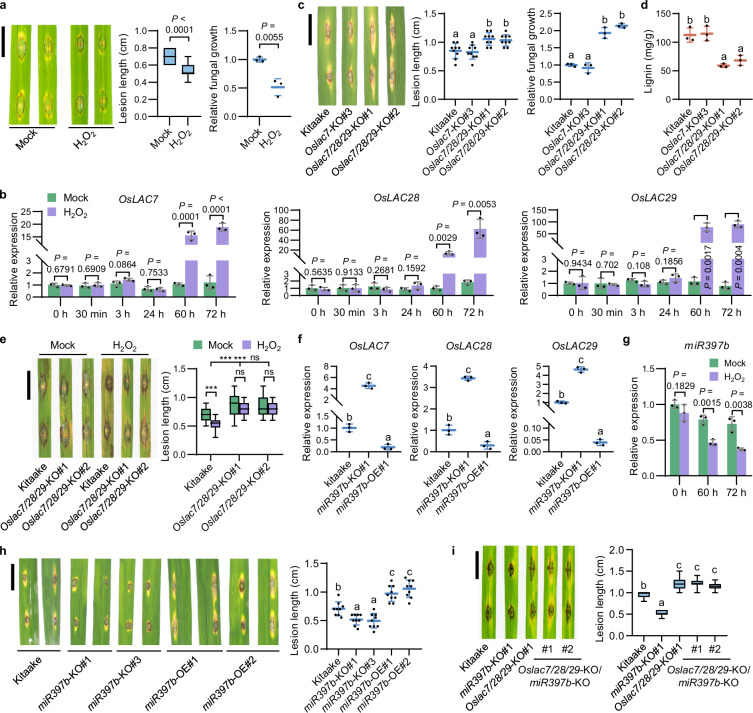
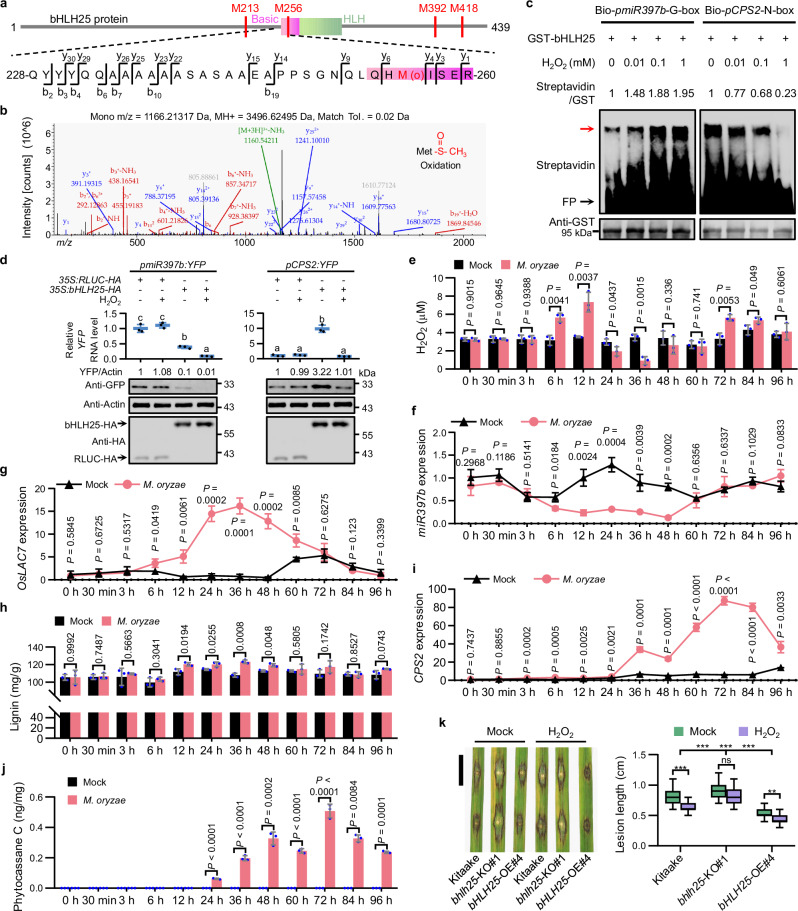
Hydrogen peroxide (HO) is a ubiquitous signal regulating many biological processes, including innate immunity, in all eukaryotes. However, it remains largely unknown that how transcription factors directly sense HO in eukaryotes. Here, we report that rice basic/helix-loop-helix transcription factor bHLH25 directly senses HO to confer resistance to multiple diseases caused by fungi or bacteria. Upon pathogen attack, rice plants increase the production of HO, which directly oxidizes bHLH25 at methionine 256 in the nucleus. Oxidized bHLH25 represses miR397b expression to activate lignin biosynthesis for plant cell wall reinforcement, preventing pathogens from penetrating plant cells. Lignin biosynthesis consumes HO causing accumulation of non-oxidized bHLH25. Non-oxidized bHLH25 switches to promote the expression of Copalyl Diphosphate Synthase 2 (CPS2), which increases phytoalexin biosynthesis to inhibit expansion of pathogens that escape into plants. This oxidization/non-oxidation status change of bHLH25 allows plants to maintain HO, lignin and phytoalexin at optimized levels to effectively fight against pathogens and prevents these three molecules from over-accumulation that harms plants. Thus, our discovery reveals a novel mechanism by which a single protein promotes two independent defense pathways against pathogens. Importantly, the bHLH25 orthologues from available plant genomes all contain a conserved M256-like methionine suggesting the broad existence of this mechanism in the plant kingdom. Moreover, this Met-oxidation mechanism may also be employed by other eukaryotic transcription factors to sense HO to change functions.
过氧化氢(H₂O₂)是一种普遍存在的信号分子,可调节所有真核生物中的许多生物过程,包括先天免疫。然而,在真核生物中,转录因子如何直接感知H₂O₂在很大程度上仍然未知。在此,我们报道水稻碱性/螺旋-环-螺旋转录因子bHLH25可直接感知H₂O₂,从而赋予对真菌或细菌引起的多种疾病的抗性。在病原体攻击时,水稻植株会增加H₂O₂的产生,H₂O₂会直接在细胞核中将bHLH25的蛋氨酸256氧化。氧化后的bHLH25会抑制miR397b的表达,从而激活木质素生物合成以强化植物细胞壁,防止病原体穿透植物细胞。木质素生物合成消耗H₂O₂,导致未氧化的bHLH25积累。未氧化的bHLH25转而促进二磷酸柯巴基合成酶2(CPS2)的表达,从而增加植物抗毒素的生物合成,以抑制逃逸到植物体内的病原体的扩散。bHLH25这种氧化/未氧化状态的变化使植物能够将H₂O₂、木质素和植物抗毒素维持在最佳水平,从而有效对抗病原体,并防止这三种分子过度积累对植物造成伤害。因此,我们的发现揭示了一种新机制,即单一蛋白质可促进两条独立的抗病原体防御途径。重要的是,现有植物基因组中的bHLH25直系同源物均含有一个保守的类似M256的蛋氨酸,这表明该机制在植物界广泛存在。此外,这种蛋氨酸氧化机制也可能被其他真核转录因子用于感知H₂O₂以改变功能。