Balthazard Renaud, Drouin-Engler Rose-Marie, Bertrand Samuel, Zine-Eddine Faycal, Li Jimmy, Tastet Olivier, Daigneault Audrey, Mamane Victoria H, Ortega-Delgado Gloria Gabrielle, Sreng Flores Alina Maria, Kaufmann Daniel E, Major Philippe, House Andrew A, Létourneau-Guillon Laurent, Arbour Nathalie, Keezer Mark R, Larochelle Catherine
Department of Neurosciences, Faculty of Medicine, Université de Montréal, Montreal, Quebec, Canada.
Centre de Recherche du Centre Hospitalier de l'Université de Montréal (CRCHUM), Montreal, Quebec, Canada.
Epilepsia. 2025 Apr;66(4):1288-1303. doi: 10.1111/epi.18261. Epub 2025 Jan 16.
Tuberous sclerosis complex (TSC) is a monogenetic disorder associated with sustained mechanistic target of rapamycin (mTOR) activation, leading to heterogeneous clinical manifestations. Epilepsy and renal angiomyolipoma are the most important causes of morbidity in adult people with TSC (pwTSC). mTOR is a key player in inflammation, which in turn could influence TSC-related clinical manifestations. Reliable biomarkers are lacking to monitor and predict evolution and response to treatment for epilepsy in pwTSC. Inflammation has been implicated in epileptogenesis in non-TSC-related epilepsy. We aimed to characterize the relation between markers of neuroglial activation/injury, markers of peripheral inflammation, and active epilepsy in pwTSC to identify accessible biomarkers and potential new therapeutic targets.
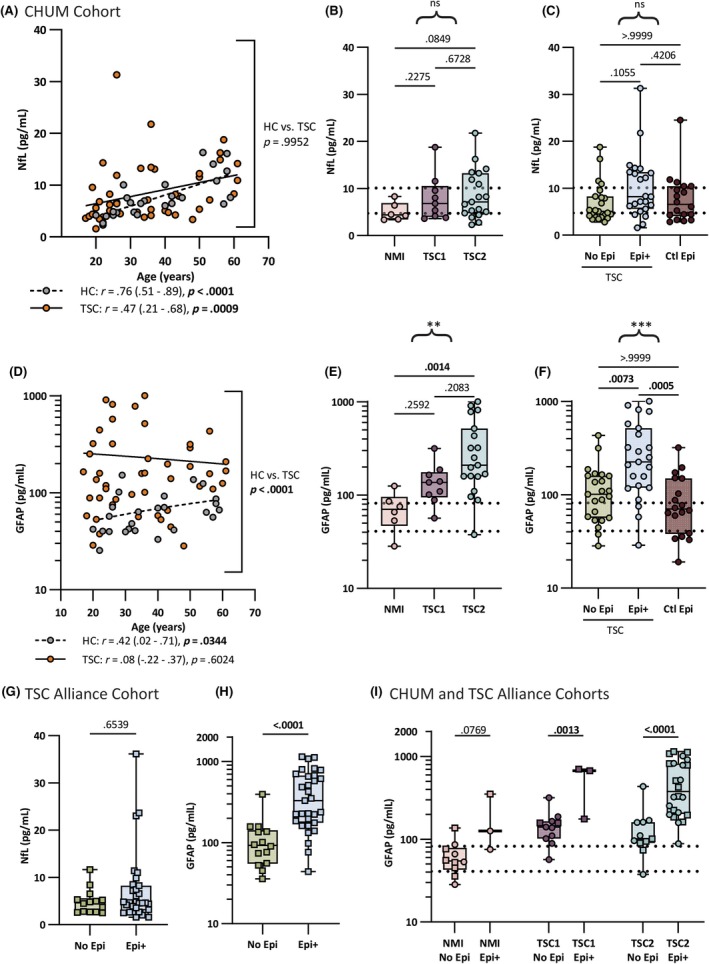
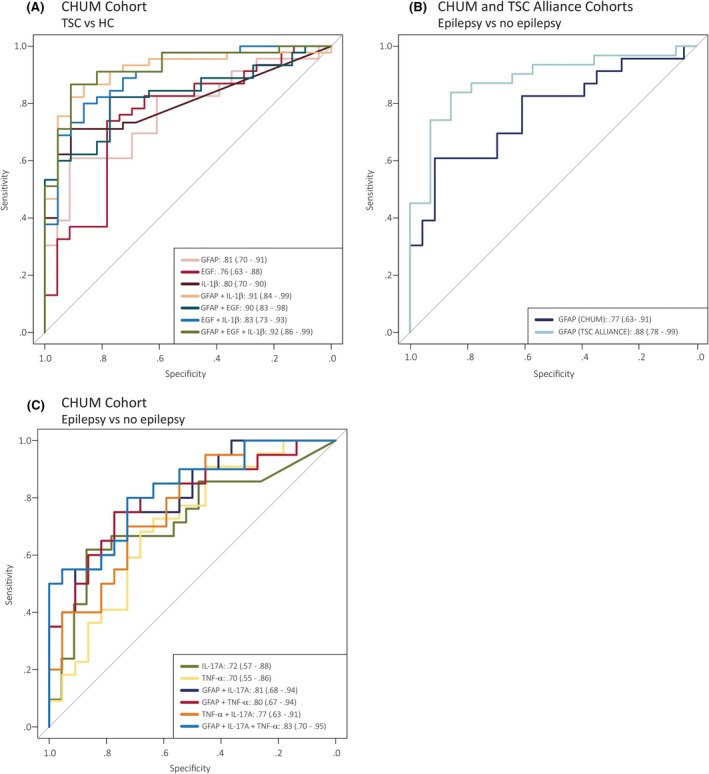
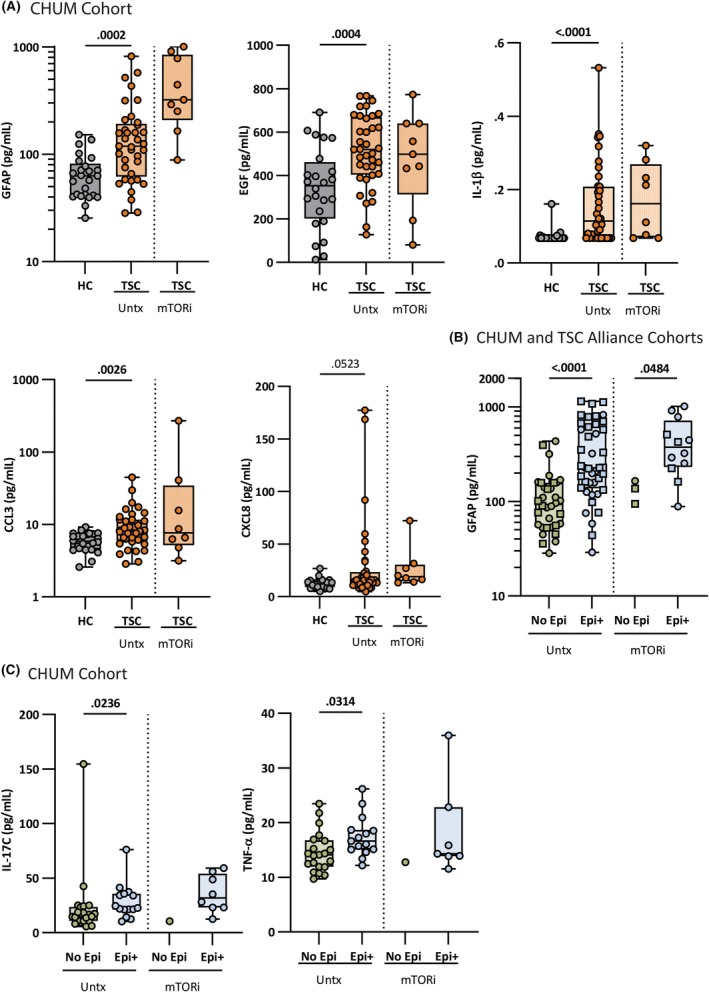
We performed a cross-sectional study to investigate markers of central nervous system (CNS) (neurofilament light [NfL] and glial fibrillary acidic protein [GFAP]) and peripheral (45 cytokines) inflammation in the peripheral blood of pwTSC (n = 46) vs age- and sex-matched healthy controls (HCs) (n = 26). In pwTSC, markers associated with active epilepsy (n = 23/46) were compared to non-TSC epilepsy controls (n = 18). Observations on markers of neuroglial activation/injury (GFAP, NfL) were confirmed in an independent TSC cohort (n = 45; 69% with active epilepsy).
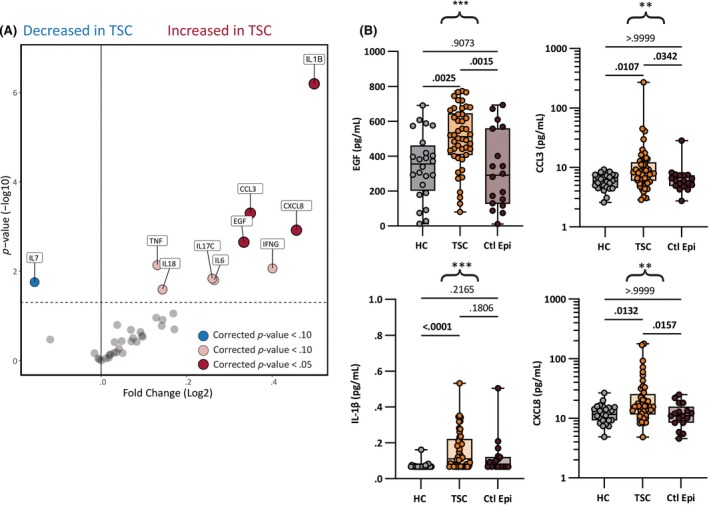
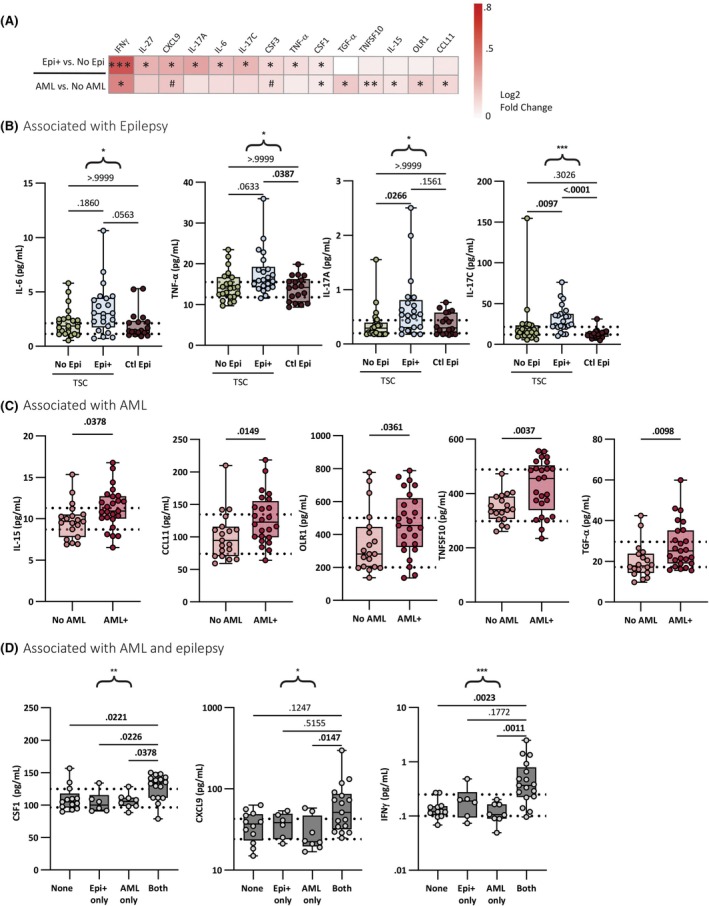
We report that TSC is characterized by elevated serum levels of marker of astrogliosis (GFAP), pro-inflammatory molecules (interleukin 1β [IL-1β], CXCL8) and trophic factor (epidermal growth factor [EGF]) compared to HCs and to non-TSC-related epilepsy controls. Among pwTSC, renal angiomyolipoma presence and size was associated with IL-15. It is notable that active epilepsy in pwTSC was associated with higher levels of GFAP compared to pwTSC without epilepsy, which was confirmed in an external validation cohort, and with elevated levels of pro-inflammatory cytokines (IL-17A, IL-17C, tumor necrosis factor α [TNF-α]), not significantly related to seizure activity or treatment with mTOR inhibitor. These associations remained significant after adjusting for age and sex.
These results suggest that key inflammatory mediators could contribute to epileptogenesis and represent novel biomarkers and therapeutic targets in TSC.
结节性硬化症(TSC)是一种与雷帕霉素机制性靶点(mTOR)持续激活相关的单基因疾病,导致临床表现异质性。癫痫和肾血管平滑肌脂肪瘤是成年TSC患者(pwTSC)发病的最重要原因。mTOR是炎症中的关键因子,而炎症反过来又可能影响TSC相关的临床表现。目前缺乏可靠的生物标志物来监测和预测pwTSC癫痫的病情进展及对治疗的反应。炎症在非TSC相关癫痫的癫痫发生中起作用。我们旨在描述神经胶质激活/损伤标志物、外周炎症标志物与pwTSC活动性癫痫之间的关系,以确定可获取的生物标志物和潜在的新治疗靶点。
我们进行了一项横断面研究,以调查pwTSC患者(n = 46)与年龄和性别匹配的健康对照者(HCs,n = 26)外周血中中枢神经系统(CNS)标志物(神经丝轻链蛋白[NfL]和胶质纤维酸性蛋白[GFAP])及外周(45种细胞因子)炎症标志物。在pwTSC患者中,将与活动性癫痫相关的标志物(n = 23/46)与非TSC癫痫对照者(n = 18)进行比较。在一个独立的TSC队列(n = 45;69%有活动性癫痫)中对神经胶质激活/损伤标志物(GFAP、NfL)的观察结果进行了验证。
我们报告,与HCs及非TSC相关癫痫对照者相比,TSC的特征是星形胶质细胞增生标志物(GFAP)、促炎分子(白细胞介素1β[IL-1β]、CXCL8)和营养因子(表皮生长因子[EGF])的血清水平升高。在pwTSC患者中,肾血管平滑肌脂肪瘤的存在和大小与IL-15相关。值得注意的是,与无癫痫的pwTSC患者相比,pwTSC患者的活动性癫痫与更高水平的GFAP相关,这在外部验证队列中得到证实,并且与促炎细胞因子(IL-17A、IL-17C、肿瘤坏死因子α[TNF-α])水平升高相关,这些细胞因子与癫痫发作活动或mTOR抑制剂治疗无显著相关性。在调整年龄和性别后,这些关联仍然显著。
这些结果表明,关键的炎症介质可能促成癫痫发生,并代表TSC中的新型生物标志物和治疗靶点。