Becking Ellis, Akkerman Elisabeth, Scheffer Peter, Smith Ian, Stemkens Daphne, Bax Caroline J, Bekker Mireille N, Crombag Neeltje, Schuit Ewoud, Henneman Lidewij
Obstetrics, Wilhelmina Children's Hospital University Medical Centre, Utrecht, The Netherlands
Department of Obstetrics, Utrecht University, Utrecht, The Netherlands.
BMJ Open. 2025 Jan 15;15(1):e088304. doi: 10.1136/bmjopen-2024-088304.
Noninvasive prenatal testing (NIPT) to screen for fetal aneuploidies by analysing cell-free DNA in maternal plasma is available to pregnant women worldwide. In the future, the scope of NIPT could potentially be expanded to the prediction of adverse pregnancy outcomes. The objective of this study was to assess and compare the preferences of pregnant women and obstetric healthcare professionals on this new test purpose of NIPT.
A discrete choice experiment was designed to assess participants' preferences on the use of NIPT to predict adverse pregnancy outcomes regarding three attributes on test characteristics: test accuracy rate, unnecessary intervention rate and false reassurance rate. A questionnaire assessed general attitudes towards using noninvasive prenatal testing to predict adverse pregnancy outcomes.
Dutch prenatal healthcare system.
Pregnant women with singleton pregnancies and obstetric healthcare professionals.
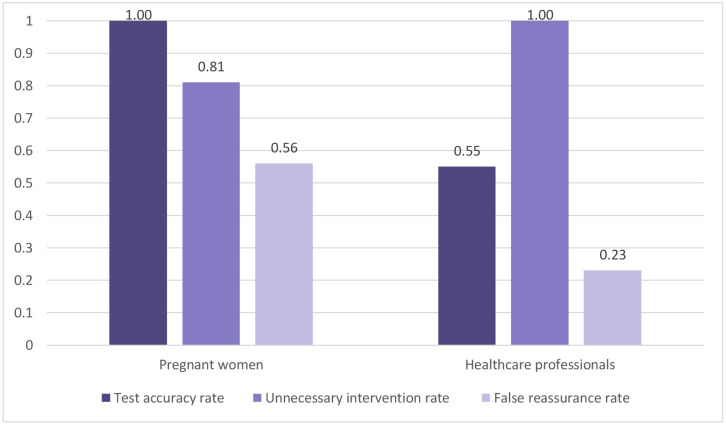
In total, 1580 pregnant women and 308 obstetric healthcare professionals participated in the discrete choice experiment. Higher test accuracy, fewer unnecessary interventions and less false reassurance all had a statistically significant (p<0.05) impact on the preference for a test. For pregnant women, the most important test characteristic when choosing a preferred test was the test accuracy rate, while for obstetric healthcare professionals, the most important test characteristic was the unnecessary intervention rate. The false reassurance rate was the least important test characteristic for both groups. Overall, 74% (n=1181) of pregnant women (strongly) agreed that NIPT to predict adverse pregnancy outcomes should be offered to pregnant women compared with 49% (n=151) of obstetric healthcare professionals.
Most pregnant women have a positive attitude towards using NIPT to predict adverse pregnancy outcomes compared with slightly less than half of the obstetric healthcare professionals. Pregnant women prioritise a prognostic test with higher test accuracy, while obstetric healthcare professionals prioritise a test that results in fewer unnecessary interventions.
通过分析孕妇血浆中的游离DNA来筛查胎儿非整倍体的无创产前检测(NIPT)已在全球范围内可供孕妇使用。未来,NIPT的范围可能会扩大到预测不良妊娠结局。本研究的目的是评估和比较孕妇和产科医疗保健专业人员对NIPT这一新检测目的的偏好。
设计了一项离散选择实验,以评估参与者对使用NIPT预测不良妊娠结局的偏好,涉及检测特征的三个属性:检测准确率、不必要干预率和假阳性率。一份问卷评估了对使用无创产前检测预测不良妊娠结局的总体态度。
荷兰产前医疗保健系统。
单胎妊娠的孕妇和产科医疗保健专业人员。
共有1580名孕妇和308名产科医疗保健专业人员参与了离散选择实验。更高的检测准确率、更少的不必要干预和更少的假阳性对检测偏好均有统计学显著影响(p<0.05)。对于孕妇而言,选择首选检测时最重要的检测特征是检测准确率,而对于产科医疗保健专业人员来说,最重要的检测特征是不必要干预率。假阳性率是两组中最不重要的检测特征。总体而言,74%(n=1181)的孕妇(强烈)同意应向孕妇提供用于预测不良妊娠结局的NIPT,相比之下,产科医疗保健专业人员中这一比例为49%(n=15)。
与略少于一半的产科医疗保健专业人员相比,大多数孕妇对使用NIPT预测不良妊娠结局持积极态度。孕妇优先考虑检测准确率更高的预后检测,而产科医疗保健专业人员则优先考虑导致不必要干预较少的检测。