Sales Igor Magalhães, Damacena Fernanda Camargo, Zandonade Eliana, Sampaio Karla Nívea
Postgraduate Program in Pharmaceutical Sciences, Federal University of Espirito Santo, Vitoria, Espírito Santo, Brazil.
Department of Statistical, Federal University of Espirito Santo, Vitoria, Espírito Santo, Brazil.
BMJ Open. 2025 Jan 15;15(1):e088084. doi: 10.1136/bmjopen-2024-088084.
Our study evaluated the prevalence of hypertension in a population of Brazilian firefighters and the association of elevated blood pressure (BP) with personal, occupational, and cardiovascular risk factors.
This was a cross-sectional study.
Our study was based on health inspections of the Military Fire Brigade of the Espírito Santo State, Brazil, performed in 2019.
The study participants were 859 male Brazilian firefighters.
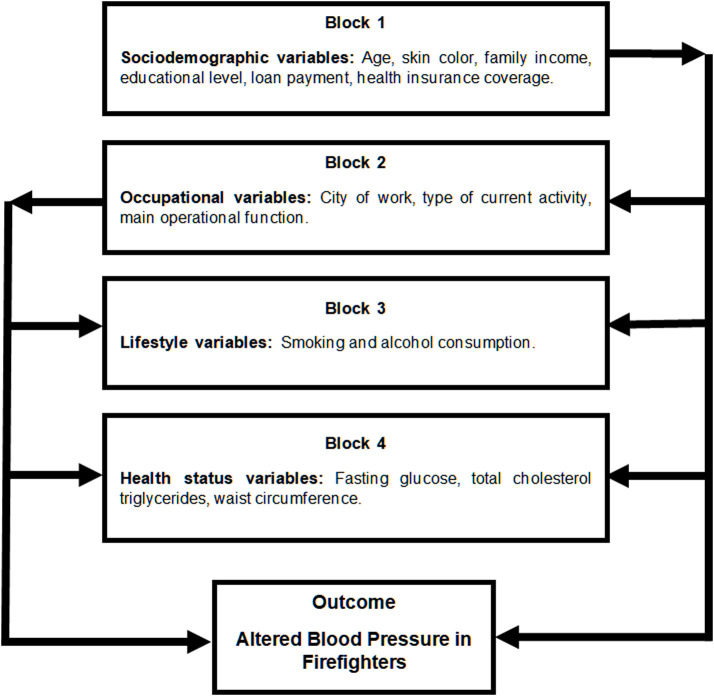
Data collected included sociodemographic (age, ethnicity, educational level, health insurance coverage), occupational (city of work, type of current activity, main operational activity), lifestyle (smoking and alcohol consumption), and health status (fasting glucose, total cholesterol and triglycerides, blood pressure, and anthropometric composition). All firefighters in the pre-hypertension and hypertension range and/or using antihypertensive medication were considered as having BP above normal, and the association of this outcome with sociodemographic, occupational, lifestyle, and health status variables was analysed by a logistic regression model.
We found that 45.6% of firefighters presented elevated BP levels. A higher chance of elevated BP was observed for firefighters with high school (1.5; 95% confidence interval (CI) 1.02 to 2.19) and postgraduate (1.54; 95% CI 1.03 to 2.30) educational levels, those self-declared as black (1.98; 95% CI 1.03 to 3.78), those working in countryside cities (ie, locations outside the metropolitan circuit; 2.32; 95% CI 1.14 to 4.71), and those with hypertriglyceridemia (1.92; 95% CI 1.19 to 3.11), hyperglycaemia (1.5; 95% CI 1.01 to 2.22), and central obesity (2.34; 95% CI 1.47 to 3.70).
We found an association between elevated BP and personal, occupational, and cardiovascular risk factors. Awareness of risk factors may grant implementation of more effective intervention and prevention strategies.
我们的研究评估了巴西消防员群体中高血压的患病率,以及血压升高与个人、职业和心血管危险因素之间的关联。
这是一项横断面研究。
我们的研究基于2019年对巴西圣埃斯皮里图州军事消防队进行的健康检查。
研究参与者为859名巴西男性消防员。
收集的数据包括社会人口统计学信息(年龄、种族、教育水平、医疗保险覆盖情况)、职业信息(工作城市、当前活动类型、主要作战活动)、生活方式(吸烟和饮酒情况)以及健康状况(空腹血糖、总胆固醇和甘油三酯、血压和人体测量组成)。所有处于高血压前期和高血压范围和/或正在使用抗高血压药物的消防员均被视为血压高于正常水平,并通过逻辑回归模型分析该结果与社会人口统计学、职业、生活方式和健康状况变量之间的关联。
我们发现45.6%的消防员血压升高。高中(1.5;95%置信区间(CI)1.02至2.19)和研究生(1.54;95%CI 1.03至2.30)教育水平的消防员、自称黑人的消防员(1.98;95%CI 1.03至3.78)、在农村城市工作的消防员(即大都市圈以外的地区;2.32;95%CI 1.14至4.71)以及患有高甘油三酯血症(1.92;95%CI 1.19至3.11)、高血糖(1.5;95%CI 1.01至2.22)和中心性肥胖(2.34;95%CI 1.47至3.70)的消防员,血压升高的可能性更高。
我们发现血压升高与个人、职业和心血管危险因素之间存在关联。了解危险因素可能有助于实施更有效的干预和预防策略。