Costa Alessandro, Pilo Federica, Pettinau Martina, Piga Matteo, Carboni Pietro, Piras Eugenia, Targhetta Clara, Rojas Rodrigo, Deias Paola, Mulas Olga, Caocci Giovanni
Hematology, Department of Medical Sciences and Public Health, University of Cagliari, Cagliari, 09121, Italy.
Hematology and BMT Unit, "A. Businco" Hospital, ARNAS Brotzu, Cagliari, Italy.
Ann Hematol. 2025 Jan;104(1):253-262. doi: 10.1007/s00277-025-06207-2. Epub 2025 Jan 17.
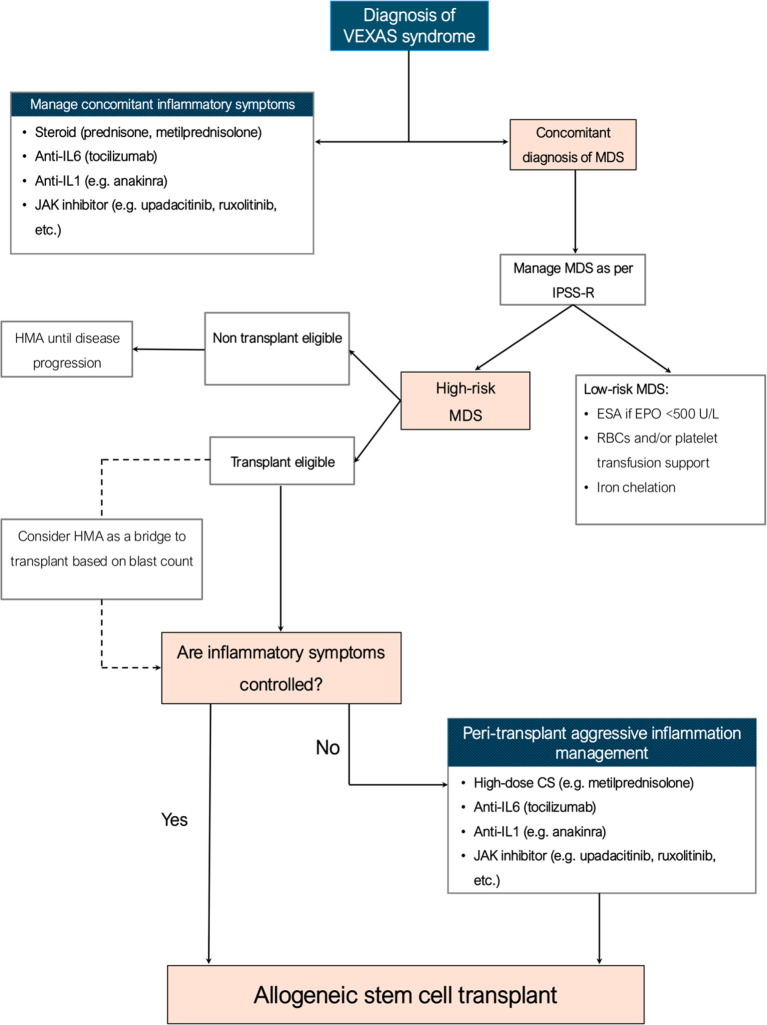
VEXAS syndrome is a complex hemato-inflammatory disorder, driven by somatic mutations in the UBA1 gene within hematopoietic precursor cells. It is characterized by systemic inflammation, rheumatological manifestations, and frequent association with myelodysplastic syndrome (MDS). We present a series of four VEXAS cases, all of which include concomitant MDS, each displaying distinct genetic signatures and clinical features at diagnosis, with a focus on their diagnostic and therapeutic implications. Our findings underscore the importance of extending UBA1 sequencing beyond exon 3 in cases with strong clinical suspicion. Given the rarity of non-canonical variants and the limited gene annotation, germline tissue control should be considered to differentiate somatic from germline mutations. Hematological management, including considerations for transplantation, was primarily guided by the Revised International Prognostic Scoring System (IPSS-R) for MDS due to the absence of a specific risk stratification system for VEXAS or therapy guidelines. A critical point of our discussion is the role of inflammation in the peri-transplant period; in one patient, the combination of disease-modifying antirheumatic drugs (DMARDs) and high-dose corticosteroids before transplant was crucial in controlling inflammation, resulting in a successful hematopoietic stem cell transplantation (HSCT). In contrast, uncontrolled inflammation contributed to the peri-transplant death of another patient. These cases highlight the importance of effective inflammation management in optimizing HSCT outcomes. Additionally, our study emphasizes the urgent need for specific management guidelines for VEXAS syndrome, including a comprehensive risk stratification system and optimal timing for transplantation.
VEXAS综合征是一种复杂的血液炎症性疾病,由造血前体细胞中UBA1基因的体细胞突变驱动。其特征为全身炎症、风湿病表现,且常与骨髓增生异常综合征(MDS)相关。我们报告了4例VEXAS病例系列,所有病例均合并MDS,每例在诊断时均表现出独特的基因特征和临床特征,重点关注其诊断和治疗意义。我们的研究结果强调,对于临床高度怀疑的病例,将UBA1测序扩展至外显子3以外具有重要意义。鉴于非典型变异的罕见性和有限的基因注释,应考虑采用种系组织对照来区分体细胞突变和种系突变。由于缺乏针对VEXAS的特定风险分层系统或治疗指南,血液学管理(包括移植相关考量)主要依据MDS的修订国际预后评分系统(IPSS-R)。我们讨论的一个关键点是炎症在移植围手术期的作用;在1例患者中,移植前使用改善病情抗风湿药(DMARDs)和大剂量糖皮质激素联合治疗对于控制炎症至关重要,从而实现了成功的造血干细胞移植(HSCT)。相比之下,炎症控制不佳导致了另1例患者在移植围手术期死亡。这些病例凸显了有效控制炎症对于优化HSCT结局的重要性。此外,我们的研究强调迫切需要针对VEXAS综合征的特定管理指南,包括全面的风险分层系统和最佳移植时机。