Jackson Sarah E, Brown Jamie, Buss Vera, Shahab Lion
Department of Behavioural Science and Health, University College London, London, United Kingdom.
SPECTRUM Consortium, United Kingdom.
JAMA Netw Open. 2025 Jan 2;8(1):e2454962. doi: 10.1001/jamanetworkopen.2024.54962.
A wide range of medications, noncombustible nicotine products, behavioral support, and alternative treatments are available in England to help people stop smoking. Understanding their effectiveness outside of clinical trial settings can support informed decision-making.
To provide up-to-date estimates of the prevalence of different smoking cessation aids and associations with quit success and to explore moderation by socioeconomic position.
DESIGN, SETTING, AND PARTICIPANTS: This survey study used data from the Smoking Toolkit Study, a monthly cross-sectional household survey, conducted from 2006 to 2024 in England, UK. Participants were individuals aged at least 16 years who reported trying to quit smoking in the past year. Analyses were conducted from July to November 2024.
The outcome variable was self-reported success in quitting smoking from the start of the most recent quit attempt up to the time of survey (hereafter, quit success). Independent variables were use (yes or no) of the following aids in the most recent attempt: nicotine replacement therapy (NRT), obtained via prescription or over-the-counter; varenicline; bupropion; electronic cigarettes (e-cigarettes); face-to-face behavioral support; telephone support; written self-help materials; websites; smartphone apps; hypnotherapy; Allen Carr's Easyway method; heated tobacco products (HTPs); and nicotine pouches. Covariates included sociodemographic characteristics and features of the quit attempt.
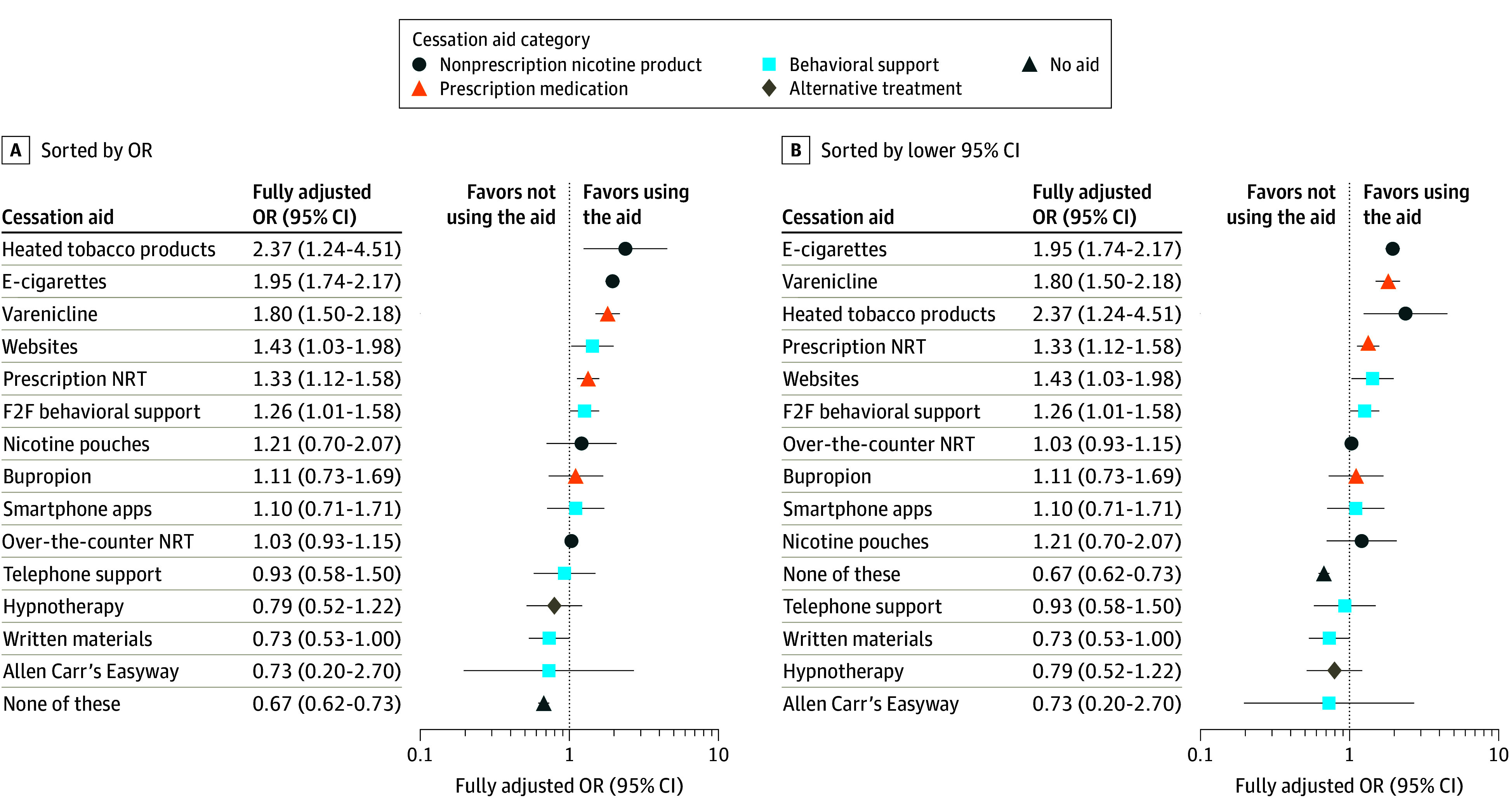
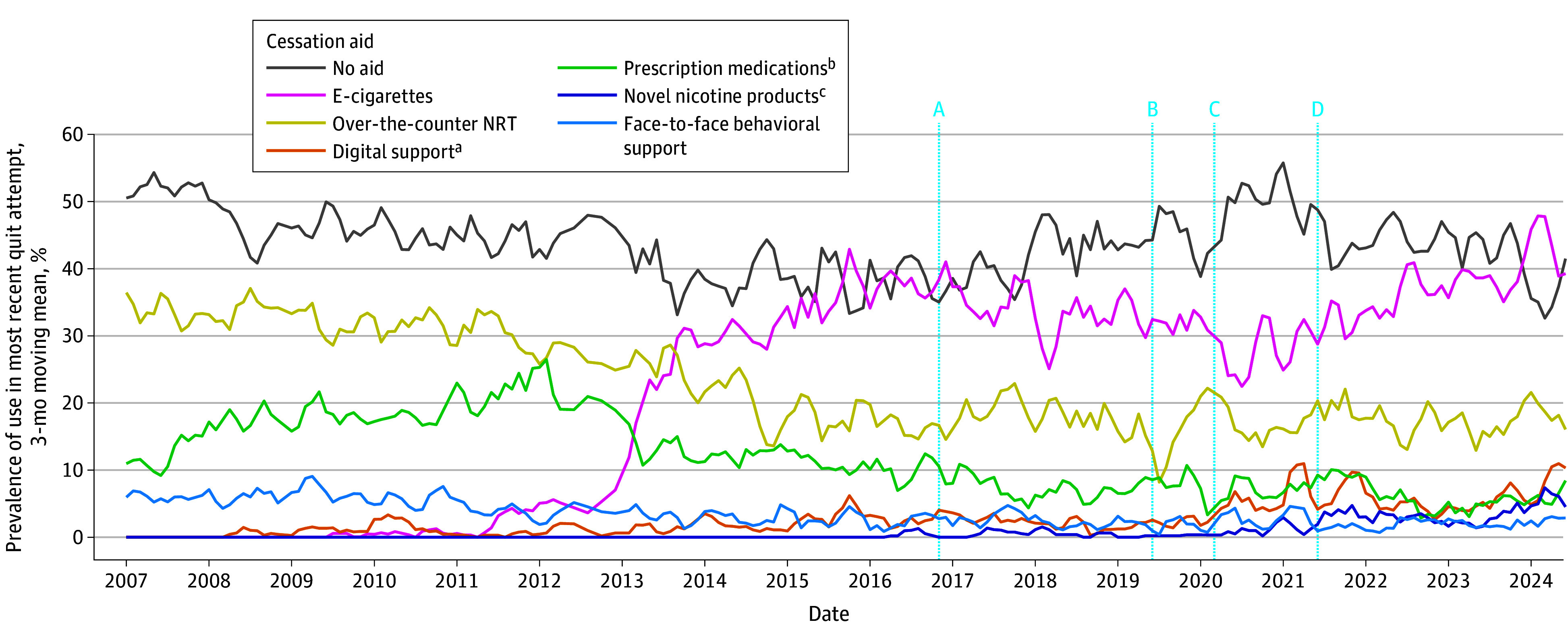
A total of 25 094 participants (mean [SD] age, 38.7 [15.3] years; 51.5% [95% CI, 50.8%-52.2%] men) were included. In 2023 to 2024, the most used aids were e-cigarettes (40.2% [95% CI, 37.6%-42.8%]) and over-the-counter NRT (17.3% [95% CI, 15.3%-19.2%]); 40.8% (95% CI, 38.2%-43.4%) of quit attempts were unaided. While e-cigarette use was associated with higher odds of quit success after adjustment for use of other aids and covariates (odds ratio [OR], 1.95 [95% CI, 1.74-2.17]), use of over-the-counter NRT was not (OR, 1.03 [95% CI, 0.93-1.15]). Other aids positively associated with quit success were websites (used by 4.6% [95% CI, 3.5%-5.7%] in 2023-2024; OR, 1.43 [95% CI, 1.03-1.98]), prescription NRT (used by 4.5% [95% CI, 3.4%-5.5%] in 2023-2024; OR, 1.33 [95% CI, 1.12-1.58]), varenicline (used by 1.1% [95% CI, 0.5%-1.7%] in 2023-2024; OR, 1.80 [95% CI, 1.50-2.18]), and HTPs (used by 0.7% [95% CI, 0.3%-1.1%] in 2023-2024; OR, 2.37 [95% CI, 1.24-4.51]). Face-to-face behavioral support (used by 2.2% [95% CI, 1.5-2.9] in 2023-2024) was associated with higher odds of quit success among those from less advantaged (OR, 1.59 [95% CI, 1.19-2.14]) but not more advantaged (OR, 0.91 [95% CI, 0.65-1.29]) socioeconomic positions. There was not clear evidence of a benefit of any other aid, although some analyses were inconclusive.
This cross-sectional study found that while a range of effective smoking cessation aids are available in England, many people tried to quit using less effective forms of support or none at all. Quit success rates could be improved by encouraging people to use more effective methods.
在英格兰,有多种药物、不可燃尼古丁产品、行为支持和替代疗法可帮助人们戒烟。了解它们在临床试验环境之外的有效性有助于做出明智的决策。
提供不同戒烟辅助工具的流行率的最新估计以及与戒烟成功的关联,并探讨社会经济地位的调节作用。
设计、设置和参与者:这项调查研究使用了吸烟工具包研究的数据,这是一项于2006年至2024年在英国英格兰进行的每月横断面家庭调查。参与者是年龄至少16岁且报告在过去一年中尝试戒烟的个人。分析于2024年7月至11月进行。
结果变量是从最近一次戒烟尝试开始到调查时自我报告的戒烟成功情况(以下简称戒烟成功)。自变量是在最近一次尝试中是否使用了以下辅助工具:通过处方或非处方获得的尼古丁替代疗法(NRT)、伐尼克兰、安非他酮、电子烟、面对面行为支持、电话支持、书面自助材料、网站、智能手机应用程序、催眠疗法、艾伦·卡尔的轻松戒烟法、加热烟草产品(HTP)和尼古丁袋。协变量包括社会人口学特征和戒烟尝试的特征。
共纳入25094名参与者(平均[标准差]年龄,38.7[15.3]岁;51.5%[95%置信区间,50.8%-52.2%]为男性)。在2023年至2024年,最常用的辅助工具是电子烟(40.2%[95%置信区间,37.6%-42.8%])和非处方NRT(17.3%[95%置信区间,15.3%-19.2%]);40.8%(95%置信区间,38.2%-43.4%)的戒烟尝试没有使用辅助工具。在调整了其他辅助工具的使用和协变量后,使用电子烟与戒烟成功的较高几率相关(优势比[OR],1.95[95%置信区间,1.74-2.17]),而使用非处方NRT则不然(OR,1.03[95%置信区间,0.93-1.15])。与戒烟成功呈正相关的其他辅助工具包括网站(2023-2024年有4.6%[95%置信区间,3.5%-5.7%]使用;OR,1.4