Moosa Aqeela, Variava Ebrahim, Calver Alistair D, Chita Gajendra, Sabet Nadia, Ngwenya Sharol, Papathanasopoulos Maria, Omar Tanvier
Department of Internal Medicine, Faculty of Health Sciences, University of the Witwatersrand, Klerksdorp, South Africa.
Perinatal HIV Research Unit, Faculty of Health Sciences, University of the Witwatersrand, Johannesburg, South Africa.
South Afr J HIV Med. 2024 Dec 20;25(1):1638. doi: 10.4102/sajhivmed.v25i1.1638. eCollection 2024.
Liver disease is the leading cause of non-AIDS-related mortality in people living with HIV (PLWH). Steatotic liver disease (SLD) is increasingly recognised as an important aetiological factor in liver dysfunction in PLWH.
This study aimed to determine the post-mortem prevalence and severity of SLD and determine HIV- and non-HIV-related risk factors associated with it.
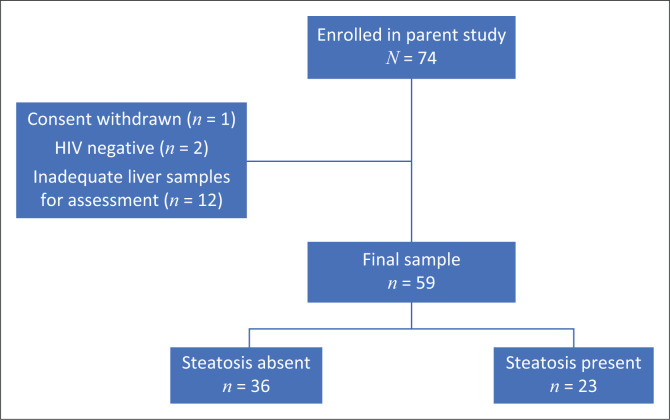
We conducted a retrospective cross-sectional study in which liver histology from 59 deceased people who were infected with HIV was assessed for steatosis, and findings correlated with clinical, epidemiological, and biochemical data.
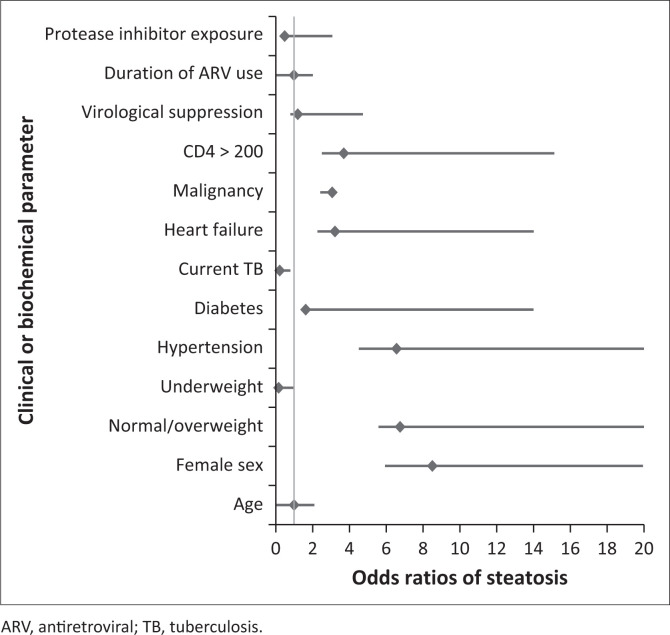
Decedents were predominantly men (33/59); 63% (37/59) were virologically supressed. Median CD4+ T-cell count was 139 cells/µL (interquartile range [IQR]: 47-344). Steatosis was present in 39% (23/59) of decedents: 74% mild, 9% moderate, and 17% severe steatosis. There were no cases of steatohepatitis, and one case with mild fibrosis. Factors associated with SLD were: CD4 T-lymphocyte count > 200 cells/µL (odds ratio [OR]: 3.69; 95% confidence interval [CI]: 1.19-11.44), female sex (OR: 8.5; 95% CI: 2.57-28.17), hypertension (OR: 6.5; 95% CI: 2.05-21.00), and being normal or overweight (OR: 6.75; 95% CI: 1.12-40.56). Virological suppression and duration of antiretroviral drug use were not associated with steatosis.
We found a high proportion of SLD with heterogeneous causes in deceased people who were infected with HIV, exceeding previously reported prevalences from elsewhere in Africa. A preserved CD4 count and being female conferred the highest risk for steatosis, underscoring the need for screening in this subgroup and further research to delineate risks in a Southern African population.
肝病是人类免疫缺陷病毒(HIV)感染者中非艾滋病相关死亡的主要原因。脂肪性肝病(SLD)日益被认为是HIV感染者肝功能障碍的一个重要病因。
本研究旨在确定尸检时SLD的患病率和严重程度,并确定与之相关的HIV相关和非HIV相关危险因素。
我们进行了一项回顾性横断面研究,对59例HIV感染者的肝脏组织学进行脂肪变性评估,并将结果与临床、流行病学和生化数据相关联。
死者以男性为主(33/59);63%(37/59)病毒学得到抑制。CD4+T细胞计数中位数为139个细胞/微升(四分位间距[IQR]:47 - 344)。39%(23/59)的死者存在脂肪变性:74%为轻度,9%为中度,17%为重度脂肪变性。无脂肪性肝炎病例,1例轻度纤维化。与SLD相关的因素有:CD4 T淋巴细胞计数>200个细胞/微升(优势比[OR]:3.69;95%置信区间[CI]:1.19 - 11.44)、女性(OR:8.5;95%CI:2.57 - 28.17)、高血压(OR:6.5;95%CI:2.05 - 21.00)以及体重正常或超重(OR:6.75;95%CI:1.12 - 40.56)。病毒学抑制和抗逆转录病毒药物使用时间与脂肪变性无关。
我们发现HIV感染者中SLD比例较高,病因各异,超过了非洲其他地区先前报告的患病率。CD4计数保留和女性是脂肪变性的最高风险因素,强调了对该亚组进行筛查的必要性以及进一步研究以明确南非人群中的风险。