Oh Jeonghyun, Catherine Christy, Kim Eun Seon, Min Kwang Wook, Jeong Hae Chan, Kim Hyojin, Kim Mijin, Ahn Seung Hae, Lukianenko Nataliia, Jo Min Gu, Bak Hyeon Seok, Lim Sungsu, Kim Yun Kyung, Kim Ho Min, Lee Sung Bae, Cho Hyunju
Center for Biomolecular and Cellular Structure, Institute for Basic Science (IBS), Daejeon, Republic of Korea.
Department of Brain Sciences, Daegu Gyeongbuk Institute of Science and Technology (DGIST), Daegu, Republic of Korea.
Nat Commun. 2025 Jan 17;16(1):737. doi: 10.1038/s41467-025-56030-6.
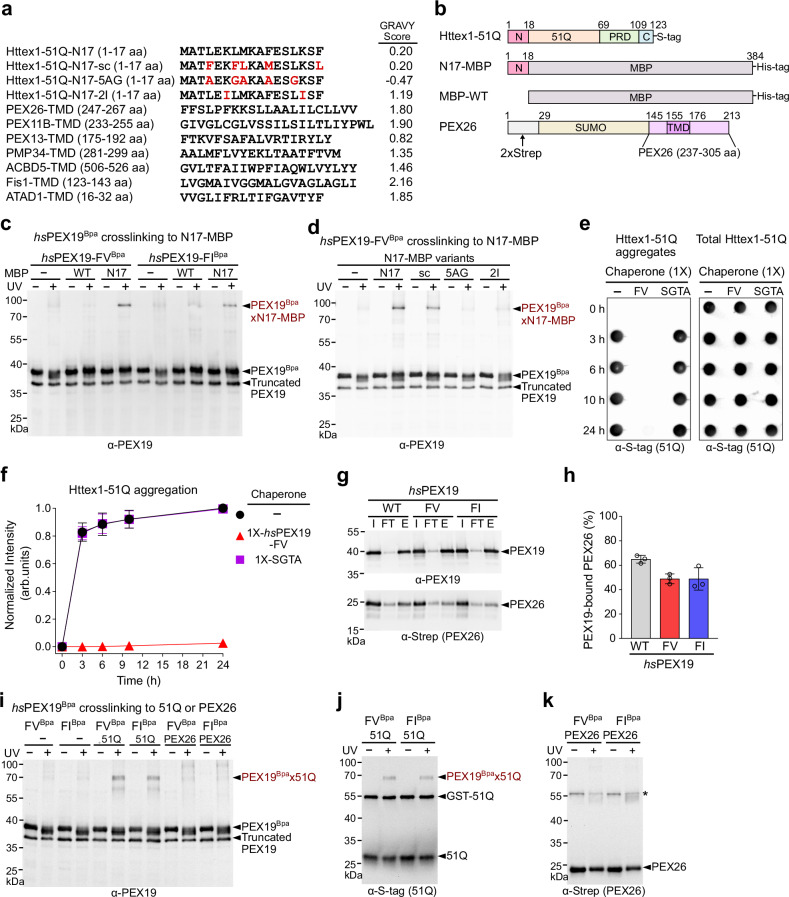
Toxic protein aggregates are associated with various neurodegenerative diseases, including Huntington's disease (HD). Since no current treatment delays the progression of HD, we develop a mechanistic approach to prevent mutant huntingtin (mHttex1) aggregation. Here, we engineer the ATP-independent cytosolic chaperone PEX19, which targets peroxisomal membrane proteins to peroxisomes, to remove mHttex1 aggregates. Using yeast toxicity-based screening with a random mutant library, we identify two yeast PEX19 variants and engineer equivalent mutations into human PEX19 (hsPEX19). These variants effectively delay mHttex1 aggregation in vitro and in cellular HD models. The mutated hydrophobic residue in the α4 helix of hsPEX19 variants binds to the N17 domain of mHttex1, thereby inhibiting the initial aggregation process. Overexpression of the hsPEX19-FV variant rescues HD-associated phenotypes in primary striatal neurons and in Drosophila. Overall, our data reveal that engineering ATP-independent membrane protein chaperones is a promising therapeutic approach for rational targeting of mHttex1 aggregation in HD.
有毒蛋白质聚集体与包括亨廷顿舞蹈症(HD)在内的多种神经退行性疾病相关。由于目前尚无治疗方法能延缓HD的进展,我们开发了一种机制性方法来预防突变型亨廷顿蛋白(mHttex1)聚集。在此,我们对不依赖ATP的胞质伴侣蛋白PEX19进行改造,该蛋白可将过氧化物酶体膜蛋白靶向输送至过氧化物酶体,以清除mHttex1聚集体。通过使用基于酵母毒性的随机突变文库筛选,我们鉴定出两种酵母PEX19变体,并在人类PEX19(hsPEX19)中引入等效突变。这些变体在体外和细胞HD模型中均能有效延缓mHttex1聚集。hsPEX19变体α4螺旋中突变的疏水残基与mHttex1的N17结构域结合,从而抑制初始聚集过程。hsPEX19-FV变体的过表达可挽救原代纹状体神经元和果蝇中与HD相关的表型。总体而言,我们的数据表明,改造不依赖ATP的膜蛋白伴侣蛋白是一种有前景的治疗方法,可合理靶向HD中mHttex1的聚集。