Vogel Marco M E, Rauscher Isabel, Gschwend Jürgen E, Hekimsoy Türkay, Gabler Nicola, Olufs Charlotte, D'Alessandria Calogero, Peeken Jan C, Combs Stephanie E, Eiber Matthias
Department of Radiation Oncology, TUM University Hospital rechts der Isar, TUM School of Medicine and Health, Technical University of Munich (TUM), Munich, Germany.
Institute for Radiation Medicine (IRM), Helmholtz Zentrum München, Neuherberg, Germany.
Sci Rep. 2025 Jan 17;15(1):2234. doi: 10.1038/s41598-024-83074-3.
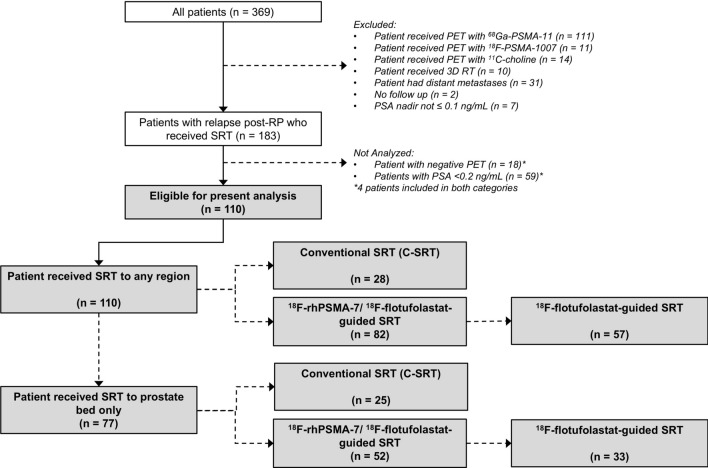
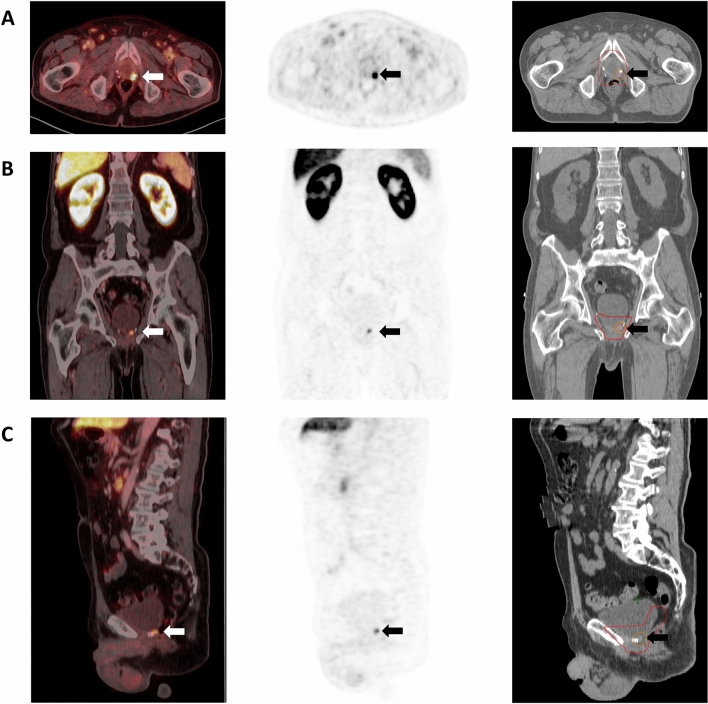
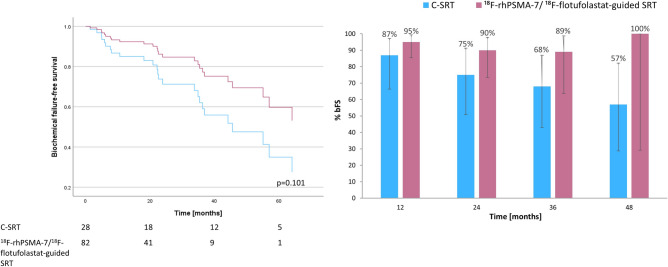
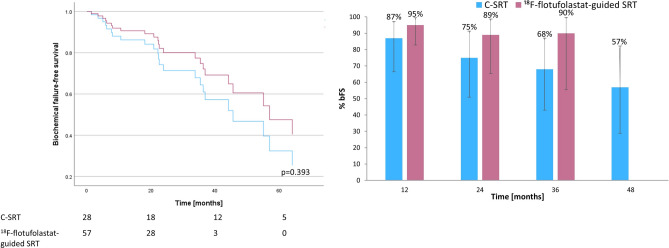
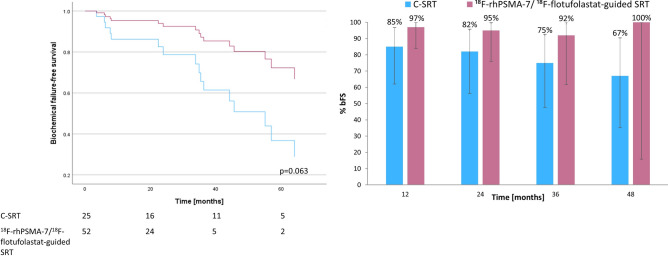
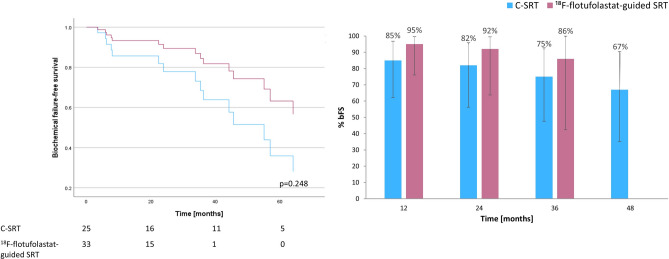
Prostate-specific membrane antigen (PSMA)-targeted positron emission tomography (PET) has improved localization of prostate cancer (PC) lesions in biochemical recurrence (BCR) for salvage radiotherapy (SRT). We conducted a retrospective review of patients undergoing F-rhPSMA-7 or F-flotufolastat (F-rhPSMA-7.3)-PET-guided SRT compared with conventional-SRT (C-SRT) without PET. We evaluated biochemical failure-free survival (bFS) and overall rates of bFS in 110 evaluable patients with recurrent PC after radical prostatectomy who received SRT. 82 patients received F-rhPSMA-7/F-flotufolastat-PET-guided SRT and 28 received C-SRT. Median bFS for patients with F-rhPSMA-7/F-flotufolastat-PET-guided SRT was not reached while median bFS was 45.6 months for patients with C-SRT (p = 0.101). %bFS were 95% (52/55) vs 87% (20/23), 90% (27/30) vs 75% (15/20), 89% (16/18) vs 68% (13/19) and 100% (3/3) vs 57% (8/14) for PET-guided vs C-SRT at 12, 24, 36, and 48 months, respectively. Among patients treated in the prostate bed only, median bFS was not reached for PSMA-PET-guided SRT (n = 52) vs 55.1 months in the C-SRT group (n = 25; p = 0.063). %bFS was greater for PSMA-PET-guided SRT than C-SRT at all evaluated timepoints. F-rhPSMA-7/F-flotufolastat-guided SRT yielded favorable disease outcomes. Although statistical significance was not reached, likely due to the limited sample size in this preliminary analysis, our data illustrate potential for F-flotufolastat-PET-guided SRT.
前列腺特异性膜抗原(PSMA)靶向正电子发射断层扫描(PET)改善了生化复发(BCR)时前列腺癌(PC)病灶在挽救性放疗(SRT)中的定位。我们对接受F- rhPSMA - 7或F-氟托泊司他(F- rhPSMA - 7.3)PET引导下SRT的患者与未进行PET的传统SRT(C - SRT)患者进行了回顾性研究。我们评估了110例接受SRT的根治性前列腺切除术后复发性PC的可评估患者的无生化失败生存期(bFS)和bFS总体率。82例患者接受F- rhPSMA - 7/F-氟托泊司他PET引导下的SRT,28例接受C - SRT。F- rhPSMA - 7/F-氟托泊司他PET引导下SRT患者的中位bFS未达到,而C - SRT患者的中位bFS为45.6个月(p = 0.101)。PET引导下与C - SRT在12、24、36和48个月时的bFS百分比分别为95%(52/55)对87%(20/23)、90%(27/30)对75%(15/20)、89%(16/18)对68%(13/19)和100%(3/3)对57%(8/14)。仅在前列腺床接受治疗的患者中,PSMA - PET引导下SRT(n = 52)的中位bFS未达到,而C - SRT组(n = 25)为55.1个月(p = 0.063)。在所有评估时间点,PSMA - PET引导下SRT的bFS百分比均高于C - SRT。F- rhPSMA - 7/F-氟托泊司他引导下的SRT产生了良好的疾病结局。尽管未达到统计学显著性,可能是由于该初步分析中的样本量有限,但我们的数据说明了F-氟托泊司他PET引导下SRT的潜力。