European Hospital Georges-Pompidou., Clinical research unit, INSERM Clinical Investigation Center., Paris Cité University, Paris, France.
Division of Nuclear Medicine, IRCCS Azienda Ospedaliero-Universitaria di Bologna, Bologna, Italy.
JMIR Cancer. 2024 Sep 20;10:e60323. doi: 10.2196/60323.
Salvage radiation therapy (sRT) is often the sole curative option in patients with biochemical recurrence after radical prostatectomy. After sRT, we developed and validated a nomogram to predict freedom from biochemical failure.
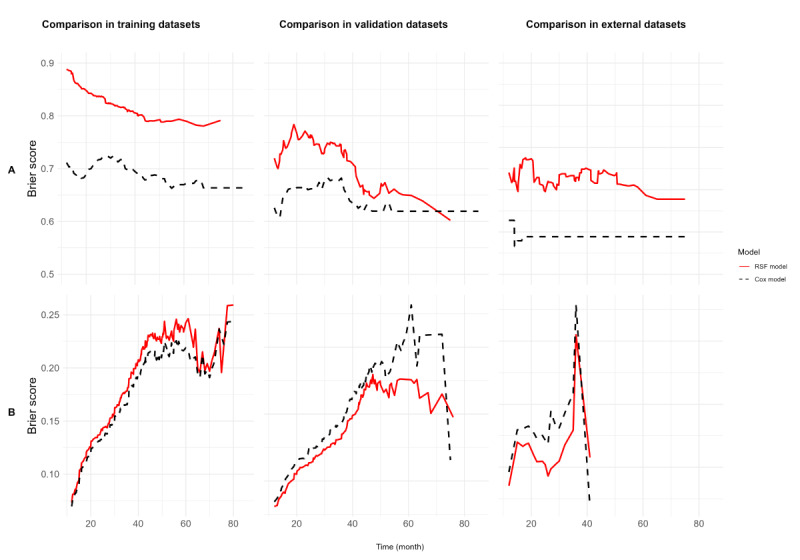
This study aims to evaluate prostate-specific membrane antigen-positron emission tomography (PSMA-PET)-based sRT efficacy for postprostatectomy prostate-specific antigen (PSA) persistence or recurrence. Objectives include developing a random survival forest (RSF) model for predicting biochemical failure, comparing it with a Cox model, and assessing predictive accuracy over time. Multinational cohort data will validate the model's performance, aiming to improve clinical management of recurrent prostate cancer.
This multicenter retrospective study collected data from 13 medical facilities across 5 countries: Germany, Cyprus, Australia, Italy, and Switzerland. A total of 1029 patients who underwent sRT following PSMA-PET-based assessment for PSA persistence or recurrence were included. Patients were treated between July 2013 and June 2020, with clinical decisions guided by PSMA-PET results and contemporary standards. The primary end point was freedom from biochemical failure, defined as 2 consecutive PSA rises >0.2 ng/mL after treatment. Data were divided into training (708 patients), testing (271 patients), and external validation (50 patients) sets for machine learning algorithm development and validation. RSF models were used, with 1000 trees per model, optimizing predictive performance using the Harrell concordance index and Brier score. Statistical analysis used R Statistical Software (R Foundation for Statistical Computing), and ethical approval was obtained from participating institutions.
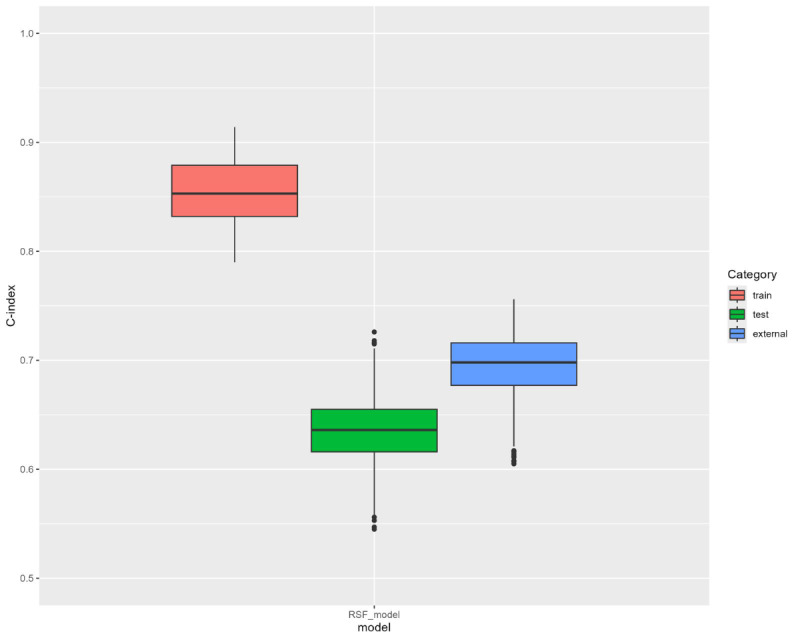
Baseline characteristics of 1029 patients undergoing sRT PSMA-PET-based assessment were analyzed. The median age at sRT was 70 (IQR 64-74) years. PSMA-PET scans revealed local recurrences in 43.9% (430/979) and nodal recurrences in 27.2% (266/979) of patients. Treatment included dose-escalated sRT to pelvic lymphatics in 35.6% (349/979) of cases. The external outlier validation set showed distinct features, including higher rates of positive lymph nodes (47/50, 94% vs 266/979, 27.2% in the learning cohort) and lower delivered sRT doses (<66 Gy in 57/979, 5.8% vs 46/50, 92% of patients; P<.001). The RSF model, validated internally and externally, demonstrated robust predictive performance (Harrell C-index range: 0.54-0.91) across training and validation datasets, outperforming a previously published nomogram.
The developed RSF model demonstrates enhanced predictive accuracy, potentially improving patient outcomes and assisting clinicians in making treatment decisions.
挽救性放射治疗(sRT)通常是根治性前列腺切除术后生化复发患者的唯一治愈选择。在 sRT 后,我们开发并验证了一种列线图来预测生化无失败。
本研究旨在评估基于前列腺特异性膜抗原-正电子发射断层扫描(PSMA-PET)的 sRT 治疗前列腺特异性抗原(PSA)持续或复发后的疗效。目标包括为生化失败建立随机生存森林(RSF)模型,将其与 Cox 模型进行比较,并评估随时间推移的预测准确性。多国籍队列数据将验证该模型的性能,旨在改善复发性前列腺癌的临床管理。
这项多中心回顾性研究收集了来自 5 个国家/地区的 13 个医疗中心的数据:德国、塞浦路斯、澳大利亚、意大利和瑞士。共有 1029 名接受 PSMA-PET 评估后出现 PSA 持续或复发的患者接受了 sRT。患者于 2013 年 7 月至 2020 年 6 月之间接受治疗,临床决策由 PSMA-PET 结果和当代标准指导。主要终点是生化无失败,定义为治疗后连续 2 次 PSA 升高>0.2ng/mL。数据分为训练集(708 例)、测试集(271 例)和外部验证集(50 例),用于机器学习算法的开发和验证。使用 RSF 模型,每个模型有 1000 棵树,使用 Harrell 一致性指数和 Brier 评分优化预测性能。统计分析使用 R 统计软件(R 基金会用于统计计算),并获得了参与机构的伦理批准。
分析了 1029 名接受基于 PSMA-PET 的 sRT 评估的患者的基线特征。sRT 时的中位年龄为 70 岁(IQR 64-74 岁)。PSMA-PET 扫描显示局部复发率为 43.9%(430/979),淋巴结复发率为 27.2%(266/979)。治疗包括 35.6%(349/979)的盆腔淋巴结剂量递增 sRT。外部异常值验证集显示出明显的特征,包括更高的阳性淋巴结率(47/50,94%比学习队列中的 266/979,27.2%)和更低的 sRT 剂量(<66Gy 为 57/979,5.8%比 50 例中的 46/50,92%的患者;P<.001)。内部和外部验证的 RSF 模型均表现出稳健的预测性能(Harrell C 指数范围:0.54-0.91),在训练和验证数据集上均表现优于之前发表的列线图。
所开发的 RSF 模型显示出增强的预测准确性,可能改善患者的预后并帮助临床医生做出治疗决策。