
探索慢性肾病患者与健康参与者之间舌诊的关键变量。
Exploring the pivotal variables of tongue diagnosis between patients with chronic kidney disease and health participants.
作者信息
Hsu Po-Chi, Chen Jia-Ming, Chang Chia-Chu, Chang Yu-Jun, Chiu Ping-Fang, Chiang John Y, Lo Lun-Chien
机构信息
School of Chinese Medicine, China Medical University, Taichung, Taiwan.
Department of Chinese Medicine, China Medical University Hospital, Taichung, Taiwan.
出版信息
Front Big Data. 2025 Jan 3;7:1443646. doi: 10.3389/fdata.2024.1443646. eCollection 2024.
INTRODUCTION
Chronic kidney disease (CKD) is a significant global health problem associated with high morbidity and mortality rates. Traditional Chinese Medicine (TCM) utilizes tongue diagnosis to differentiate symptoms and predict prognosis. This study examines the relationship between tongue characteristics and CKD severity using an automatic tongue diagnosis system (ATDS), which captures tongue images non-invasively to provide objective diagnostic information.
METHODS
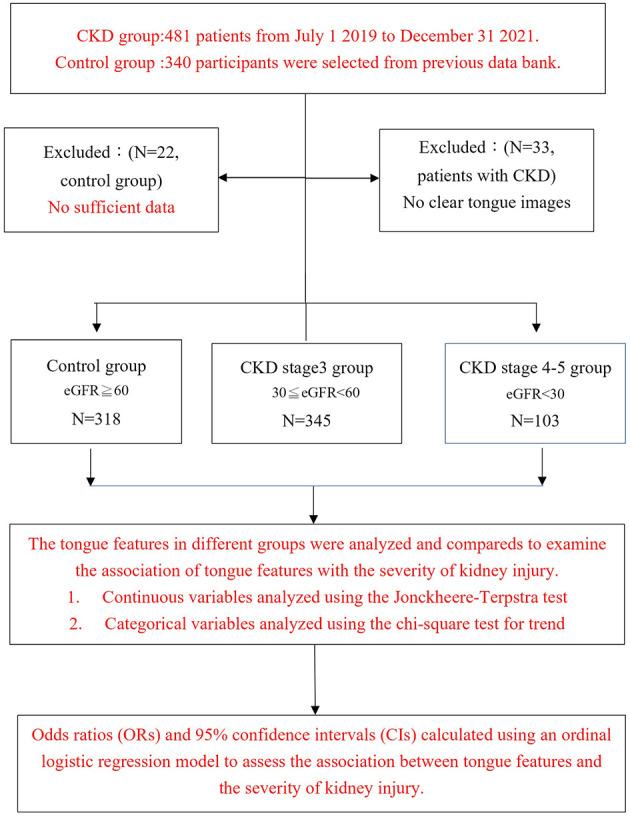
This cross-sectional, case-control study was conducted from July 1, 2019, to December 31, 2021. Participants were divided into three groups based on estimated glomerular filtration rate (eGFR): control (eGFR > 60 ml/min/1.732), CKD stage 3 (30 ≤ eGFR < 60 ml/min/1.732), and CKD stage 4-5 (eGFR < 30 ml/min/1.732). Tongue images were analyzed using ATDS to extract nine primary features: tongue shape, color, fur, saliva, fissures, ecchymosis, tooth marks, and red dots. Statistical analyses included non-parametric methods and ordinal logistic regression.
RESULTS
This study revealed that significant differences in the fur thickness, tongue color, amount of ecchymosis, and saliva among three groups. Ordinal logistic regression indicated that pale tongue color (OR: 2.107, < 0.001), bluish tongue color (OR: 2.743, = 0.001), yellow fur (OR: 3.195, < 0.001), wet saliva (OR: 2.536, < 0.001), and ecchymoses (OR: 1.031, = 0.012) were significantly associated with increased CKD severity. Additionally, each red dot and tooth mark decreased the odds of severe CKD.
CONCLUSION
Tongue features such as paleness, wet saliva, yellow fur, and ecchymosis are prevalent in CKD patients and can serve as early clinical indicators of the disease. This study demonstrates that TCM tongue diagnosis, facilitated by ATDS, is a valuable, non-invasive method for identifying CKD and distinguishing its stages.
引言
慢性肾脏病(CKD)是一个严重的全球性健康问题,其发病率和死亡率都很高。中医利用舌诊来辨别症状并预测预后。本研究使用自动舌诊系统(ATDS)来检查舌象特征与CKD严重程度之间的关系,该系统通过非侵入性方式获取舌图像以提供客观的诊断信息。
方法
本横断面病例对照研究于2019年7月1日至2021年12月31日进行。根据估计肾小球滤过率(eGFR)将参与者分为三组:对照组(eGFR>60 ml/min/1.732)、CKD 3期(30≤eGFR<60 ml/min/1.732)和CKD 4 - 5期(eGFR<30 ml/min/1.732)。使用ATDS分析舌图像以提取九个主要特征:舌形、颜色、苔、津液、裂纹、瘀斑、齿痕和红点。统计分析包括非参数方法和有序逻辑回归。
结果
本研究显示三组之间在苔厚度、舌颜色、瘀斑数量和津液方面存在显著差异。有序逻辑回归表明,舌色淡白(OR:2.107,<0.001)、舌色青紫(OR:2.743,=0.001)、黄苔(OR:3.195,<0.001)、津液湿(OR:2.536,<0.001)和瘀斑(OR:1.031,=0.012)与CKD严重程度增加显著相关。此外,每个红点和齿痕都会降低严重CKD的几率。
结论
舌色淡白、津液湿、黄苔和瘀斑等舌象特征在CKD患者中很常见,可作为该疾病的早期临床指标。本研究表明,在ATDS辅助下的中医舌诊是一种有价值的、非侵入性的识别CKD及其分期的方法。
 Zotero 插件